Stained Glass - Table of Contents ....................Illustrated Stained Glass Dictionary............... Illustrated Architecture Dictionary
Louis C. Tiffany
Left: Louis C. Tiffany, c. 1908
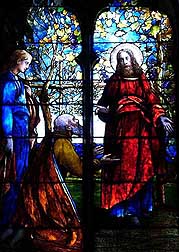
Right: Christ Healing the Blind, Trinity Episcopal Church, Buffalo

On this page, below:
Bio Born Feb.18, 1848 (died Jan.17,1933), Louis Comfort was the son of Charles Lewis Tiffany, founder of Tiffany and Company [jewelry and silverware), sill located on Fifth Avenue in NY City.
He attended school at Pennsylvania Military Academy in Chester, Pennsylvania, and Eagleswood Military Academy in Perth Amboy, New Jersey.
His first artistic training was as a painter, studying under George Inness and Samuel Colman in New York City and Léon Bailly in Paris.
Louis maintained close ties with the family firm which sold sold many products produced by his Tiffany Studios (glass company). Louis became Artistic Director of Tiffany & Co. after his father's death in 1902.
Bio
Louis Comfort Tiffany (1848-1933) embodied the artistic spirit of the Gilded Age. His career spanned more than half a century, from the 1870s to the mid-1920s - a time of experimentation, intense scrutiny of aesthetic ideals, and proliferation of new styles.
Tiffany demonstrated a multitude of talents as an architect and painter and as a designer of interiors, landscapes, and all of the decorative arts. Together with his studios of artists, glassmakers, stonemasons, mosaicists, modelers, metalworkers, wood-carvers, potters, and textile workers, Tiffany heralded in America the notion of continuity of design, orchestrating pattern, texture, color, and light to produce a single aesthetic expression.
Collection:
The Charles Hosmer Morse Museum of American Art in Winter Park, Florida (a first ring suburb north of Orlando), houses the world's most comprehensive collection of the works of Louis Comfort Tiffany including Tiffany jewelry, pottery, paintings, art glass, leaded-glass windows, lamps, and the chapel interior he designed for the 1893 World's Columbian Exposition in Chicago.
LaFarge and Tiffany: Opalescent Glass "[John] La Farge and [Louis C.] Tiffany, dissatisfied with the anemic colors and poor quality of available window glass, experimented with novel types of materials, achieving a more varied palette with richer hues and greater density. Working independently, they explored the pictorial, coloristic, and textural qualities of stained glass in new and daring ways that completely changed the look of the medium. By 1881, each artist had patented an opalescent glass, which has a milky, opaque, and sometimes rainbow-hued appearance when light shines through it. It was a uniquely American phenomenon that proved to be among the most important advances in decorative windows since the Middle Ages.
- Louis Comfort Tiffany at the Metropolitan Museum. 1998 catalog
LaFarge and Tiffany: Opalescent Glass
The creation of opalescent glass in the 1870s was independently arrived at by both Tiffany and John LaFarge (1835-1910), and enabled the artists to make glass containing exaggerated textures and color variations, and then to use those variations as part of their compositions.
La Farge probably deserves the credit for first conceiving the idea of window designs based on patterning and variations within the glass itself.
However, opalescent windows based on abstract and geometrical designs were introduced by Tiffany, who is also considered the creator of the landscape windows in opalescent glass.
Tiffany experimented extensively, developing every kind of glass he could imagine. Some glass was wrinkled and folded before it cooled so as to look like drapery, some was rippled to suggest water, and other efforts resulted in sky, glass and sunset glass. Some combinations he developed even suggested marble.
Eventually the Tiffany Company had thousands of sheets of different kinds and colors of glass, all about three feet long, all color coded and stored so that the right glass could be found to suggest any effect Tiffany wanted. He used the brush only for detail and shading.
- Discovering Stained Glass in Detroit, by Nola Huse Tutag. Detroit: Wayne State U. Press, 1987, p. 153
LaFarge and Tiffany: Opalescent Glass Use of the colored glass itself to create stained glass pictures was motivated by the ideals of the Arts and Crafts movement and its leader William Morris in England. This can be contrasted with the method of painting in glass paint or enamels on colorless glass that had been the dominant method of creating stained glass for several hundred years in Europe.
John LaFarge was the first designer to incorporate opalescent glass into a window and received a patent for his new product on February 24, 1880. Tiffany received several patents for variations of the same opalescent process in November of the same year. La Farge was persuaded by Tiffany with hints of a future partnership and possible collaborations to waive his patent. The promises never materialized while competition and animosity grew between the two artists.
Fellow artist and glassmakers Oliver Kimberly and Frank Duffner, founders of the Duffner and Kimberly company, and John La Farge were Tiffany's chief competitors in this new American style of stained glass. Tiffany, Duffner and Kimberly, along with La Farge, had learned their craft at the same glass houses in Brooklyn in the late-1870s.
Eventually Tiffany became the darling of the Gilded Age industrialists and he created a glass and decorating studio that boasted more than a hundred workers. La Farge remained the lone artist who contracted out fabrication of his designs to smaller studios.Both LaFarge and Tiffany secured their glass from the Kokomo glass factory in Kokomo, Indiana, after it became a reliable source for them in 1888.
Beyond Tiffany and La Farge, a plethora of stained glass studios developed in America around the turn of the century.
LaFarge and Tiffany: Opalescent Glass
The opalescent era encouraged academically trained artists to design for glass.
We also find the phenomenon of the out-of-house designer, as well as the studio with designers working exclusively as a team of glass cutters, painters and fabricators. La Farge, Tiffany, and David Maitland Armstrong (1836-1918), painters and later designers of stained glass, never actually touched the window. They may have provided designs and supervised execution, but they were not the artists who cut or painted the glass or assembled the window into its frame.
- Virgina Chieffo Raguin, Stained Glass from its Origins to the Present. 2003, p. 230
Kokomo Opalescent Glass was incorporated in 1888.
The company's economic advantage rested on what was once a huge pocket of gas. This resource provided ideal fuel for gas furnaces.
Kokomo Opalescent Glass, then known simply as "The Opalescent Glass Works," specialized in one-of-a-kind sheets of art glass. They sold not only to the burgeoning studio clientele, but to Tiffany as well. In 1893, even while the Corona factory was open, Tiffany purchased from Kokomo Opalescent Glass; one invoice lists almost 10,000 pounds of glass to "The Tiffany Glass Decorating Co."-Virgina Chieffo Raguin, Stained Glass from its Origins to the Present. 2003, p. 2
Tiffany Stained Glass Innovations
Tiffany used unusual construction techniques and effects that produced stunning results. These included:the following:
Drapery glass: pulling and pushing glass while it cools
Mottled glass - gives the impression of sunlight filtered through foliage
Confetti glass - embedded with tiny paper-thin flakes of glass in different colors,
Marbleized glass
Ripple glass - sometimes used to evoke movement of water
Turtleback glass
Cames of varying widths - sometimes specially milled and sculpted to replicate the natural textures of vines or branchesCopper cames - Using copper instead of lead for joining glass sections. Tiffany adapted the copper technique to construct lampshades and capitalized on the new innovation of electric lighting.
Sometimes substituting nature for religious traditional figures (God, saints) and conferring religious significance to the landscape and natural world (Pantheism). For example, streams symbolize the River of Life, one's path from birth to death.
Religious memorial windows
Today [2012] Louis Comfort Tiffany is widely recognized as America's leading designer of the decades around 1900, but during his lifetime he was best known primarily as a designer of religious art, particularly memorial windows. They were installed by the thousands - mostly in Protestant churches and cemetery mausoleums - and formed the bulk of his business over four decades.
Shortly after Tiffany switched careers from painting to interior decorating in the late 1870s, he began receiving commissions to decorate religious buildings. Indeed, Tiffany was slow to promote landscape as a topic for religious windows, and they'd remained a niche segment of his prodigious production.
Tiffany's earliest windows generally reinterpreted standard religious subjects and copied contemporary religious paintings or Old masters... By the late 1890s Tiffany and his staff began producing a new religious window type that took nature as its subject. Some windows showed religious symbols nearly obscured by flowers and plants. Others featured landscapes and gardens apparently absent of religious iconography. using a range of new glass types in a variety of experimental formats,
Recent investigation by Alice Frekinghuysen has shown that, with a few possible exceptions, the design of the floral and landscape windows is almost certainly by a single artist - Agnes Northrup - one of the few women creating windows for Tiffany.
Tiffany's landscape windows were initially commissioned by a small group of Protestant denominations - Congregationalists, Unitarians, and Universalists - and in a few instances by reformed Jewish congregations. By 1900 Presbyterians and Episcopalians were also ordering landscape windows.
Natural beauty was used as a primary exemplar of God's benevolence and presence throughout the world. For liberal religious groups nature had the advantage of conveying its message without the intervention of doctrine or cant.
- Elizabeth De Rosa , "Louis C. Tiffany's Landscapes of Devotion," in The Magazine Antiques, November/December, 2012 (online June 2013)
Blown glass
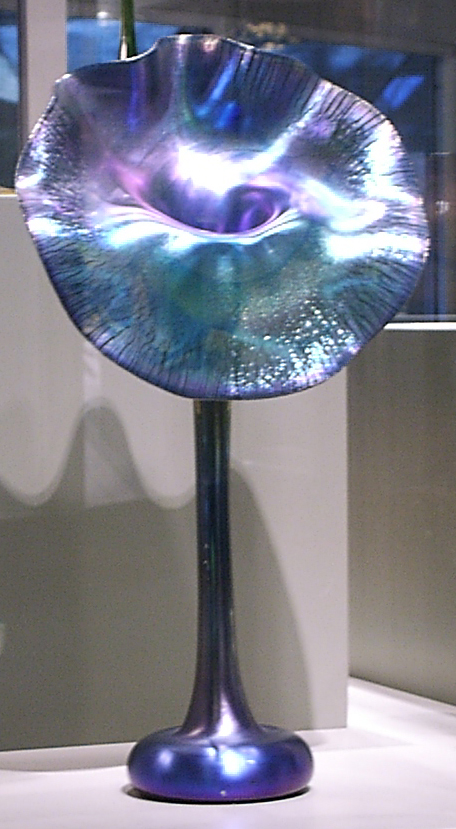
Tiffany's first collection of blown glass strongly expressed the Art Nouveau style. It was exhibited at the World's Columbian Exposition in Chicago in 1893, where it was an immediate success. The metallic iridescence, its chief characteristic, was inspired, he said, by the iridescence resulting from decay on on excavated Roman glass. Tiffany's glass had a silky, delicate patina over luminous colors. The metallic luster was a film of metal produced by exposing the glass to chemical sprays. It was believed, erroneously, that $20 gold pieces were dissolved in acid and used as a source for the gold in the metallic film.
- Chloe Zerwick, A Short History of Glass, 1990, p. 9
Tiffany Companies
Tiffany became interested in glassmaking from about 1875 and worked at several glass houses in Brooklyn between then and 1878. Tiffany began his glass career as a designer of stained glass windows, which were becoming more and more popular for domestic and ecclesiastical use, and glass mosaics.
- 1878 - Tiffany founded a glassmaking factory in Queens, N.Y., in 1878. In 1879, he joined with Candace Wheeler (embroiderer and specialist in 1878 - textile and needlework production), Samuel Colman (collector of rare textiles) and Lockwood de Forest (artist; collector of Indian artifacts) to form Louis Comfort Tiffany and Associated American Artists . (Dissolved in 1883)
- 1885 - Tiffany formed his own company: Tiffany Glass Company which became the the largest stained glass studio in the nation, riding the church construction boom of the 1880s. He assembled windows using glass that was purchased from other manufacturers.
- 1892 - Tiffany started his own glasshouse in Corona, Queens, New York. He hired Arthur Nash, an experienced English glassblower to run the factory. It was originally called the Tiffany Glass and Decorating Company. In addition to fabricating the glass for hundreds of Tiffany's stained glass windows, the company produced blown glass vessels. Nash and his sons operated Tiffany's glasshouse and its successor firms until production ended around 1930.
- 1902 - Name changed to Tiffany Studios, incorporating several autonomous divisions into firm, including glass furnaces and a metal foundry (Closed in 1932)
1878 - Louis C. Tiffany & Company
1880 - Tiffany & Wheeler; Tiffany & de Forest Decorators
1881-83 - Louis C. Tiffany & Co., Associated Artists
1885 - Tiffany Glass Company
1892 - Tiffany Glass & Decorating Company
1892 - Incorporates Tiffany Glass & Decorating Company
(1893 - Stourbridge Glass Company; Allied Arts Company)
1902-1932 - Tiffany Studios.
(1902 - Tiffany Furnaces Inc.)
1919 - Divides Tiffany Studios into Tiffany Furnaces; Tiffany Ecclesiastical Department under the name Tiffany Studios
Tiffany Companies
The establishment of the glass furnaces at Corona in 1893 effectively launched Tiffany on a secondary career, one through which he could pursue the domestic American market directly. Until that time he had worked largely for a single client, the church, in the creation of a comprehensive range of liturgical items. ... The opening of the furnaces changed this, ... which 'Tiffany could offer to the public through both the firm's showroom and a network of retail outlets across the country.It remains unclear whether Tiffany foresaw at the time the huge popularity that his art glass would soon enjoy in the marketplace, or whether, as has been claimed by some art historians, the decision to extend the furnaces' production from sheet-form glass (for windows and mosaics) to the hand-blown variety was purely one of expediency: to utilize the vast inventory of glass shards that had accumulated through twenty-odd years of window production. Certainly, if the latter was the case, Tiffany could not in 1893 have envisioned the scale of the giant industrial-art manufactory that sprang up at Corona within the next ten years as a byproduct of his decision to enter the domestic art market.
- Alastair Duncan, Louis Comfort Tiffany, 1992, p.81
Tiffany Companies
The Tiffany Glass Company employed hundreds of people and produced thousands of windows. The company relied on a department of artists to design the windows.
The firm's design department was formed from members of the craft's itinerant labor force, which by tradition circulated among local glasshouses as business necessitated. Foremost among these was Joseph Lauber (1855-1948), a German immigrant who had worked previously for John La Farge, and who remained with Tiffany from 1888 to 1892. Lauber was a gifted and versatile artist who switched easily between the disciplines of window and mosaic design, sculpture, and mural painting.
Other early recruits were Will H. Low (1853-1932), another gifted mixed-medium artist and craftsman, and Jacob Adolphus Holzer (1858-1938), a Swiss-born muralist, mosaicist, interior designer, and sculptor who had been associated previously with both La Farge and Saint-Gaudens.
Clearly, these designers brought invaluable experience and technical expertise - particularly for liturgical commissions - to the Tiffany Glass Company in its formative years, as did others slightly later, such as Edward Peck Sperry (d. 1925) and Frederick Wilson (1858-1932), who succeeded Holzer as the chief designer of the window department in 1897. A portraitist and cartoonist armed with an inexhaustible knowledge of Old and New Testament iconography, Wilson emerged as the firm's most prolific and talented designer of figural windows and mosaic friezes, producing the bulk of its church memorials until his departure in 1923.
In a discussion of Tiffany's principal designers, mention must also be made of Agnes J. Northrop, who joined the women's work force in the glass department in 1884, at age twenty-seven, and who was promoted later to the window department. Northrop became the principal designer after Tiffany of nonfigural landscape and floral window compositions. So similar was her style to his that today it is impossible in many instances, without documentation, to attribute designs to one or the other with certainty. In 1933, when the firm closed, Northrop joined those employees who established the Westminster Memorial Studios in New York to complete Tiffany's outstanding commissions. She retired in 1936.- Alastair Duncan, Louis Comfort Tiffany, 1992, p.81
The Tiffany Glass Company employed hundreds of people and produced thousands of windows. The company relied on a department of artists to design the windows.
Another important artist was René Théophile de Quélin.
In the 1920s and 1930s there was a decline in workmanship and quality of glass (Tiffany died in 1933 the age of 84.).
International Competitions
At the 1893 Columbian Exposition, Tiffany won 54 medals. This catapulted him to national recognition
At the Exposition Universelle in Paris in 1900, he won a gold medal with his stained glass windows The Four Seasons.
- Fathers fof the Church, Columbian Exposition
At the 1901 Pan-American Exposition in Buffalo awarded Grand Prize for enamels. Designs central fountain for the inner court of the Manufactures and Liberal Arts Building.
Tiffany continued to make strong showings and receive awards at international fairs, notably at Turin in 1902, and St. Louis in 1904.
As a result, his work was widely known and acclaimed throughout America and around the world.
Stained Glass
- Trinity Episcopal Church, Buffalo
- St. Cecilia
- Christ Healing the Blind
- The Calling of Matthew
- Archangels Raphael and Gabriel
- The Annunciation
- Church of the Good Shepherd, Buffalo
- The Good Shepherd Chancel
- St. Paul Transept
- Purity Transept
- Two Floral Windows Nave
- Christ Blessing the Little Children Children's Chapel
- First Presbyterian Church, Buffalo:
- St. Paul's Episcopal Cathedral, Buffalo:
- Holy Angels RC Church, Buffalo
- Baker Memorial United Methodist Church, East Aurora: 17 signed windows
- First Presbyterian Church, Lockport 6 windows. Four other Tiffany designs and Tiffany Studios glass used by another fabricator after Tiffany's death
- Tiffany Glass on display at the Corning Glass Museum
- Sunset Scene - Memorial Art Gallery of the U. Rochester
Other than Stained Glass
- Jack-in-the-Pulpit Favrile Vase, about 1912 - Corning Glass Museum
- Flower-form Vase - Corning Glass Museum
- Shade with King Tut pattern - Private collector, Buffalo
- "Lilly" table lamp - Memorial Art Gallery of the U. of Rochester
- "Pond Lilly" Table lamp - Montreal Museum of Fine Arts
- Interior - Westminster Presbyterian Church Interior - but no windows - designed by Tiffany Studios
- Interior - Shea's Buffalo Interior - but no windows - designed by Tiffany Studios
- Bricks - Clement Brick Museum
- Saint Louis Cathedral, Saint Louis, MO - Rose window; two chapels