Illustrated Architecture Dictionary .................................. Styles of Architecture
Illustrated Architecture
Dictionary .................................. Styles
of Architecture
Roman / Romanesque / Romanesque
Revival
Romanesque: Later 11th-12th
centuries
Romanesque Revival:
1840-1900
|
|
|
Romanesque: 8th -12th centuries
Romanesque Revival in America: 1840-1900
Roman
Roman
Roman
Roman
Roman
Roman
Roman
Roman
The Roman contributions to the history of architecture included development of rounded arch and concrete.
The ancient Romans learned the arch from the Etruscans, refined it and were the first builders to tap its full potential for above ground buildings: The Romans were the first builders in Europe, perhaps the first in the world, fully to appreciate the advantages of the arch, the vault and the dome.
Throughout the Roman empire, their engineers erected arch structures such as bridges, aqueducts, and gates. They also introduced the triumphal arch as a military monument. Vaults began to be used for roofing large interior spaces such as halls and temples, a function which was also assumed by domed structures from the 1st century BC onwards.
- Wikipedia (Online March 2012)
- Wikipedia (Online March 2012)Roman examples:
- Arch of Constantine, Rome
- Coliseum, Rome
- Pantheon, Rome
- Curia Julia (Senate House)
- Roman Architecture, Nimes, France
- Exterior - Roman baths, Cluny Museum, Paris
- Roman Aqueduct, Segovia, Spain
- 200AD Floor tiles - Clement Brick Museum
Romanesque
Romanesque
Romanesque
Romanesque
Romanesque
Romanesque
Romanesque
Romanesque
Romanesque
Romanesque
Romanesque
Romanesque
Romanesque
Romanesque
Romanesque
Romanesque
Romanesque
8th-12th centuries
A style of architecture developed in Italy and western Europe between the Roman and the Gothic styles; characterized by round arches and vaults and by the substitution of piers for columns
Massive masonry, round arches, small windows, groin- and barrel- vault
Combined features of Western Roman and Byzantine buildings
First international style of architecture to come about after the fall of the Roman Empire, and became prevalent in Europe circa 1050-1200.
The Romanesque style was based on the basilica form, and the cruciform basilica, but incorporated a nave higher than the side aisles .
The preferred medium of construction was stone masonry - wooden structural elements were rejected and the Roman craft of concrete had been lost by this time.
Romanesque construction is characterized by massive vaulting and round arches dividing the nave into bays.
Painted and carved decoration was applied in an attempt to make the interiors seem lighter.
The term "Romanesque" was first applied by critics in the early nineteenth century. The word served to distinguish Romanesque from Gothic buildings.
While many regional expressions of form developed throughout Europe, Romanesque often refers to all works of this era, including the later Norman variations.
The style came to be characterized by the following:
- Heavy articulated masonry construction with narrow openings,
- The use of the round arches and barrel vault
- Wall arcade
- Development of the vaulting rib and shaft
- Cylindrical apse and chapels
- Introduction of central and western square, round or polygonal towers.
- Ornamentation in the form of stylistically rendered animal and plants forms
Romanesque Vaults:
- Vault - a masonry roof or ceiling constructed on the arch principle
- Barrel (or tunnel) vault - semi cylindrical in cross-section is, in effect, a deep arch or an uninterrupted series of arches, one behind the other, over an oblong space
- Groin (or cross) vault - formed at the point at which two barrel (tunnel) vaults intersect at right angles
- Ribbed vault - framework of ribs or arches under the intersections of the vaulting sections.
In general, the vault system fails in one critical requirement - that of lighting. Due to the great thrust exerted by the Barrel (or tunnel) vault, a clerestory was difficult to construct, and windows cut into the haunch of the vault would make it unstable. A more complex and efficient type of vaulting was needed.
Round arch ...... Figures ...... Corbel tables ...... Animals ...... Grotesques and fantastic figures ...... Foliage ...... Heraldic devices ...... Linenfold ...... Zigzags ...... Lozenges ...... Geometric forms
Molding designs:
Zigzag ..... Star ..... Billet ..... Lozenges
Church floors:
Important design elements because there are no pews or seats and few furnishings. Treatments vary from plain stone or brick with simple washes of color to elaborate patterns in tile or marble.
- History of Design Through the 18th Century (Online Nov, 202)
Romanesque religious buildings have three different types of entrance:
Romanesque features may include:
Romanesque window types:
- Simple semicircular headed window
- Pairing of two arched windows or arcade openings, separated by a pillar or colonette and often set within a larger arch. Sometimes referred to a "Arcade windows."
- Trefoil-headed window
- Ocular windows
- Wheel windows or rose windows, in later Romanesque churches
- Clearstory
Romanesque/Gothic windows:
4 types of Romanesque church ceilings:
- Flat ceiling taken over from the early Christian basilica
- Gradually replaced by the simple barrel vault
- Intersection of the transept vaults and the nave vault result in a groin vault
- Dome
Romanesque examples:
- Baptistery, Florence, Italy
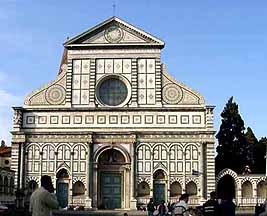
- Santa Maria Novella Church, Florence, Italy
- Façade - Basilica of San Lorenzo, Florence, Italy
- Siena Cathedral, Italy
- Monreale Cathedral, Sicily
- Cathédral St. Pierre, Geneva, Switzerland
- Façade - St. Denis Abbey, Paris, France
- Church of St. Andrew, Cracow, Poland
- Catalonian National Art Museum, Barcelona, Spain Art
- Spire - Chartres Cathedral, Chartres, France
| England | Romanesque style:
England Romanesque architecture in England is called "Norman." |
| Italy Italy Italy |
Romanesque style: Italy
The Romanesque Period in Italy may be taken to date approximately from the eighth to the twelfth century. The use of marble for facing for walls distinguishes Italian Romanesque from the rest of Europe. Central Italy: The basilican type of church was closely adhered to. Campaniles, originated in the sixth century, now became an integral part of the church group. North Italy: Influenced by north of the Alps, where the principal innovation was the ribbed vault. The churches are basilican in type, but naves as well as side aisles are vaulted and have external wooden roofs. South Italy and Sicily: Changing architectural character can be traced through Byzantine, Muslim and Norman rule. Byzantine: dome, supported by four columns, covers square, central space. Muslim: colored marble, striped marble, and mosaic interiors. Norman: Cf., Monreale Cathedral |
America
America
America
America
America
America
America
America
America
America
America
America
America
America
America
America
America
America
America
America
America
America
America
America
America
America
America
America
America
America
America
America
America
America
America
America
America
America
America
America
America
America
America
America
America
America
America
America
America
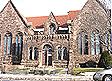
Romanesque Revival in America: In general 1840-1890
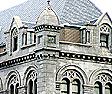
American architects experimented with the Romanesque in the 1840s and 1850s for churches and public buildings, using round arches, corbels and historically correct features such as chevrons and Lozenges borrowed from the pre-Gothic architecture of Europe. But in texture and outline these early Romanesque structures resembled their Gothic Revival contemporaries. The outstanding example of this early phase of the style is the original Smithsonian Institution building (1847-55, James Renwick), Washington, D.C. It was designed with extremely irregular outlines, battlemented cornices and relatively smooth-faced ashlar walls.
As interpreted by Richardson in the 1870s and 1880s, the American Romanesque became a different, and uniquely American, style (see below).
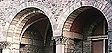
The defining feature of the [American] Romanesque Revival is the semi-circular arch used for all window and door openings and for wall enrichment.
Other distinguishing motifs are beltcourses and the arcaded corbel table which is a series of miniature arches below the eaves.
Belt- or stringcourses mark horizontal divisions.
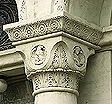
Column capitals and compound arches are enriched with geometric medieval ornament.
Facades have gabled roofs flanked by square or polygonal towers of differing heights, with parapets or various roof shapes, and occasionally spires of Gothic origin.
Pyramidal roofs often have concave slopes.
The typical plan is basilican, with a long, narrow nave, vestibule, central tower or paired side towers, and self-contained massing.
Broad, smooth wall surfaces of monochromatic brick or ashlar masonry laid with thin mortar joints were favored.
- New York Landmarks Conservancy: Common Bond (Online May 1997)
Romanesque Revival in America: Houses
A hallmark of the Italian villa and Romanesque styles (and their close cousins, the Tuscan and Norman styles) is the three- or four-story tower with arched openings. The low roof, pitched (gabled) or hipped, has a wide overhang.
Constructed of solid masonry, American Romanesque Revival houses were expensive and, with the exception of row houses built on speculation, largely the purview of architects designing for affluent clients. The style was popular in urban and suburban areas. Interest in it faded in 1890s.
- Example: 120 North Pearl Street
Romanesque Revival in America: Victorian Romanesque 1870-1890
A polychromatic exterior finish combined with the semicircular arch highlight the American Victorian Romanesque style.
The rock-faced stone finish is relieved by
- different colored and textured stone or brick for window trim
- arches
- quoins
- decorated bricks and terra cotta tiles in conjunction with stone trim
- round arches usually supported by short polished stone columns
- foliated forms
- grotesques and arabesques decorate capitals
- corbels
- belt courses
- windows varying in size and shape
Like Victorian Gothic compared to the Gothic Revival, American Victorian Romanesque was a freer interpretation of historical forms, visually heavier and more ornate than Romanesque Revival It was also more readily adaptable to all types of construction, residential included, provided the scale was large enough to employ the characteristic heavy stonework
- Example in Buffalo: Old County Hall
Romanesque Revival in America: Richardsonian Romanesque 1870-1900
Few architects are prominent and innovative enough to have an architectural style named after them.As interpreted by H. H. Richardson in the 1870s and 1880s, the Romanesque became a different, and uniquely American, style. Still present were the round arches framing window and door openings, but gone were vertical silhouettes and smooth stone facings. Richardson's buildings were more horizontal and rough in texture.
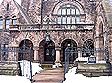
Heaviness was an ever-present characteristic of the style -- emphasized not only by the stone construction but also by deep window reveals, cavernous door openings and, occasionally, bands of windows. These openings were often further defined by a contrasting color or texture of stone or by short, robust columns.
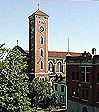
Richardsonian Romanesque was favored for churches, university buildings and public buildings such as railroad stations and courthouses. Consequently, towers were often part of the design. In the best examples, a single tower, massive and bold in outline, crowns the ensemble.
Just as one architect was responsible for this style, one building established its popularity. Richardson's 1872 design of Trinity Church in Boston won one of the most prestigious architectural competitions of the day.
Although Richardson produced fewer houses in the Romanesque style (he is also noted for his Queen Anne and Shingle Style designs), there were enough to inspire a plethora of followers.
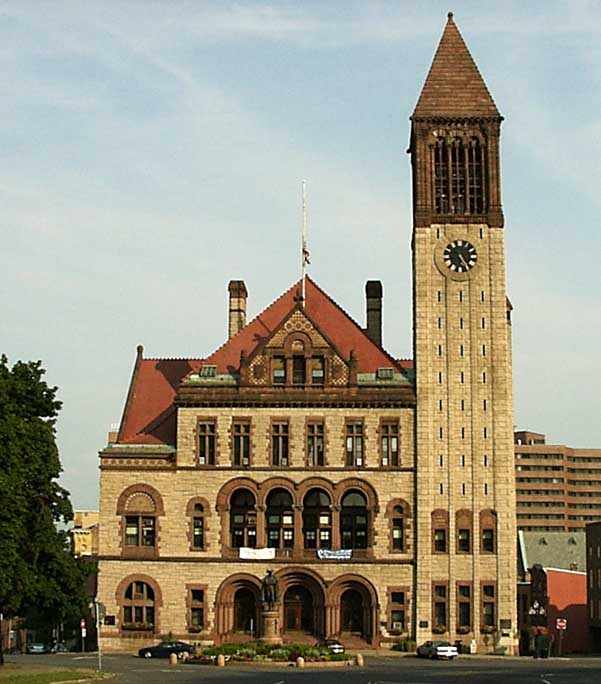
A large house, such as the Glessner House in Chicago, the Ames Gate Lodge in Massachusetts, and the Gratwick House Richardsonian Romanesque style, but elements of Richardson's work -- such as broad round arches, squat columns, eyebrow dormers and carved, intertwining floral details -- found their way into the vocabulary of many local builders. Numerous masonry row houses still exist to pay tribute to Richardson's creativity and immense popularity. See, also, a photo of Albany City Hall (1880-83). (demolished) in Buffalo,was required to support the massive stoniness of the
Some critics characterize Richardsonian Romanesque as being basically the Shingle style (H. H. Richardson) is credited with popularizing the style) in masonry form.
Richardson's style is characterized by the following:
- Ruggedness and craggy texture
- Massive stone walls
- Dramatic semicircular arches. His arches are frequently not truly Romanesque but Syrian, an early Christian form which springs from the ground level.
- Unusual sculptured shapes in stone which give his structures great individuality.
- Heaviness was the ever-present characteristic of the style, emphasized by
- Stone construction
- deep windows
- Cavernous recessed door openings and
- Bands of windows
- Contrasting color - polychromy - or texture of stone
- Short, robust columns.
- Towers occur in about 75 percent of Richardson's buildings, a second tower occurs in about 15 percent.
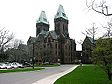
An early transitional Richardsonian Romanesque building - some would say the beginning of the style - is the Buffalo Psychiatric Center.
Richardsonian Romanesque e xamples in Buffalo:
- Buffalo Psychiatric Center H. H. Richardson, architect
- William H. Gratwick House H. H. Richardson, architect - DEMOLISHED
- Webb Building
- First Presbyterian Church
- Connecticut Street Armory
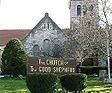
- Good Shepherd Church
- Lafayette Presbyterian Church
- Delaware Avenue Baptist Church
- Eberhardt House at 2746 Delaware, KENMORE
- Adams Power Plant Transformer House, NIAGARA FALLS
- Baltimore & Ohio (B&O) Railroad Depot, ORCHARD PARK Modeled after Richardson's Auburndale, MA station
- Photo - Bryant B. Glenny House
- Photo - Noye House, 291 North Street (Demolished)
- No image - Drullard Carriage House, 564 Franklin
Richardsonian Romanesque other examples:
- Trinity Church, Boston, MA H. H. Richardson, architect
- Albany, NY, City Hall H. H. Richardson, architect
- Oliver Ames Library, North Easton, MA H. H. Richardson, architect
- Oakes Ames Memorial Hall, North Easton, MA H. H. Richardson, architect
- Ames Gate Lodge, North Easton, MA H. H. Richardson, architect
- 66 Main Street, North Easton, MA
- Union Station, Palmer, MA H. H. Richardson, architect
- Glessner House, Chicago IL H. H. Richardson, architect
- Washington, DC Old Post Office Building
- Amos Block, Syracuse, NY
Romanesque Revival in America: Churches
Even as the Greek Revival flourished, the feeling grew that pagan forms were hardly appropriate for Christian worship, that the intensely religious Middle Ages could provide more appropriate models. Thus, in the 1840s and 1850s, the self-contained, horizontal, monumental, static mass of Greek temple-church gave way to the irregular, vertical, picturesque, and lively forms of the Gothic and Romanesque Revival styles.
While the Gothic Revival was particularly favored by Episcopalian and Catholic parishes, the German or Italian Romanesque or early Renaissance style was generally preferred by Congregationalist, Methodist, Baptist, and other low-church groups.
The distinguishing characteristics of the Romanesque was its use of the round arch for door and window openings and its distinctive rounded moldings. In mood, it was less spiritual than the Gothic, but more reasoned; less picturesque, but more serene.Brick or ashlar masonry, laid with thin mortar joints, is characteristic of Romanesque and Renaissance Revival churches.
Basilican is a substyle of Romanesque and Romanesque Revival. The distinguishing feature is a flat ceiling.
Church examples in Buffalo:
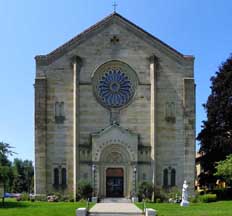
- Illustration above: St. John the Evangelist RC Church
- St. Francis Xavier RC Church (Basilican)
- St. Mary of Sorrows (Rhenish Romanesque)
- Blessed Trinity (Lombard)
- St. Francis de Sales RC Church (Ravenna)
- Plymouth Methodist Church / Karpeles Manuscript Library Museum
- St. Anthony's RC Church (Italian)
- Westminster Presbyterian Church (Norman)
- Holy Angels RC Church (French)
- St. Luke's Roman Catholic Church/St. Luke's Mission of Mercy (Italian basilican)
- Assumption RC Church
- St. Stanislaus RC Church
- Prospect Avenue Baptist Church
- Christ the King Chapel at Canisius College
- Holy Family RC Church
Examples of Church capitals in New York City: St. Bartholomew's Episcopal Church
Romanesque Revival in America: Civic and Commercial BuildingsExamples in Buffalo:
|
Click on photos to enlarge |
All buildings are in Buffalo, New York, unless indicated otherwise |
|
|
Apse |
|
|
Arcade |
|
|
Barrel
Vault |
|
|
Belt
course / Stringcourse / Band course A projecting horizontal course of masonry, of the same or dissimilar material used to throw off water from the wall; usually coincides with the edge of an interior wall. Illustration: Buffalo Gas Light Company |
|
|
Brick masonry |
|
|
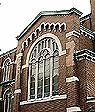
Church -
Romanesque Revival Style |
|
|
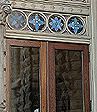
Colored glass transom |
|
|
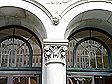
Compound
arches |
|
|
Corbel tables along the eaves Other Examples: |
|
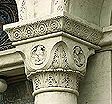
Cushion capital |
|
|
|
Deeply recessed windows |
|
|
Diaper
pattern |
|
|
Domed corner buttress Illustration: Old Post Office/ECC (Victorian Gothic style building) |
|
|
Flat roof Illustration: St. Francis Xavier RC Church |
|
|
Geometric medieval
moldings carved on capitals |
| Groin(ed)
vault/Cross
vault A compound vault in which barrel vaults intersect |
|
|
|
Heavy, rough-cut stone Illustration: Old County Hall |
|
|
Monochromatic brick or
stone |
|
|
Richardsonian
Romanesque |
|
|
Rinceau An ornamental band of undulant and curving plant motifs, found in classical architecture Illustration: St. Francis de Sales RC Church |
|
|
Round-arch transom |
|
|
Semicircular arch for
window and door openings |
|
|
Squat dwarf-columns,
sometimes engaged
|
|
|
Tower
|
|
|
Victorian
Romanesque Illustration: Old County Hall |
|
|
Voussoir
|
Sources:
- "A Visual Dictionary of Architecture," by Francis D. K. Ching. New York: John Wiley & Sons, 1997
- "The Visual Dictionary of American Domestic Architecture," by Rachel Carley. New York: Henry Holt & Co., 1994
- "Identifying American Architecture," by John J.-G Blumenson. New York: Norton. 1981
- Romanesque Revival / Richardsonian Romanesque (Chicago landmarks)
- "A Field Guide to American Architecture," by Carole Rifkind. New York: New American Library, 1980.
- "Gardner's Art Through the Ages, Tenth Edition," by Richard G. Tansey and Fred S. Kleiner. Harcourt Brace College Pub., 1996
- "What Style is it? A Guide to American Architecture," pub. by the National Trust for Historic Preservation, 1983