Rome - Table of Contents ................. Architecture Around the World
Arch of Constantine
Rome, Italy
Dedicated 315 AD
HISTORY Beneath Illustrations
This
arch is religiously significant because it commemorates the battle that
led the Emperor Constantine to convert to Christianity, thereby
changing the religious landscape of the western world.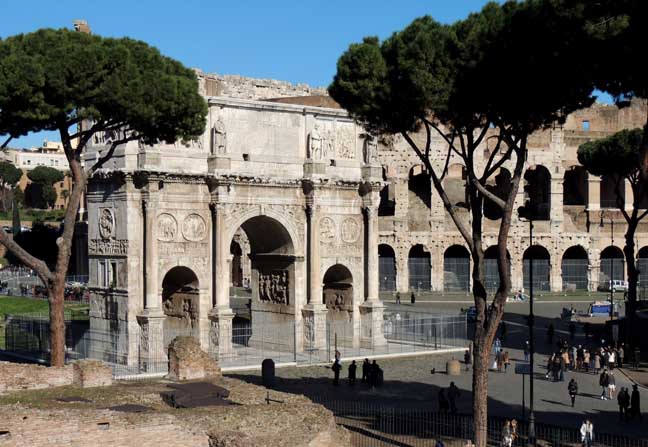 2013 photo ... The Coliseum in background. The arch is the last and largest in Rome and served as the finish line for the marathon athletic event for the 1960 Summer Olympics. 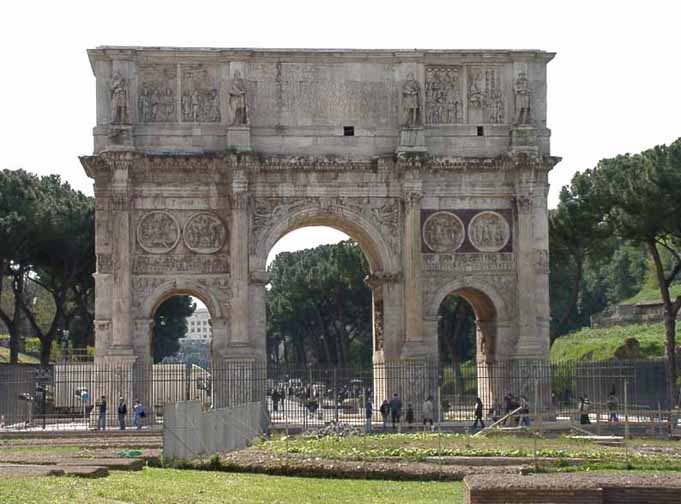 2002 photo ... The arch seen from Via Triumphalis ... The arch is heavily decorated with parts of older monuments, for example, the head of an earlier emperor was replaced by that of Constantine. 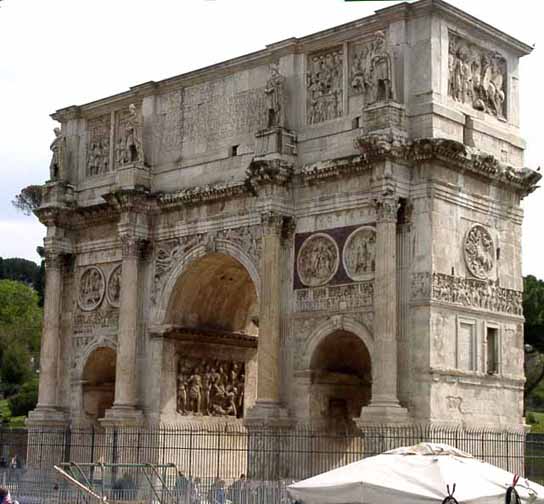 2002 photo. The arch was erected by the Roman Senate to commemorate Constantine I's
victory over Maxentius at the Battle of Milvian Bridge on October 28,
312 for sole control of the Roman empire in the west.
Constantine believed that his improbable victory over Maxentius was the result of the help of the Christian god. As a result, during Constantine's reign persecution of Christians ended and Christianity became the official religion in the Roman Empire. He also moved the capital of the empire from Rome to Constantinople in 325 AD (before known as Byzantium, now Istanbul). 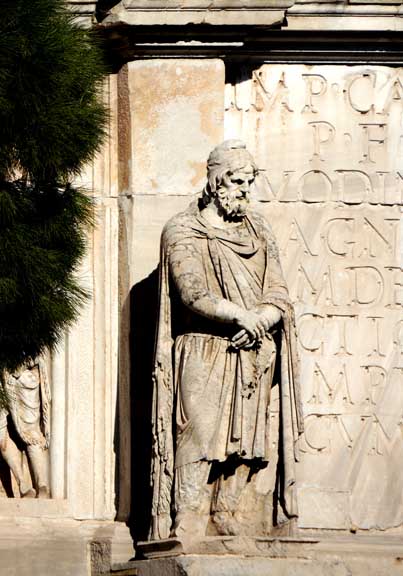 2013 photo ... The statues at the top were taken from the Forum of Trajan. They depict Dacian captured soldiers, defeated by the Trajan army. 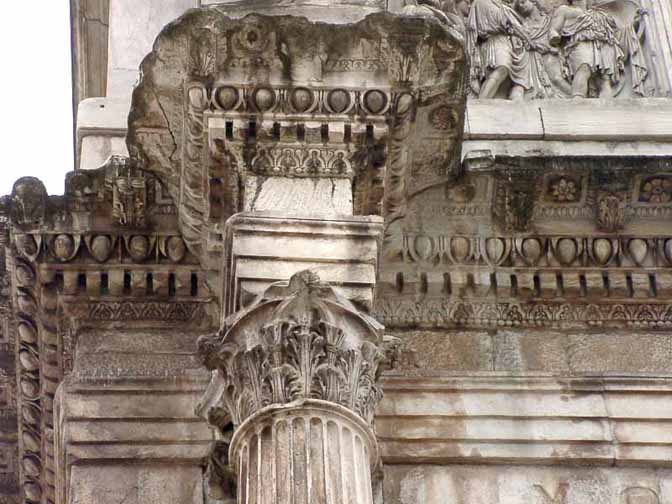 2002 photo ... Egg-and-dart ... Dentils... Greek (fluted) Corinthian column 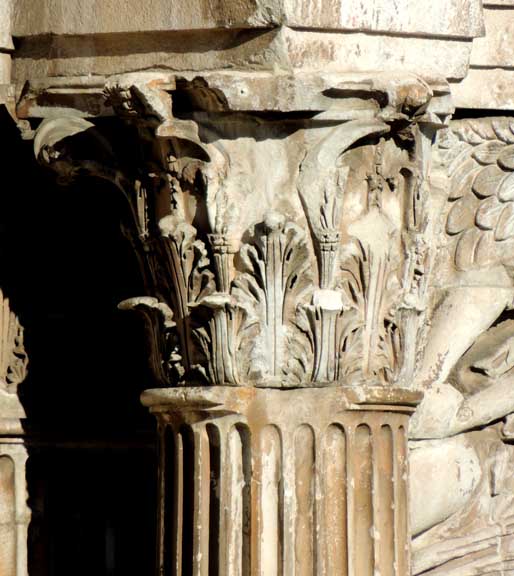 2013 photo ... Greek (fluted) Corinthian column 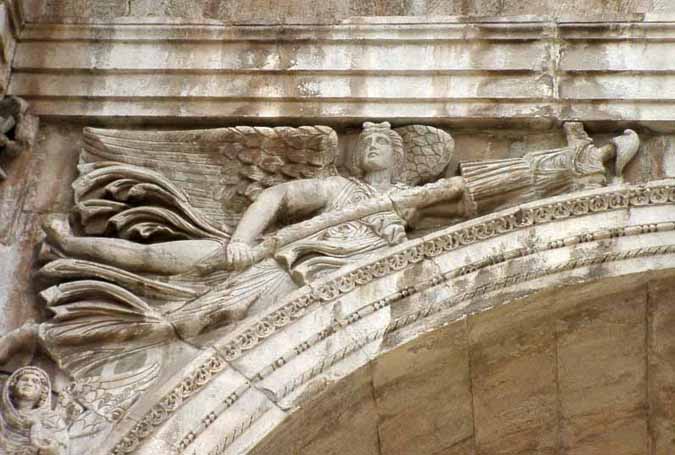 2002 photo ... Spandrel. The spandrels of the main archway are decorated with reliefs depicting victory figures with trophies. Spandrel reliefs are from the time of Constantine. 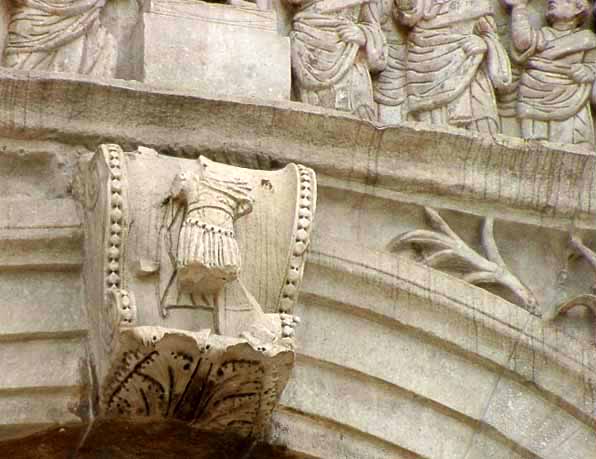 2002 photo ... Keystone: emperor, beads and acanthus leaf decorate the ancone. 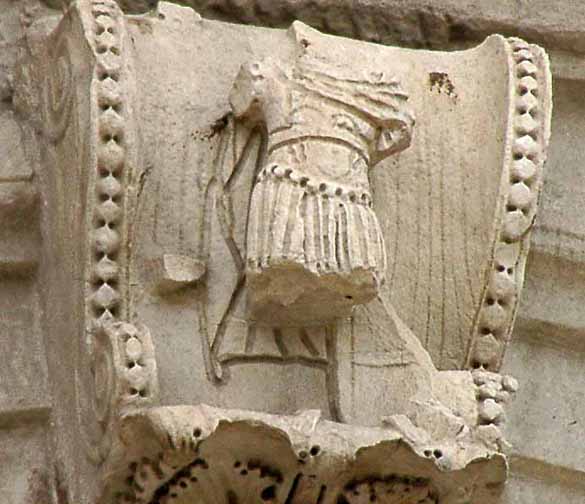 2002 photo 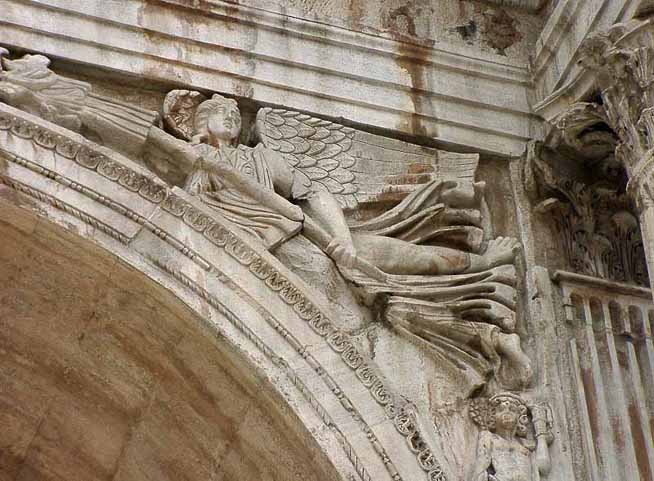 2002 photo ... ... Spandrel. The spandrels of the main archway are decorated with reliefs depicting victory figures with trophies. 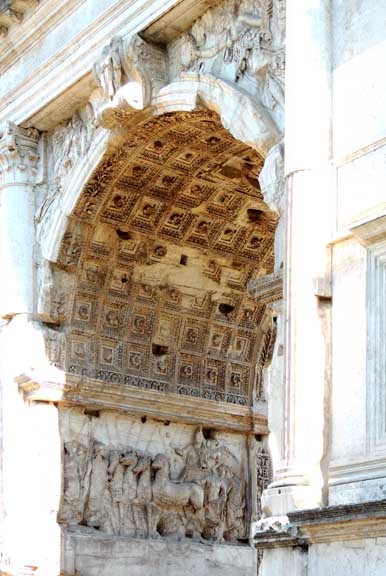 2013 photo ... Coffered soffit above bas-relief scene 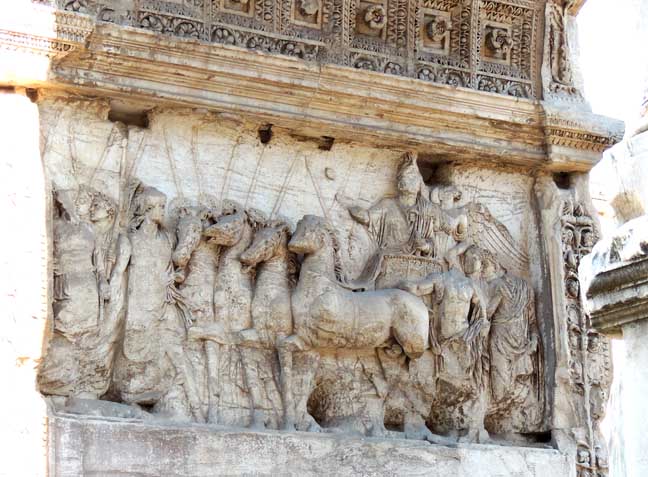 2013 photo 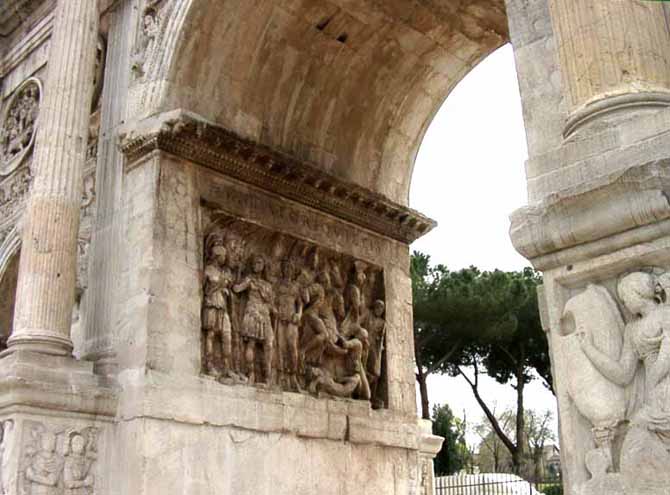 2002 photo 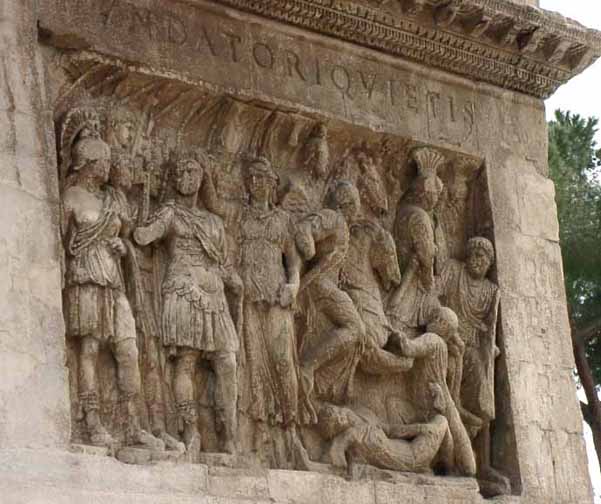 2002 photo 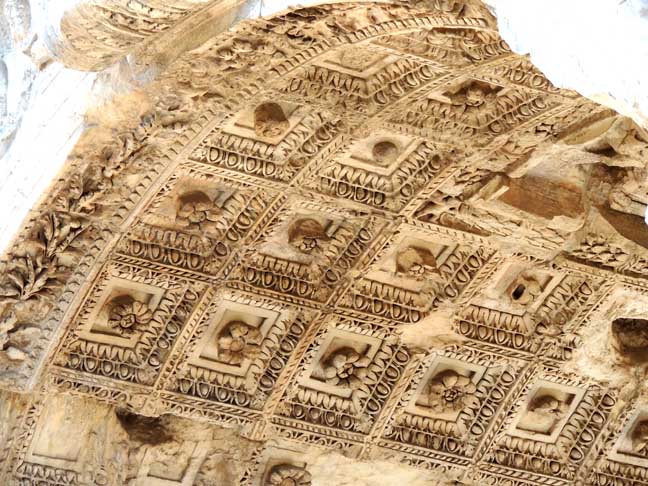 2013 photo ... Coffered soffit above bas-relief scene ... Egg-and-dart panel border ... Rosette in center |
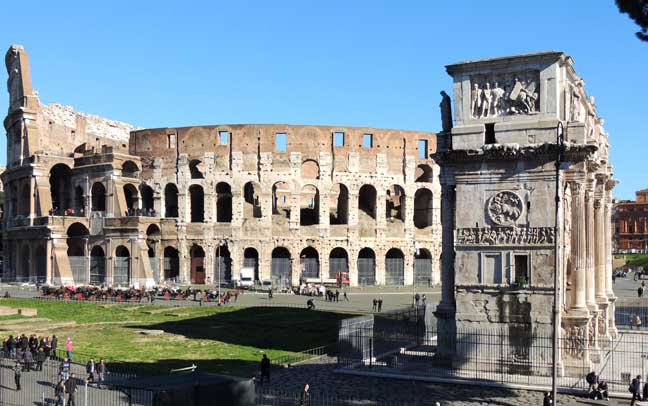 2013 photo ... The Coliseum at left 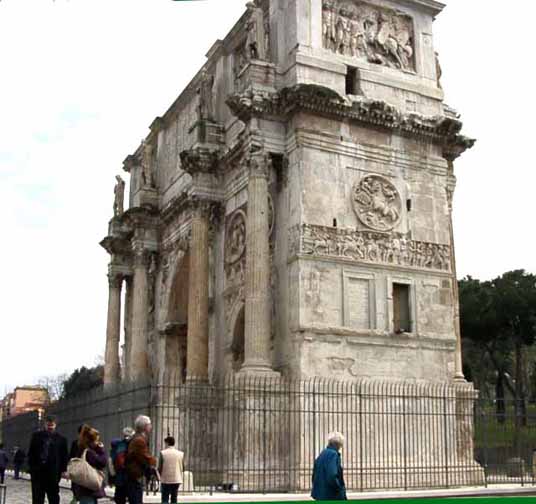 2002 photo 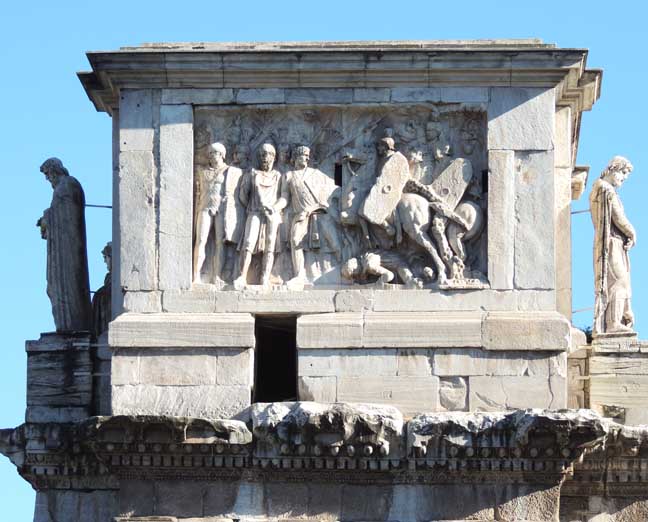 2013 photo ... The eight rectangular reliefs in the attic come from an arch erected in AD 176 to celebrate the victories of Marcus Aurelius. Scholars used to argue that this use of "spolia" from earlier buildings was a good indication of artistic decline. More recently scholars have seen this inclusion of earlier monuments as a way of linking Constantine to the great emperors of the past. 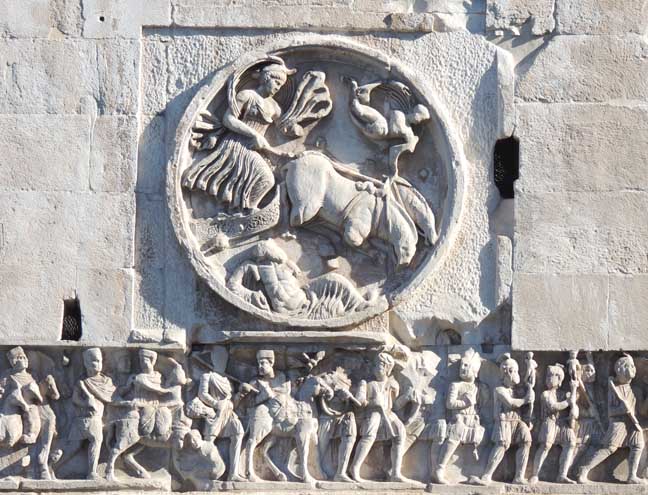 2013 photo ... The roundel depicts Luna, the moon goddess, in a chariot. The roundels or medallions were originally made for the Emperor Hadrian nearly two hundred years earlier. 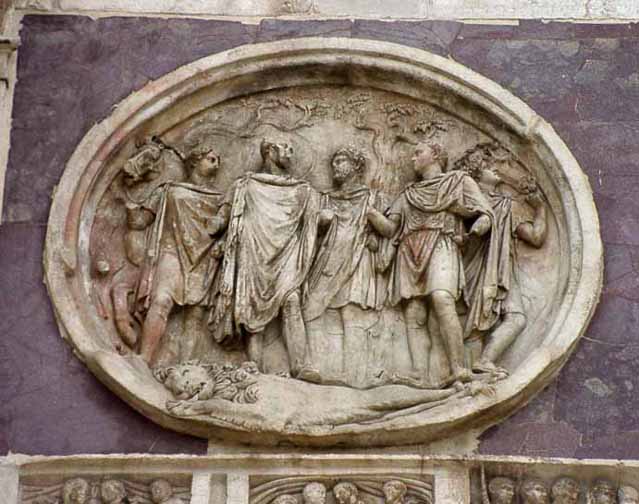 2002 photo ... Sacrifice (lion) to the gods |
The Arch of Constantine (Italian: Arco di Costantino) is a triumphal arch in Rome, situated between the Colosseum and the Palatine Hill. It was erected by the Roman Senate to commemorate Constantine I's victory over Maxentius at the Battle of Milvian Bridge on October 28, 312. Dedicated in 315, it is the latest of the existing triumphal arches in Rome [others being the nearby Arch of Titus and Arch of Septimius Severus], and the only one to make extensive use of spolia, re-using several major reliefs from 2nd century imperial monuments, which give a striking and famous stylistic contrast to the sculpture newly-created for the arch. The arch spans the Via Triumphalis, the way taken by the emperors when they entered the city in triumph. This route started at the Campus Martius, led through the Circus Maximus and around the Palatine Hill; immediately after the Arch of Constantine, the procession would turn left at the Meta Sudans and march along the Via Sacra to the Forum Romanum and on to the Capitoline Hill, passing both the Arches of Titus and Septimius Severus. The contrast between the styles of the re-used Imperial reliefs of Trajan, Hadrian and Marcus Aurelius and those newly made for the arch is dramatic... - Wikipedia: Arch of Constantine (online May 2013)
|
| The Arch of Constantine
was erected to commemorate Constantine's victory over Maxentius at the
Battle of Milvian Bridge in 312 AD. This event is a highly important
one for Christian history. According to contemporary historians, the night before the battle Constantine had a vision. He saw the symbol of chi-rho (the first letters of "Christ" in Greek) - or the cross in some accounts - in the sky with the words, "By this sign, conquer." Facing an army larger than his own, Constantine was happy to try anything. He had his soldiers carry the Christian symbol into battle, and he was victorious. So Constantine adopted Christianity for himself and declared the religion officially tolerated throughout the Roman Empire. With Constantine's conversion, Christian persecution ended and the development of Christendom began. Thus, the event celebrated by the Arch of Constantine was a major turning point in the history of the western world. - Sacred Destinations (online May 2013)
|
| After the death of his father (Constantine
the Great 272-337), Constantine I invaded Italy in AD. 312 and defeated and killed his chief
rival, Maxentius, at a battle at the Milvian Bridge at the gateway to Rome - a victory
that Constantine attributed to the aid of the god of the Christians. In 313, he and Licinius, Constantine's co-emperor in the East, issued the Edict of Milan, ending the persecution of Christians. Immediately after the Battle of the Milvian Bridge, Constantine erected a great triple-passageway arch in the shadow of the Coliseum to commemorate his victory over Maxentius. The arch was the largest to be erected in the capital since the end of the Severan dynasty nearly a century before, but the achievement is less impressive when it is revealed that much of the sculptural program of the arch was taken from earlier monuments of Trajan, Hadrian, and Marcus Aurelius, and that the columns and other architectural members also date to an earlier era. The second-century reliefs were, however, refashioned to honor Constantine by recutting the heads of the earlier emperors with the features of the new ruler and by adding labels to the old reliefs. The reuse of second-century sculptures by the Constantinian artists has frequently been cited as evidence of a decline in creativity and technical skill in the waning years of the pagan Roman Empire. While such a judgment is in large part deserved, it ignores the fact that the reused sculptures were carefully selected in order to associate Constantine with the "good emperors" of the second century.
Sources:
|