Roman/Romanesque/Romanesque Revival .............................Illustrated Architecture Dictionary
Norman/Norman Revival
11th-12th centuries / Late 19th century
Term applied to the buildings erected by the Normans in all lands that fell under their dominion. It is used not only in England and Northern France, but also in Southern Italy (Apulia) and in Sicily.
"Norman" is a variation of "Northman," referring to the Scandinavians who conquered Normandy in France; later the mixed (Norman-French) race who, under William the Conqueror, in 1066, conquered England
The age is characterized by the building of great Benedictine abbeys, the two-tower facade supplementing a central tower over the crossing, and the use of geometric ornamentation. Nearly every cathedral and abbey was rebuilt. (Most of the bishops and abbots came from Normandy.) Norman ("Romanesque") architecture in England continued until the rise of Gothic around 1180 with the building of the east end in Canterbury Cathedral.
Features:
- Plain and massive
- Geometrical ornament, e.g., zigzag, crenelation
- Exterior: two facade towers
- Exterior: square crossing tower
- Interior: plain archways and capitals (cushion capitals) devoid of ornament
- Interior: arcades
- Interior: gallery
- Interior: clearstory
- Interior: open timber roof
See also: Mario Salvadori, Romanesque versus Gothic Cathedrals
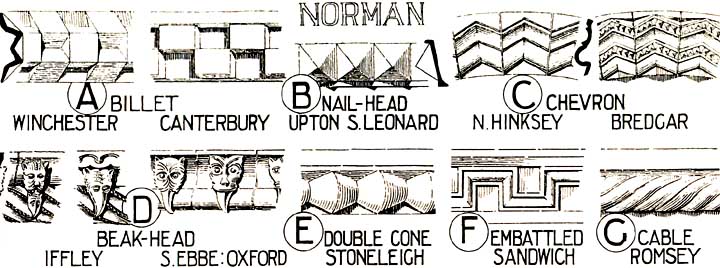
Norman Moldings reprinted from A History of Architecture on the Comparative Method, by Sir Banister-Fletcher, New York, 1950 Online, p. 348
Norman Moldings: Billet ..... Nail-head ..... Chevron ..... Beak-head ..... Double-cone ..... Embattled ..... Cable
It was towards the year 795 that the first Viking fleets, driven by famine and cold weather, landed on the coasts of the English Channel and traveled the river Seine up to Paris, pillaging and devastating everything in their wake. The "Normans," as the local population called these men who came from the north, committed numerous atrocities in the region for more than a century. It was an uneven fight. France was then made up of many rival feudal landowners who were easy targets as they couldn’t seem to unite to fight a common enemy. Rouen was systematically sacked.
With so much destruction over the years, the loot of these pillaging barbarians began to dwindle, just as the population was getting organized at last. They started resisting more effectively and rendered these attacks more difficult, but they were still unable to push the Vikings back for good.
No one was really getting anywhere. Finally, King Charles III “the Simple” decided to negotiate with Rollo, the Viking leader. He offered him the city [Rouen] and the surrounding land in exchange for which Rollo promised to protect the region from any future invasions. The treaty was signed in St-Clair-sur-Epte, in 911. And so came into being the Duchy of Normandy, with Rouen as its capital city.
- France Monthly (March 2012)
Their settlement proved successful, and the Vikings in the region became known as the "Northmen" from which "Normandy" is derived. The Normans quickly adapted to the indigenous culture, renouncing paganism and converting to Christianity. They adopted the langue d'oïl of their new home and added features from their own Norse language, transforming it into the Norman language.
They further blended into the culture by intermarrying with the local population.
-Wikipedia (January 2012)
11th, 12th centuriesThe Romanesque architecture of England, from the Norman Conquest under William the Conqueror in 1066 until the rise of the Gothic around 1180.The greatest activity was in England, where after 1070 the Normans built hundreds of parish churches and commenced most of the great cathedrals. All underwent later restorations.
In both England and Normandy church plans were cruciform. Over the crossing of nave and transepts was a prominent square tower, one of the most effective Norman features.Monasteries, which had been destroyed by the Vikings, were being rebuilt and given huge grants of land by the Dukes of Normandy.
11th, 12th centuriesConquering the island after more than two centuries of Arab rule in 1072, early Norman kings adopted and built upon its local Islamic vocabulary in art and architecture.
The austere grandeur of the English and French Norman style was modified in Southern Italy and especially in Sicily by the mingling of Byzantine and Arabic elements. These Byzantine motifs were particularly obvious in the interiors of certain churches that decorated with gilded mosaics, such as that at the cathedral at Monreale.
The "Arab-Norman" style declined with the Norman persecution of local Muslims in the early thirteenth century, and was gradually replaced by Gothic forms favored by the Cisternians.
Norman examples:
Norman Revival examples from Buffalo architecture:
- Norman fireplace: Saturn Club
- Nail-head molding: Matthews House
- Bed ornament: McCann House

web site consulting by ingenious, inc.