Iconography in Art and Architecture ............. Illustrated Dictionaries - Table of Contents
Mary, the Mother of Jesus -
Iconography in Art and Architecture
Iconography: Study of the
symbolic, often religious, meaning of objects, persons, or
events depicted in works of art
Research
contributions by Gregory L. Witul
| Image | History | Examples |
| Annunciation | In Christianity, the
revelation to Mary, the mother of Jesus by the angel
Gabriel that she would conceive a child to be born the
Son of God. Luke 1: 26-38: 26And in the sixth month the
angel Gabriel was sent from God unto a city of
Galilee, named Nazareth,
27To a virgin espoused to a man whose name was Joseph, of the house of David; and the virgin's name was Mary. 28And the angel came in unto her, and said, Hail, thou that art highly favoured, the Lord is with thee: blessed art thou among women. 29And when she saw him, she was troubled at his saying, and cast in her mind what manner of salutation this should be. 30And the angel said unto her, Fear not, Mary: for thou hast found favour with God. 31And, behold, thou shalt conceive in thy womb, and bring forth a son, and shalt call his name JESUS. 32He shall be great, and shall be called the Son of the Highest: and the Lord God shall give unto him the throne of his father David: 33And he shall reign over the house of Jacob for ever; and of his kingdom there shall be no end. 34Then said Mary unto the angel, How shall this be, seeing I know not a man? 35And the angel answered and said unto her, The Holy Ghost shall come upon thee, and the power of the Highest shall overshadow thee: therefore also that holy thing which shall be born of thee shall be called the Son of God. 36And, behold, thy cousin Elisabeth, she hath also conceived a son in her old age: and this is the sixth month with her, who was called barren. 37For with God nothing shall be impossible. 38And Mary said, Behold the handmaid of the Lord; be it unto me according to thy word. And the angel departed from her. .... Luke 1:42-48 (King James Version) 42And she spake out with a loud voice, and said, Blessed art thou among women, and blessed is the fruit of thy womb. 43And whence is this to me, that the mother of my Lord should come to me? 44For, lo, as soon as the voice of thy salutation sounded in mine ears, the babe leaped in my womb for joy. 45And blessed is she that believed: for there shall be a performance of those things which were told her from the Lord. 46And Mary said, My soul doth magnify the Lord, 47And my spirit hath rejoiced in God my Saviour. 48For he hath regarded the low estate of his handmaiden: for, behold, from henceforth all generations shall call me blessed. The "Hail, Mary" prayer is fashioned from the Biblical texts above. Hail Mary, full of grace. Our Lord is with thee. Blessed art thou among women, and blessed is the fruit of thy womb, Jesus. Holy Mary, Mother of God, pray for us sinners, now and at the hour of our death. Amen. The "Hail, Mary" prayer in Latin: Ave Maria, gratia plena, Dominus tecum. Benedicta tu in mulieribus, et benedictus fructus ventris tui, Iesus. Sancta Maria, Mater Dei, ora pro nobis peccatoribus, nunc, et in hora mortis nostrae. Amen. Depictions: Archangel Gabriel and the Virgin Mary. Often includes the Holy Spirit in the form of a dove. |
Stained glass: Grace Episcopal Church, Lockport Westminster Presbyterian Church St. Joseph RC Cathedral St. Joseph RC Cathedral St. John the Evangelist RC Church Our Lady of Victory RC Basilica Holy Angels RC Church Annunciation RC Church Assumption RC Church Santa Maria De Ricci Church, Florence, ITALY Icons: Hellenic Orthodox Church of the Annunciation Paintings: Catalonian National Art Museum, Barcelona, Spain Chest Catalonian National Art Museum, Barcelona, Spain By Francisco de Solis Pitti Palace, Florence, Italy By Leonardo da Vinci Sgraffito: Assumption RC Church |
| Assumption | Assumption of Mary
into Heaven There is no biblical support or scriptural basis for the Assumption of Mary doctrine. In fact, the Bible does not even record Mary's death. Pope Pius XII proclaimed the Assumption as doctrine in 1950 in his Munificentissimus Deus. This dogma states that the "Immaculate Virgin, after the completion of her earthly life was assumed body and soul into the glory of Heaven." The doctrine further states that Mary was glorified in heaven and is "exalted by the Lord as Queen over all things." See Dormition below. |
Painting: Blessed Trinity RC Church Stained glass: Our Lady of Victory RC Basilica Holy Angels RC Church Assumption RC Church Sgraffito: Assumption RC Church |
| Birth of Mary | Not recorded in the Bible | Stained glass: St. Joseph RC Cathedral Icon: Saint Nicholas Greek Orthodox Cathedral, Tarpon Springs, Florida |
| Coronation / Queen of Heaven: | There is nothing in the Bibe about Mary being crowned upon her arrival in Heaven, yet this has been a popular theme in the art for more than eight centuries. Mary crowned with stars and standing on a crescent moon Possible origin: Revelation 12:1 A woman clothed with the sun, having the moon under her feet, and on her head a crown of twelve stars. See The Virgin Mary as the Woman of the Apocalypse by Peter Paul Rubens "Book of the Revelation of John", usually referred to simply as "Revelation," is the last book of the New Testament. It is also called the "Apocalypse of John." See What is the meaning of the crescent moon that Mary is sometimes pictured standing upon? |
Sculpture: Blessed Trinity RC Church Painting: Holy Angels RC Church Annunciation RC Church Stained glass: Holy Angels RC Church St. Joseph RC Cathedral Annunciation RC Church St. Joseph RC Cathedral Holy Angels RC Church Hellenic Orthodox Church of the Annunciation Cologne Cathedral, Germany |
| Death/ Dormition | The Bible does not
record Mary's death. Feast of the Dormition of the Mother of God: The Dormition of the Theotokos is a Great Feast of the Eastern Orthodox, Oriental Orthodox and Eastern Catholic Churches which commemorates the "falling asleep" or death of the Theotokos (Mary, the mother of Jesus; literally translated as God-bearer), and her bodily resurrection before being taken up into heaven. See Assumption above. |
Stained glass: St. Joseph RC Cathedral Our Lady of VictoryRC Basilica Mural: Kirillo-Belozersky Monastery, Goritsy, Russia |
| Deesis |
"In Byzantine art, and later
Eastern Orthodox art generally, the Deësis or Deisis,
is a traditional iconic representation of Christ in
Majesty or Christ Pantocrator: enthroned, carrying a
book, and flanked by the Virgin Mary and St. John the
Baptist, and sometimes other saints and angels. "Mary and John, and any other figures, are shown facing towards Christ with their hands raised in supplication on behalf of humanity. "The presence of Mary and John, and other figures, is one of the differences with the Western Christ in Majesty, where the Four Evangelists and/or their symbols are more commonly included around Christ. The Deesis composition is also commonly found in the West, especially those parts of Italy under Byzantine influence, but also the rest of Europe." - Wikipedia: Deesis (online Dec. 2014) |
Mosaics: Hagia Sophia, Istanbul, Turkey |
| Immaculate Conception |
Mary
Immaculata: Mary without any stain (macula in Latin). Roman Catholic belief that states that Mary, the mother of Jesus, was conceived and born without bearing the original sin of human beings. In art, the Immaculate Conception is depicted as Mary with a crown of stars, standing on a crescent moon above a snake. The
Sun, Moon and Stars: This depiction of the
Immaculate Conception refers to the Book of
Revelations 12:1 "A great sign appeared in heaven: a
woman clothed with the sun, with the moon under her
feet and a crown of twelve stars on her head... She
was pregnant and cried out in pain as she was about
to give birth."
The Snake: Pope Pius IX,
officially defining the Immaculate Conception as
dogma for the Roman Catholic Church, primarily
appealed to the text of Genesis
3:15 where the serpent was told by God, "I
will put enmity between you and the woman, between
your seed and her seed." In Catholic
understanding, this was a prophecy that foretold of
a "woman" who would always be at enmity with the
serpent - that is, a woman who would never be under
the power of sin, nor in bondage to the serpent.
Furthermore, in art, Mary has her foot on the head of the reptile. This also refers to the Genesis creation story (Genesis 3:14-15) and the serpent's punishment: "So the Lord God said to the
serpent: "Because you have done this, You are cursed
more than all cattle, And more than every beast of
the field; On your belly you shall go, And you shall
eat dust All the days of your life. And I will put
enmity Between you and the woman, And between
your seed and her seed; He shall bruise your
head, And you shall bruise His heel."
|
Mural: Buffalo Religious Arts Center Paintings: Catalonian National Art Museum, Barcelona, Spain Zurbaran painting Stained glass: Cologne Cathedral, Germany |
| Immaculate Heart of Mary Sacred Heart of Mary | "Physical heart of
Blessed Virgin Mary as a symbol of Mary's interior
life" - Wikipedia:
Immaculate
Heart of Mary Depictions: Heart is pierced with seven wounds or swords |
Sculpture: Felician Sisters Immaculate Heart of Mary Convent Chapel |
| Jesus, Holding | See
Mother of God below |
|
| John the Apostle, Protected by | Stained glass: Our Lady of Victory RC Basilica |
|
| Lourdes, Our Lady of | "Beginning
on 11 February 1858, a 14-year old peasant girl called
Bernadette Soubirous claimed to have experienced a
series of apparitions of a girl dressed in white and
with a blue belt around her waist, who eventually
introduced herself as the Immaculate Conception, a
name by which the Virgin Mary was known. The figure
always appeared in one place, a niche above the main
cavity of the grotto, in which a wild rose bush was
growing. Among the instructions from 'the Virgin' were
"Go and drink from the spring", "Go and tell the
priests to build a chapel here", and "Have the people
come here in procession." - Wikipedia
(July 2011) |
Stained glass: Felician Sisters Convent Chapel |
| Madonna
/ Madonna and Child |
See "Mother of God" below | |
| Mandorla |
||
| Marriage of Mary and Joseph | Mary and Joseph were betrothed when Mary became pregnant. See Matthew 1:18-25 | Stained glass: Our Lady of Victory Basilica Corpus Christi RC Church Milan Cathedral Museum |
| "Mother
of God" / Madonna and Child |
A Madonna is a representation of
Mary, either alone or with her child Jesus. These
images are central icons for both the Catholic and
Orthodox churches. The word is from Italian ma
donna, meaning "my lady". One of the most common subject matters in art, especially in icons, is Mary holding Jesus in her arms. In Orthodox theology, the Virgin Mary is the Theotokos ("God-bearer") - the fulfillment of the Old Testament archetype revealed in the Ark of the Covenant, because she carried the New Covenant in the person of Christ; thus, the Orthodox consider her the Ark of the New Covenant, and give her the respect and reverence as such. |
Icons: Hellenic Orthodox Church of the Annunciation St. Casimer's RC Church Mural: Kirillo-Belozersky Monastery, Goritsy, Russia Sculpture: Catalonian National Art Museum, Barcelona, Spain Romanesque Catalonian National Art Museum, Barcelona, Spain Renaissance Bargello, Florence, Italy Painting: Catalonian National Art Museum, Barcelona, Spain By Vincenzo Frediani Mosaic: Hagia Sophia, Istanbul, Turkey Palermo Cathedral, Sicily |
| North America, Patron Saint of | See Immaculate Conception above |
Painting:
Buffalo Religious Arts Center Xavier Hall Gallery |
| Nursing Madonna/Madonna Lactans | Painting: Siena Cathedral, Italy |
|
| Our Lady of Perpetual Help | Our Lady of Perpetual
Help is a title given to the Blessed
Virgin Mary, associated with a Byzantine icon of the
same name, said to be 13th or 14th century, but perhaps 15th
century. - Wikipedia The original picture of Mary under this title is venerated in the Redemptorist church of Sant'Alfonso in Rome. The tradition of Our Mother of Perpetual Help is traced back to 1495. Stolen from a Cretan monastery by a wine merchant a few years after its creation, it was brought to the church of St. Matthew in Rome. For 300 years, it resided at the church, and even survived the church’s destruction by Napoleon’s army in 1798. 88 years later, Pope Pius IX gave the icon to the Redemptorist congregation at the Church of Saint Alphonsus, where it remains today. – The Basilica of the national Shrine of the Immaculate Conception (online July 2022)
"The
original picture of Our Lady of Perpetual Help is
painted on wood, and it measures about 17 by 21
inches. It is distinctly Byzantine in style, and
many similar portrayals of Our Lady are found
throughout the East and in Russia. "In addition to Mary, the picture represents her divine Son as a child of two or three years old, seated on his Mother's left hand, with his hands clasping her right hand. On either side are the angels Michael and Gabriel, bearing the instruments of the Passion. In Greek characters the abbreviated names of the four figures are added. The artist wished to depict the mental anguish of Christ as He gazes at the cross, and with a touching stroke painted the left sandal falling off His foot as He winces in terror." - Encyclopedia.com (online July 2022)
|
Painting: Our Lady of Perpetual Help RC Church |
| Our Lady of Mount Carmel | See St. Simon Stock and Brown Scapular | |
| Our
Lady of Victory |
On October 7, the Roman Catholic Church
celebrates the yearly feast of Our Lady of the
Rosary. Known for several centuries by the
alternate title of “Our Lady of Victory,” the feast
day takes place in honor of a 16th century naval
victory which secured Europe against Turkish invasion.
Pope St. Pius V attributed the victory to the
intercession of the Blessed Virgin Mary, who was
invoked on the day of the battle through a campaign to
pray the Rosary throughout Europe. |
|
| Portrait | Usually portrayed as an attractive young woman | Stained glass: Saints Peter and Paul RC Church St. Joseph RC Cathedral |
| Presentation of Mary in the Temple | Presentation of Mary in the Temple (November 21 Feast day): The Scriptures tells us nothing of Mary's hidden life. That which is known about the Presentation of the Blessed Virgin Mary in the Temple is found in the Apocrypha, principally in chapter seven of the Protoevangelium of James, which has been dated by historians prior to the year 200 AD. | Stained glass: Felician Sisters Convent Chapel Our Lady of Victory RC Basilica Painting: Santa Maria Novella, Florence, Italy |
| Queen of Heaven | Stained glass: Annunciation RC Church St. Margaret's RC Church Sculpture: Blessed Trinity RC Church Cologne Cathedral, Germany Mosaic: Church on Spilled Blood, St. Petersburg, Russia Mural: St. Casimir's RC Church |
|
| Queen of Peace | Hold the child Jesus in her arms | Sculpture: Buffalo Religious Art Center Stained glass: Grace Episcopal Church, Lockport |
| Seven Joys | Seven
Joys The Annunciation The Nativity of Jesus The Adoration of the Magi The Resurrection of Christ The Ascension of Christ to Heaven The Pentecost The Coronation of the Virgin in Heaven Alternative choices might include the Visitation, the Finding in the Temple, or the Assumption of Mary |
|
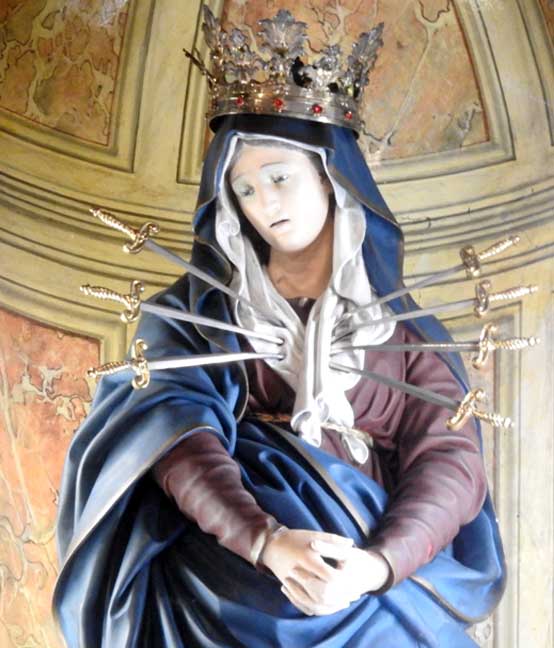
| Seven Sorrows |
Our
Lady of Sorrows
|
Sculpture: Buffalo Religious Art Center Painting: Basilica of the Most Holy Annunciation/Ss. Annunziata di Firenze, Florence,Italy (2020 photo) |
| Visitation | Mary Visits Elizabeth: Luke 1:39-56 | Painting: Annunciation RC Church Stained glass: Our Lady of Victory RC Basilica Holy Angels RC Church Sculpture: Florence Baptistery, Italy |