Iconography in Art and Architecture .......... ................. Illustrated Dictionaries - Table of Contents .......... ..................Bible verses .................
Jesus
- Iconography
in Art and
Architecture
Iconography:
Study of the symbolic,
often religious, meaning of objects, persons, or events depicted in
works of art
Research
contributions
by Gregory L. Witul
| Agony in the Garden | According
to all four Gospels,
immediately after the Last
Supper, Jesus took a walk to pray in the Garden
of Gethsemane,
accompanied by St.
Peter, St.
John and St.
James the Greater,
whom he asked to stay awake and
pray. Luke 22:39-46 Matthew 26:36-46 Mark 14:32-42 John 18:4 |
Stained
glass: Holy Angels RC Church Holy Family Church |
|
| Alpha and Omega | "I
am the
alpha and the
omega": an appellation of God in the Book of Revelation
(verses 1:8,
21:6, and 22:13). Its meaning is found in the fact that
Alpha and
Omega are respectively the first and last letters of the
Classical
(Ionic) Greek alphabet. This would be similar to referring to
someone
in English as "the A to Z". Symbol for Christ: This phrase is interpreted by many Christians to mean that Jesus existed from eternity (as the second person of the Trinity), and will exist eternally. |
Mosaic:
Delaware
Avenue
Baptist Church Sculpture: Episcopal Church of the Ascension On 1873 marble baptismal font St. John's United Evangelical Church / St. John's United Church of Christ Stained glass: Westminster Presbyterian Church Holy Angels RC Church Murals: St. Casimir's RC Church |
|
| Ascension | Mark
16:14-19 14 Later Jesus appeared to the Eleven [apostles] as they were eating; he rebuked them for their lack of faith and their stubborn refusal to believe those who had seen him after he had risen... 19 After the Lord Jesus had spoken to them, he was taken up into heaven and he sat at the right hand of God. Acts 1:1-14 10 They were looking intently up into the sky as he was going, when suddenly two men [interpreted as angels] dressed in white stood beside them. 11 "Men of Galilee," they said, "why do you stand here looking into the sky? This same Jesus, who has been taken from you into heaven, will come back in the same way you have seen him go into heaven." The event took place on the mount of Olives, east of Jerusalem, between Bethany and the Holy City (Luke 24:50, Acts 1:12) and was accompanied by the appearance of two angels (Acts 1:10). The event took place forty days after the resurrection (Acts 1:3). The Catholic and Orthodox traditio nal view is that Mary was also present at the Ascension, following her mention in Acts 1:14. |
Stained
glass: St. Paul Episcopal Cathedral Saints Peter and Paul RC Church Trinity Episcopal Church Holy Angels RC Church Annunciation RC Church Assumption RC Church |
|
| Baptism
of
Jesus |
Matthew
3:13-17 (New International Version): 13 Then Jesus came from Galilee to the Jordan to be baptized by John. 14 But John tried to deter him, saying, "I need to be baptized by you, and do you come to me?" 15 Jesus replied, "Let it be so now; it is proper for us to do this to fulfill all righteousness." Then John consented. 16 As soon as Jesus was baptized, he went up out of the water. At that moment heaven was opened, and he saw the Spirit of God descending like a dove and lighting on him. 17 And a voice from heaven said, "This is my Son, whom I love; with him I am well pleased." Depictions: Jesus, John, Holy Spirit as a dove and the voice of God the Father The "official" way to become a Christian is to be baptized. Baptists practice baptism by immersion in a small pool, as opposed to affusion or sprinkling over a baptismal font in most other Christian denominations. See also: St. John the Baptist |
Stained
glass: Grace Episcopal Church, Lockport Saints Peter and Paul RC Church (Mazur) St. Joseph's RC Cathedral Westminster Presbyterian Church Our Lady of Victory RC Basilica Saints Peter and Paul RC Church (Andrle) Episcopal Church of the Ascension Annunciation RC Church Assumption RC Church Icons: Church of the Intercession, Kizhi, Russia Paintings: Blessed Trinity RC Church Catalonian National Art Museum, Barcelona, Spain Sculpture: St. Peter's Basilica, Vatican City Florence Baptistery, Italy |
|
| Beatitudes | Stained glass: Westminster Presbyterian Church | ||
| Cana, Marriage at | John 2:1-11: Jesus turns water into wine | Stained
glass: Westminster Presbyterian Church St. Joseph RC Cathedral St. Stanislaus RC Church |
|
| Chalice |
|||
| Chasing Merchants from the Temple | Jesus
and his disciples travel to Jerusalem for Passover, where
Jesus expels
the merchants and money changers from the Temple, accusing
them of
turning the Temple into "a den of thieves" through their
commercial
activities. Matthew 21:12–17, Mark 11:15–19, and Luke 19:45–48 |
Sculpture: Florence Baptistery, Italy |
|
| Children, Christ with | Luke
18:16,
"Let the little children come
to me, and do not stop them, for it is to such as these that
the
kingdom of God belongs." Mark 10:13-16 |
Stained
glass: First Presbyterian Church, Lockport Episcopal Church of the Good Shepherd Chapel Westminster Presbyterian Church St. John's Grace Episcopal Church Our Lady of Victory RC Basilica Corpus Christi RC Church St. Paul Episcopal Cathedral Episcopal Church of the Ascension Annunciation RC Church Holy Trinity Lutheran Church St. John Kanty RC Church |
|
| Chi
Rho |
One
of the earliest forms of christogram,
formed by superimposing the first two (capital) letters—chi
and rho (ΧΡ) |
|
|
| Christogram | Combination of
letters that forms an abbreviation for the name of Jesus
Christ,
traditionally used as a Christian symbol. See IHS, ICXC, PX below. |
||
| Crown of thorns | Woven
thorn branches placed on
Jesus Christ before his crucifixion. Matthew 27:29: And when they had platted a crown of thorns, they put it upon his head, and a reed in his right hand: and they bowed the knee before him, and mocked him, saying, Hail, King of the Jews! Mark 15:17 ........ John 19:2, 5 King Louis IX bought what is believed by many Christians to be the Jesus' crown of thorns and built Sainte Chapelle to house it. The crown of thorns is usually found on the Sacred Heart of Jesus (below) d |
Sculpture: Buffalo Religious Arts Museum/St. Francis Xavier RC ChurchSt. John Kanty RC Church St. Louis RC Church Stained glass: Holy Family Church |
|
| Crucifix | See Illustrated Architecture Dictionary: Cross | ||
| Crucifixion |
According to Matthew 27:54-55, the following were present at the Crucifixion:
Salome: Mark 15:40 adds Salome to those present at the Crucifixion. Mary, mother of Jesus: In John 19: 26-27, the evangelist adds, "When Jesus therefore saw His mother, and the disciple whom He loved standing by, He said to His mother, "Woman, behold your son!" 27 Then He said to the disciple, "Behold your mother!" And from that hour that disciple took her to his own home." (The disciple is interpreted as John.) "25 Now there stood by the crosse of Jesus, his mother, and his mother's sister, Mary the wife of Cleophas, and Mary Magdalene.26 When Jesus therefore saw his mother, and the disciple standing by, whom he loved, he saith unto his mother, Woman, behold thy sonne. 27 Then saith he to the disciple, Behold thy mother. And from that houre that disciple tooke her vnto his owne home." - John 19 St. Mary Magdalene is sometimes depicted with the cross on which Jesus was crucified on Golgotha and with Adam's skull which tradition holds was also buried in Golgotha ("the place of the skull). See also: cross ..... Stations of the Cross ..... stigmata |
Stained
glass: Saints Peter and Paul RC Church Holy Family Church St. Paul Episcopal Cathedral Westminster Presbyterian Church St. Joseph's RC Cathedral St. John's Grace Episcopal Church Mary and John at the foot of the cross St. John the Evangelist RC Church Our Lady of Victory RC Basilica St. Paul Episcopal Cathedral Holy Angels RC Church Church of Saint Joan of Arc, Rouen, France Sculpture: Blessed Trinity RC Church St. Casimir's RC Church Catalonian National Art Museum, Barcelona, Spain 3 examples St. Peter's Basilica, Vatican City Bargello, Florence, Italy Icons: Church of Santa Anna, Barcelona, Spain Church of the Intercession, Kizhi, Russia |
|
| Deesis |
"In
Byzantine art, and later
Eastern Orthodox art generally, the Deësis or Deisis, is a
traditional
iconic representation of Christ in Majesty or Christ
Pantocrator: enthroned,
carrying a book, and flanked by the Virgin
Mary
and St. John the Baptist, and sometimes other saints
and
angels. "Mary and John, and any other figures, are shown facing towards Christ with their hands raised in supplication on behalf of humanity. "The presence of Mary and John, and other figures, is one of the differences with the Western Christ in Majesty, where the Four Evangelists and/or their symbols are more commonly included around Christ. The Deesis composition is also commonly found in the West, especially those parts of Italy under Byzantine influence, but also the rest of Europe." - Wikipedia: Deesis (online Dec. 2014) |
Mosaics:
|
|
| "Ecce Homo" | Latin
words used by Pontius Pilate in the Vulgate translation of the
Gospel
of
John, Chapter 19, when he presents a scourged
Jesus
Christ, bound and crowned with thorns, to a hostile crowd
shortly
before his Crucifixion. |
Sculpture: Florence Baptistery |
|
| Epiphany, Magi | "To
manifest" or "to show" Christian festival, observed on January 6, commemorating the manifestation of Christ to the gentiles in the persons of the Magi; Twelfth-day. Matthew 2:1-12 Luke 2:1-20 Because three gifts were recorded, there are traditionally said to have been three Magi. "January 6 is the feast of these three Magi, who brought Jesus gifts of gold, frankincense and myrrh. The Magi brought Jesus gold to show that He was a king; frankincense to honor Him as God; and myrrh to greet Him as man. These Magi first saw the star which led them to Bethlehem on the previous March 25, the day, and at the moment, that Jesus was conceived in Mary’s womb. It took the Magi nine months and twelve days to reach Bethlehem, guided by the star. The star left them when they were in Jerusalem. But it shone again after the Magi left Jerusalem, and led them to the cave of Bethlehem. Our Lady let each of the Magi hold Jesus in his arms. They were given some of His baby clothes to bring back to the East by way of relics. The Magi returned to the East, to Persia and later were baptized there by Saint Thomas the Apostle, in the year 40. All three of the Magi were martyred for the Catholic Faith. Their names are now, and should always be called, Saint Gaspar, Saint Melchior and Saint Balthasar. The bodies of Saint Gaspar, Saint Melchior and Saint Balthasar were first brought to Constantinople, and then to Milan, and in the twelfth century they were placed in the Cathedral of Cologne, in Germany, where they are venerated with much love by the Christians who worship there." - Catholicism.ORG (online Dec. 2019) |
Painting:
Annunciation RC Church Cologne Cathedral Stained glass: Grace Episcopal Church, Lockport St. Joseph RC Cathedral Westminster Presbyterian Church Westminster Presbyterian Church St. Joseph's RC Cathedral Episcopal Church of the Good Shepherd St. John the Evangelist RC Church Trinity Episcopal Church Louvre, Paris |
|
| Fish |
In
Greek,
the phrase, "Jesus Christ, Son of God Savior," is "Iesous
Christos Theou Yios Soter." The first letters of each of these
Greek
words, when put together, spell "ichthys," the Greek word for
"fish"
(ICQUS ). Used by Early Christians as a secret symbol. The ichthys is seen in 1st-century catacombs in Rome. According to tradition, ancient Christians, during their persecution by the Roman Empire in the first few centuries after Christ, used the fish symbol to mark meeting places and tombs, or to distinguish friends from foes. Because of the story of the miracle of the loaves and fishes, the fish symbolized, too, the Eucharist The "Jesus Fish" has become an icon of modern Christianity. Today, it can be seen as a decal or emblem on the rear of automobiles or as pendants or necklaces as a sign to the world that the owner is a Christian. The fish has also been used to symbolize Pisces, the Zodiac sign. |
Sgraffito: Assumption RC Church |
|
| Flight Into Egypt | Matthew 2: 13-23 | Painting:
Annunciation RC Church Sgraffito: Assumption RC Church Sculpture: Siena Cathedral, Italy |
|
| Garden of Gethsemane / Mount of Olives | Mark
14:32-42
(Gethsemane) Luke 22:39-46 (Mount of Olives) Matthew 26:36-46 Gethsemane: the bottom of the slope of Mt. of Olives Parallels the Garden of Eden where the first sin was committed. In Gethsemane Jesus accepts that he will die for the sins of mankind. Depictions: Sleeping apostles / Jesus kneeling |
Stained
glass: Episcopal Church of the Ascension Buffalo Religious Arts Center/St. Francis Xavier RC Church Holy Trinity Lutheran Church St. Stanislaus RC Church |
|
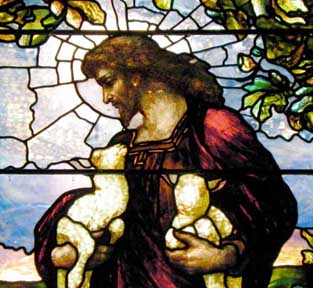
| Good Shepherd, Christ as | Psalm
23 John 10:11: "I am the good shepherd. The good shepherd lays down his life for the sheep." "The Good Shepherd is one of the oldest Christian symbols. In the catacombs of Rome there is a Good Shepherd picture painted in the fourth century A.D., probably just before Emperor Constantine officially recognized Christianity." - Nola Huse Tutag, Discovering Stained Glass in Detroit, Wayne State University Press, 1987 Christ depicted with a flock of sheep |
Stained
glass: Episcopal Church of the Good Shepherd Plymouth Methodist Church / Karpeles Manuscript Library Museum St. John's Grace Episcopal Church First Presbyterian Church, LOCKPORT Unitarian Universalist Church Trinity Episcopal Church Baker Memorial United Methodist Church, EAST AURORA St. Stanislaus RC Church Sculpture: St. Peter's Basilica, Vatican City |
|
| Grapes |
|||
| Holy Communion | Also
called the Eucharist
and Blessed Sacrament A commemoration of the Last Supper below. Takes the form of a host in Roman Catholicism. |
Stained
glass: Annunciation RC Church St. Joseph University Church |
|
| ICXC | Traditional
abbreviation of the
Greek words for "Jesus Christ" In Eastern Christianity, the most widely used Christogram (above) |
Murals: St. Casimir's RC Church |
|
| IHS | Example
of a Christogram:
IHS are the
first 3 letters in Jesus' name in Greek: iota, eta, and sigma.
Also, IHS in Latin stands for "In Hoc Sanctis," which means "In this sacred place" or "In His Service" or "I Have Suffered." |
Stained
glass: First Presbyterian Church, Lockport Episcopal Church of the Ascension Buffalo Religious Arts Center /St. Francis Xavier RC Church On Jesus' robe Baker Memorial United Methodist Church, EAST AURORA Sgraffito: Assumption RC Church Furniture: St. Stephen Walbrook |
|
| Infant of Prague |
|
Sculpture: Buffalo Religious Art Center Lace gowns Buffalo Religious Arts Center Murals: St. Casimir's RC Church |
|
| INRI | INRI
is an acronym of the Latin
inscription IESVS·NAZARENVS·REX·IVDÆORVM (Iesus Nazarenus, Rex
Iudaeorum), which translates to English as "Jesus the
Nazarene, King of
the Jews." In John19:19-20, the inscription is explained: "And Pontius Pilate wrote a title, and put it on the cross. And the writing was JESUS OF NAZARETH THE KING OF THE JEWS. This title then read many of the Jews: for the place where Jesus was crucified was nigh to the city: and it was written in Hebrew, and Greek, and Latin." This is a Christogram (above) |
Sculpture:
Assumption RC Church Siena Cathedral, Italy |
|
| Jairus' Daughter | Luke
8:
40-42, 49-56: 53 They laughed at him, knowing that she was dead. [54] But he took her by the hand and said, "My child, get up!" |
Stained glass: St. Paul Episcopal Cathedral | |
| Jesus Anointed by a Sinful Woman | Luke
7:36-50 37When a woman who had lived a sinful life in that town learned that Jesus was eating at the Pharisee's house, she brought an alabaster jar of perfume, 38and as she stood behind him at his feet weeping, she began to wet his feet with her tears. Then she wiped them with her hair, kissed them and poured perfume on them. The "sinful woman"is sometimes identified in tradition as Mary Magdalene, but there is no textual evidence for this. |
Stained
glass: St. Louis RC Church Annunciation RC Church |
|
| Jesus Heals a Blind Man | Mark
8:22-25 John 9:1-7 List - Healing Miracles of Jesus |
Stained
glass: Assumption RC Church |
|
| Jesus Learning Carpentry (from Joseph) / The Holy Family | No
direct evidence in the Bible Depictions: The boy Jesus often is carving a cross. |
Stained
glass: St. John's Grace Episcopal Church St. Joseph RC Cathedral Westminster Presbyterian Church Corpus Christi RC Church Assumption RC Church St. Stanislaus RC Church |
|
| Jesus Teaching in the Temple | Luke 2:39-52: 12-year-old Jesus teaches in the Jerusalem Temple | Stained
glass: Felician Sisters Convent Chapel Episcopal Church of the Good Shepherd St. John's Grace Episcopal Church Episcopal Church of the Good Shepherd Episcopal Church of the Good Shepherd Westminster Presbyterian Church Our Lady of Victory RC Basilica St. Paul Episcopal Cathedral Holy Angels RC Church Baker Memorial United Methodist Church, EAST AURORA |
|
| Lamb, sacrificial | Lamb
is symbolic of the shepherd
and his flock and also of sacrifice. See the Good
Shepherd above. Jesus is sometimes depicted as a sacrificial lamb. |
Sculpture:
Episcopal Church of the Ascension Church of Santa Anna Stained glass: Episcopal Church of the Ascension Holy Family Church Sgraffito: Assumption RC Church |
|
| Lamentation
and
Pieta |
"A
'Lamentation' groups Christ's
followers around his lifeless body; a 'Pietà' is a Lamentation
in which
the Virgin Mary alone cradles the body, most often in her lap
as she
sits on a chair or throne. Neither of these traditional
subjects is
specifically mentioned in the gospels, which say only that the
body was
taken down and entombed by Joseph of Arimathea and Nicodemus. "Lamentations almost always include the Virgin Mary among other mourners ... Mary Magdalene is almost always included among the mourners, sometimes posed at Jesus' feet. St. John is also usually pictured. Others may include Joseph and Nicodemus, the various Mary's mentioned in the Passion narratives, and the "daughters of Jerusalem" whom Jesus addressed on the way to Calvary... "It is usual for a Pietà to show the traditional five wounds [stigmata] on the hands, feet, and chest." - Richard Stracke, A Guide to Christian Iconography: Images, Symbols, and Texts (online March 2020) |
Sculpture:
Bargello, Florence, Italy Opera del Duomo Museum, Florence, Italy Galleria dell'Accademia di Firenze, Florence, Italy |
|
| Last
Judgement / Judgement |
Matthew
7:2,
King James: "For with what judgment ye judge, ye shall
be judged:
and with what measure ye mete, it shall be measured to you
again." "Christianity teaches that all will stand to be judged by God at the Second Coming of Jesus Christ. In early Christian art the scene is one of Christ the judge, the resurrection of the dead, the weighing of souls, the separation of the saved and the damned, and representations of heaven and hell." - Encyclopaedia Britannica (online April 2020) Apostles' Creed: "He ascended into heaven. From thence He shall come to judge the living and the dead". |
Sculpture:
Florence
Baptistery |
|
| Last Supper | The
final
meal that
Jesus Christ shared with his
disciples before his arrest and eventual crucifixion. The
consecration
of bread and a cup within the rite recalls the moment at the
Last Supper
when Jesus gave his
disciples bread, saying, "This is my body", and wine, saying,
"This is
my blood." Matthew 26: 17-35 |
Stained
glass: St. John the Evangelist RC Church St. Paul Episcopal Cathedral Trinity Episcopal Church Episcopal Church of the Ascension Annunciation RC Church Holy Trinity Lutheran Church Cologne Cathedral, Germany Icon: Hellenic Orthodox Church of the Annunciation |
|
| Loaves and fishes, Miracle of | Matthew 14:13-21 | Stained
glass: St. John's Grace Episcopal Church Westminster Presbyterian Church St. Joseph RC Cathedral St. Paul Episcopal Cathedral |
|
| Mandorla | |||
| Mary and Martha, Jesus With | Luke
7:36-50 |
Stained
glass: Episcopal Church of the Ascension Trinity Episcopal Church |
|
| Nativity / Shepherds | Luke 2:8-17 | Stained
glass: Our Lady of Victory RC Basilica Apse window Our Lady of Victory RC Basilica Clerestory window St. Paul Episcopal Cathedral Holy Angels RC Church Episcopal Church of the Ascension Assumption RC Church Cologne Cathedral, Germany |
|
| Noli
Me Tangere |
Latin
for
"Touch me not" John 20:17, King James Version: Jesus saith to her, Touch me not; for I am not yet ascended |
Sculpture:
Bargello, Florence, Italy Stained glass: By John LaFarge |
|
| Palm Sunday | Jesus'
Entry into Jerusalem Symbolizes victory over death |
Stained
glass: Westminster Presbyterian Church St. Paul Episcopal Cathedral Episcopal Church of the Ascension |
|
| Pantocrator, Pantokrator Christ Pantocrator | (Pron.:
PAN tow CRATOR) Artwork of Christ holding the gospel book that dominates the center of the dome of a church showing him as almighty God, Lord of the Universe. In his left hand, Christ holds the New Testament, usually a closed book with a richly decorated cover featuring the Cross, representing the Gospels. The icon depicts Christ fully frontal with a somewhat melancholy and stern aspect. Sometimes, on each side of Christ's halo are Greek letters: IC and XC (the Christogram ICXC for "Jesus Christ"). With his raised right hand he makes the gesture of teaching or of blessing. (An icon where Christ has an open book is called "Christ the Teacher," a variant of the Pantocrator). The Pantokrator is largely an Eastern Orthodox theological conception; it is less common in Western (Roman) Catholicism and largely unknown to most Protestants. |
Painting:
New Cathedral of Saint Andrew, Patra, Greece Cemetery Chapel, Olympia, Greece Buffalo Religious Art Center Hellenic Orthodox Church of the Annunciation Kirillo-Belozersky Monastery Goritsy, Russia Mosaics: Church on Spilled Blood, St. Petersburg, Russia 3 mosaics in Hagia Sophia, Istanbul, Turkey Florence Baptistery Murals: St. Casimir's RC Church Mosque of Christ of the Light, Toledo, Spain |
|
| Peacock |
|||
| Pelican and chicks | Mother
pelican is a symbol for
Jesus. Just as a pelican mother pecks its own breast for blood to feed her young, Jesus sacrificed his blood for mankind. Depictions: Pelican mother feeding her chicks |
Sculpture:
St. Ann RC Church St. Luke's Roman Catholic Church/St. Luke's Mission of Mercy St. Stanislaus RC Church Stained glass: Annunciation RC Church Episcopal Church of the Ascension St. Joseph's RC Cathedral Trinity Episcopal Church Holy Family Church Sgraffito: Assumption RC Church |
|
| Presentation of the of the infant Jesus in the Temple | Luke 2:22-39 | Stained
glass:
Episcopal Church of the Good Shepherd St. Joseph RC Cathedral Our Lady of Victory RC Basilica St. Paul Episcopal Cathedral Holy Angels RC Church Episcopal Church of the Ascension Assumption RC Church Galleria dell'Accademia di Firenze, Florence, Italy |
|
| PX | Chi
Rho (kie ROW) "The Chi Rho is one of the earliest christograms used by Christians. It is formed by superimposing the first two letters in the Greek spelling of the word Christ Although not technically a cross, the Chi Rho invokes the crucifixion of Jesus as well as symbolizing his status as the Christ. There is early evidence of the Chi Rho symbol on Christian Rings of the third century." - Wikipedia: Chi Rho (A Christogram is a monogram or combination of letters that forms an abbreviation for the name of Jesus Christ, traditionally used as a Christian symbol.) |
Stained
glass:
First Presbyterian Church, Lockport Holy Angels RC Church Mosaic: Delaware Avenue Baptist Church Sculpture: Episcopal Church of the Ascension Murals: St. Casimir's RC Church Assumption RC Church |
|
| Resurrection | Matthew
28:1-10
(An angel tells "Mary
Magdalene and the other
Mary" that Jesus "has risen.") Mark 16:1-8 (A young man dressed in a white robe tells "Mary Magdalene, Mary the mother of James, and Salome that Jesus "has risen.") Luke 24:1-12 (2 angels tell Mary Magdalene, Joanna, and Mary the mother of James that Jesus has risen") John 20 (Jesus speaks to Mary) Christians annually celebrate the resurrection of Jesus at Easter, although There is no scriptural basis for this. |
Stained
glass:
St. Joseph's RC Cathedral Saints Peter and Paul RC Church Episcopal Church of the Good Shepherd St. John the Evangelist RC Church Trinity Episcopal Church LaFarge Trinity Episcopal Church Tiffany Saints Peter and Paul RC Church St. Paul Episcopal Cathedral Baker Memorial United Methodist Church, EAST AURORA Tiffany Assumption RC Church Mosaic: Church on Spilled Blood, St. Petersburg, Russia Exterior Church on Spilled Blood, St. Petersburg, Russia Interior |
| Sacred Heart of Jesus | "Flaming
heart shining
with divine light, pierced
by the lance-wound, surrounded
by a crown of thorns, surmounted by a cross
and bleeding.
Sometimes the image is over Jesus' body with his wounded hands
pointing
at the heart. The wounds and crown of thorns allude to the
manner of
Jesus' death, while the fire represents the transformative
power of love." - Wikipedia The origin of this devotion in its modern form is derived from a French Roman Catholic nun, Marguerite Marie Alacoque, who said she learned the devotion from Jesus during a mystical experience. |
Painting:
Blessed
Trinity
RC Church Sculpture: Buffalo Religious Art Center Assumption RC Church Stained glass: Felician Sisters Convent Chapel With two angels Felician Sisters Convent Chapel With St. Margaret Mary Alacoque St. Joseph RC Cathedral St. Margaret's RC Church |
| Salvator
Mundi |
Latin
for Saviour of the World, is a subject in iconography
depicting Christ
with his right hand raised in blessing and his left hand
holding an orb
(frequently surmounted by a cross). "Salvator Mundi" is a painting by Italian Renaissance artist Leonardo da Vinci dated to c. 1500. Long thought to be a copy of a lost original veiled with overpainting, it was rediscovered, restored, and included in a major Leonardo exhibition at the National Gallery, London, in 2011–12. |
Stained
glass: Annunciation Greek Orthodox Church St. Margaret's RC Church Basilica of Santa Croce, Florence, Italy Mosaic: Florence Cathedral, Italy |
| Sermon
on
the Mount |
Matthew
5-7 |
Stained
glass: Westminster Presbyterian Church Lafayette Presbyterian Church Grace Episcopal Church, Lockport Parkside Lutheran Church |
| Shepherds Visit Infant Jesus | See: Nativity/Shepherds above | |
| Stations of the Cross | Wikipedia:
Stations
of
the Cross (or Way of the Cross; in Latin, Via Crucis;
also
called the Via Dolorosa or Way of Sorrows, or simply, The Way)
refers
to the depiction of the final hours (or Passion) of Jesus, and
the
devotion commemorating the Passion. The tradition as chapel devotion began with St. Francis of Assisi and extended throughout the Roman Catholic Church in the medieval period. It is less often observed in the Anglican and Lutheran churches. It may be done at any time, but is most commonly done during the Season of Lent, especially on Good Friday and on Friday evenings during Lent. Events: 1. The condemnation of Jesus by Pilate ((see Matthew 27:15-26; Mark 15:6-15; Luke 2:17-25; John 18:38-40, 19:4-16);); 2. Jesus' acceptance of the cross (see John 19:17); 3. His first fall; 4. The encounter with his mother; (John 19:25-26) 5. Simon of Cyrene helping Jesus (the Gospels, however, place this event at the beginning of the Via Dolorosa; see Matthew 27:32; Mark 15:21; Luke 23:26); 6. Veronica wiping Jesus' face (NOT in the bible); 7. His second fall; 8. The encounter with the women of Jerusalem (see Luke 23:27-31); 9. His third fall; 10. Jesus being stripped of his garments (see Matthew 27:28); 11. The crucifixion; 12. Jesus' death (see Matthew 27:45-56; Mark 15:33-41; Luke 23:44-49; John 19:30); 13. Jesus' removal from the cross; and 14. The burial of Jesus (see Matthew 27:57-61; Mark 15:42-47; Luke 23:50-56; John 19:38-42). |
Sculpture:
Felician Sisters Convent Chapel Station #1 Our Lady of Victory Basilica Opera del Duomo Museum, Florence, Italy Station #2 Basilica of Santa Croce, Florence, Italy Station #2 Stained glass: Buffalo Religious Arts Center /St. Francis Xavier RC Church Stations 1-8 Assumption RC Church Station #3 Basilica of Sante Croce, Florence, Italy Station #2 Basilica of Sante Croce, Florence, Italy Station #13 Painting: Buffalo Religious Art Center Mosaic: Church on Spilled Blood, ST. PETERSBURG, RUSSIA Station #5 |
| Stigmata |
| Teacher, Christ the | Popular
icon. Similar to Christ Pantocrator (above) , but with an open book. |
Icon: Buffalo Religious Art Center Hellenic Orthodox Church of the Annunciation Florence Cathedral, Italy |
| Te
Deum |
"Te
Deum Laudamus" - "We
praise You, O God." See the Latin and English texts on Wikipedia
(June 2011). The "Te Deum" or "Te Deum Laudamus" is an early Christian hymn of praise, based on Nicene Creed, dating from the fourth century. It has been in use in the morning prayers of the church since at least the ninth century. The usual representation of Christ in a stained glass "Te Deum Window" is that of Christ the King seated in heaven He is surrounded by Angels, Cherubim and Seraphim, with instruments of praise and smoking censers of incense. They represent different races. |
Stained
glass:
St. John's Grace Episcopal Church First Presbyterian Church United, SYRACUSE, NY |
| Temptation | After
being baptized by John
the
Baptist, Jesus was tempted by the devil for 40 days and
nights in
the Judaean Desert. |
|
| Three nails | 3
nails symbolize the
Crucifixion. They are three in number because two nails were
used to
secure Christ's Hands, and a third was used to secure His
Feet. The 3 nails are often combined with other symbols, such as they are in the Jesuit seal -- the letters IHS (above) with the three nails underneath, all surmounted by a Cross. |
Sgraffito: Assumption RC Church Paintings: Galleria dell'Accademia di Firenze, Florence, Italy |
| Transfiguration of Christ | Mark
9:2-7:
2 And after six days Jesus taketh with him Peter (above), and James (above), and John (above), and leadeth them up into an high mountain apart by themselves: and he was transfigured before them. 3 And his raiment became shining, exceeding white as snow; so as no fuller on earth can white them. 4 And there appeared unto them Elias with Moses (above): and they were talking with Jesus. ... 7 And there was a cloud that overshadowed them: and a voice came out of the cloud, saying, This is my beloved Son: hear him. 8 And suddenly, when they had looked round about, they saw no man any more, save Jesus only with themselves. |
Stained
glass:
St. Paul Episcopal Cathedral Trinity Episcopal Church Annunciation RC Church Icons: Church of the Intercession, KIZHI RUSSIA |
| Trinity | The
Trinity consists of three
Persons: God (often a voice; father), Jesus (son), Spirit (dove) Matthew 3:16, 28:19 Depictions: 3 intertwining circles |
Sculpture:
Blessed
Trinity
RC Church Blessed Trinity RC Church Blessed Trinity RC Church Painting: Buffalo Religious Arts Center |
| Walking on Water and Saving Peter | Gospel
of Matthew:
14:22-33 |
Sculpture: Florence Baptistery, Italy |
| Wheat |
||
| Woman of Samaria at the Well | John
4:4-42 |
See also: