Iconography in Art and Architecture ............... Illustrated Dictionaries - Table of Contents
Four Evangelists:
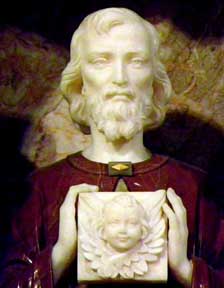
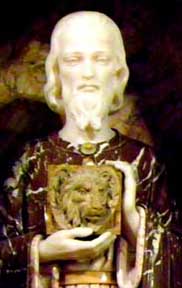
Matthew, Mark,
Luke & John
Iconography in Art and Architecture
Iconography: Study of the symbolic,
often religious, meaning of objects, persons, or events depicted in
works of art
Research
contributions by Gregory L. Witul
Four
Evangelists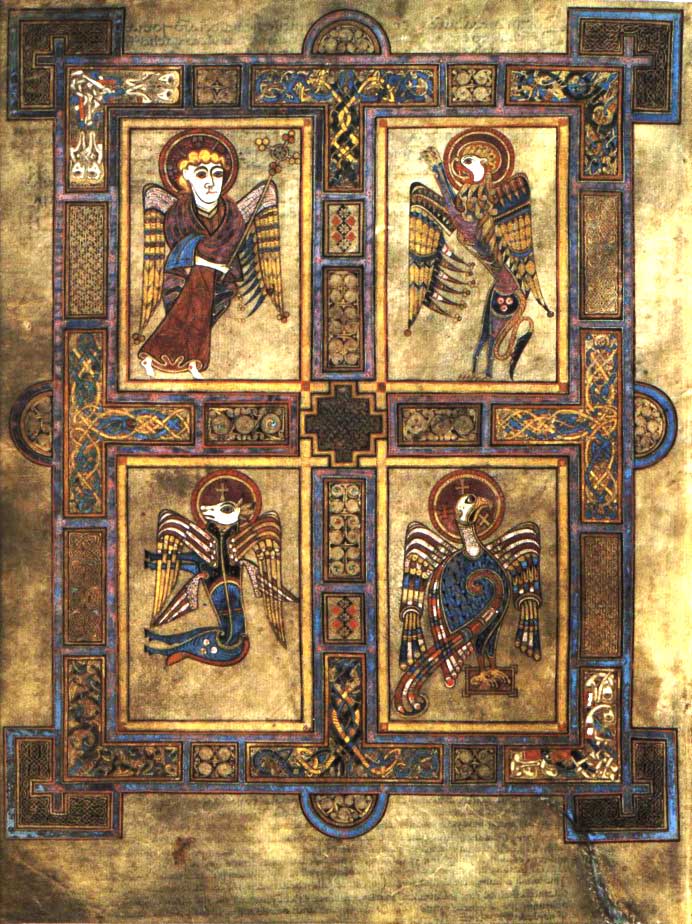 Four Evangelists in the Book of Kells ... Book of Kells Upper left: Matthew (winged man) ... Upper right: Mark (winged lion) ... Lower left: Luke (winged ox) ... Lower right: John (winged eagle) Photo source: Public Domain / Wikimedia Commons |
| The
most-developed of all foursome or fournesses in religious symbolism
in Christianity is the tetramorph of the four evangelists.
It
originated from the Jewish prophet Ezekiel who whilst in exile
in
Babylonia circa 550 BCE used the symbolism of Babylonian astrology for
his own prophetic purposes. Ezekiel describes his vision in which the
likeness of four living creatures came out of the midst of the fire
thus: As for the likeness of their faces, they four had the face of a man, and the face of a lion, on the right side: and they four had the face of an ox on the left side; they four also had the face of an eagle. Ezekiel 1 verse 10. Ezekiel’'s vision is based upon the astrology of the ancient Babylonians in which the constellations of the Zodiac (Greek for circle of animals) signs of Aquarius (the man/angel) Leo the Lion, Taurus the Bull and Scorpio the Eagle are represented. Known astrologically as the Fixed Cross (with the substitution of the scorpion, a creature little known outside the Mediterranean basin was early on replaced by the winged eagle). These four animal figures are also depicted in the early Christian evangelist Saint John’s book of the Apocalypse, the last book of the New Testament , the book of Revelation in which the events of the end times are revealed. Saint John alludes to Ezekiel’s vision thus: "And the first beast was like a lion, and the second beast like a calf, and the third beast had a face as a man, and the fourth beast was like a flying eagle." - Revelation 4 verse 7 - WordIQ (2/2011)
|
On this page:
Matthew
Mark
Luke
John
|
Matthew, painting: Matthew, sculpture:
Matthew, stained glass:
|
|
Mark, stained glass:
Mark, painting: Mark, sculpture:
Mark, metalwork: |
|
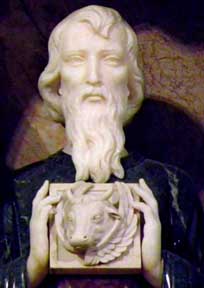
Luke the Evangelist, born of
Greek origin in the city of Antioch, was an early Christian leader who
the Church Fathers such as Jerome and Eusebius said was the author of
the Gospel of Luke and the Acts of the Apostles. 2nd century document: "Luke, a
native of Antioch, by profession a physician. He had become a disciple
of the apostle Paul and later followed Paul until his [Paul's]
martyrdom. Having served the Lord continuously, unmarried and without
children, filled with the Holy Spirit he died at the age of 84 years." Depictions: Ox with wings,
as a reference
to his gospel that
begins with a sacrifice
Luke, metalwork: Luke, sculpture:
Luke, stained glass:
|
|
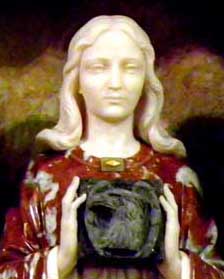
Christian
tradition says that John the Evangelist was one of Christ's original
twelve apostles; he was the only one to live into old age, and not
martyred for his faith. John was the son of Zebedee and Salome, and the
brother of James the Greater. Originally they were fishermen and fished
with their father. See also: Iconography:
Eagle John, metalwork: John,
sculpture:
John, painting:
John,
stained glass:
|