Illustrated Architecture Dictionary................. Illustrated FURNITURE Glossary.................... Greek Revival Style
Corinthian order
 |
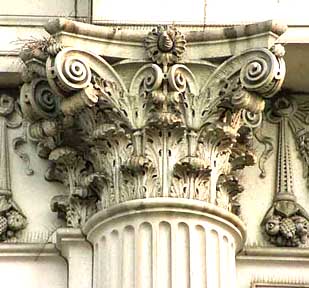 |
| Temple
E, Corinth, Greece |
Buffalo Savings
Bank, M&T Branch |
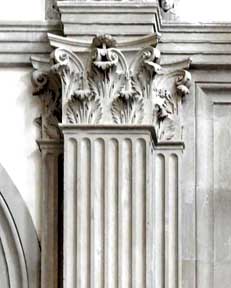 Basilica of San Lorenzo, 1421 Renaissance: The correct use of the Corinthian order for the capitals was new and a testament to architect Filippo Brunelleschi’s studies of ancient Roman architecture. |
|
Palladio's Drawings of the Five Classical
Orders 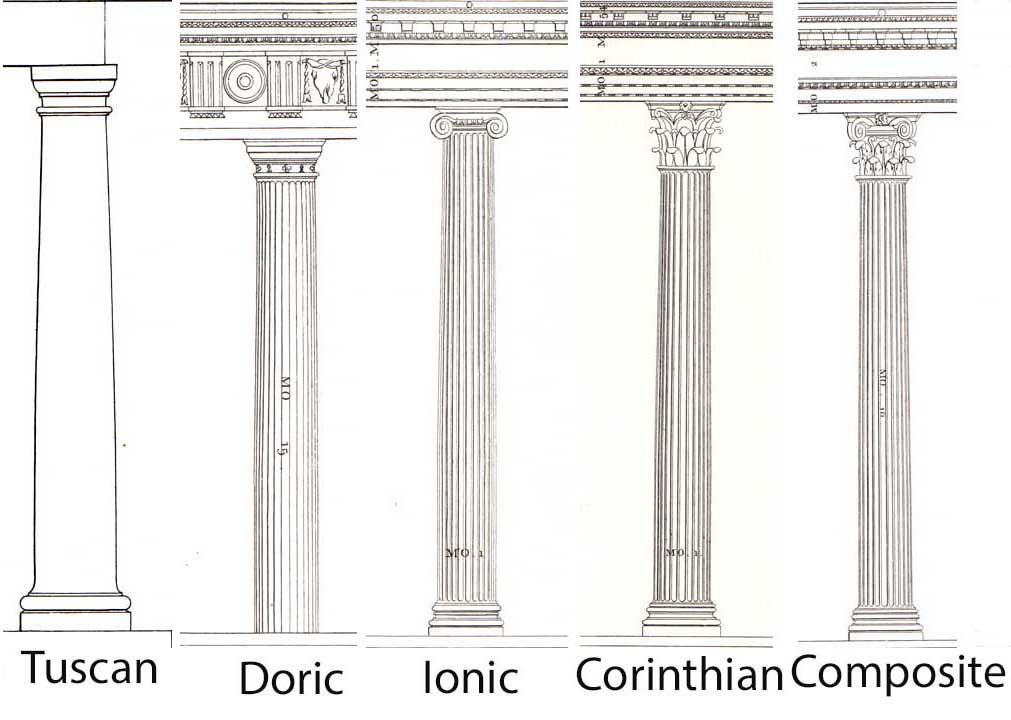 Click on drawing for larger size Source: Andrea Palladio, The Four Books of Architecture, Dover Books |
Palladio:
Corinthian Order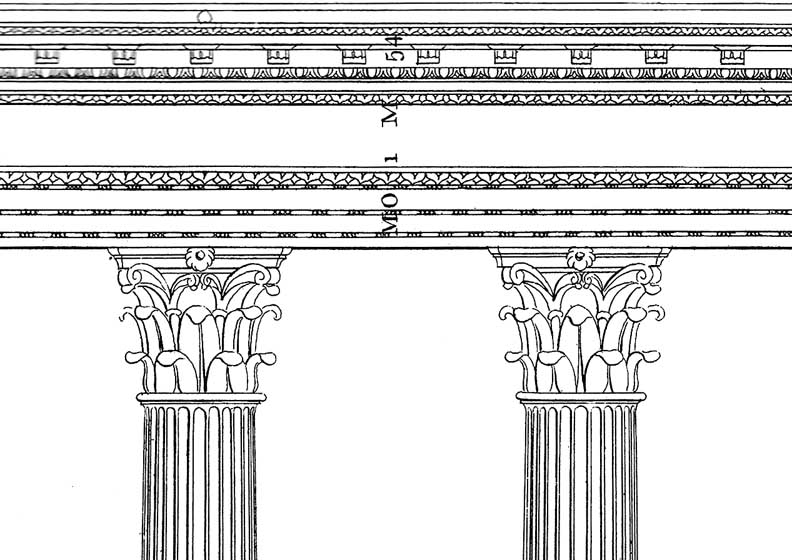 Source: Andrea Palladio, The Four Books of Architecture, Dover Books, illus. XXI |
Palladio:
Corinthian Order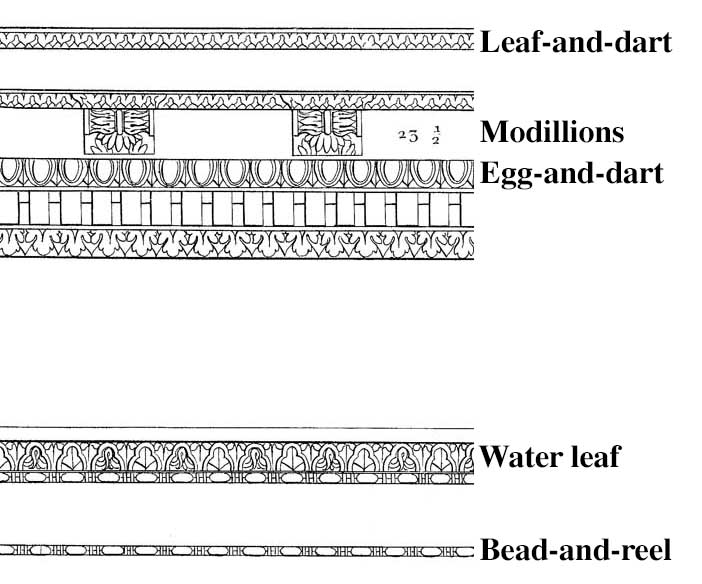 Source: Andrea Palladio, The Four Books of Architecture, Dover Books, illus. XXIV |
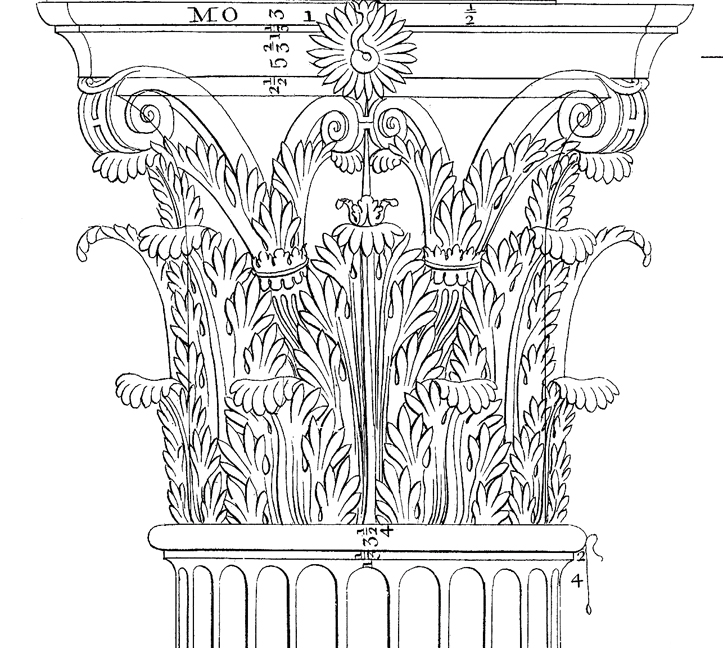 Source: Andrea Palladio, The Four Books of Architecture, Dover Books, illus. XXIV |
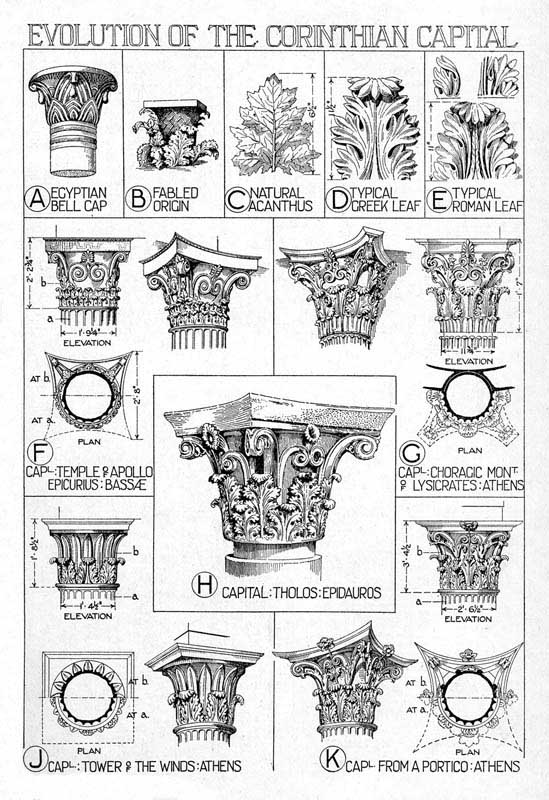 Source: Sir Banister Fletcher, A History of Architecture, 1950, p. 111 |
 Plate VII, Chapter III, Volume I,
Antiquities of Athens, by
Stuart and Revett.
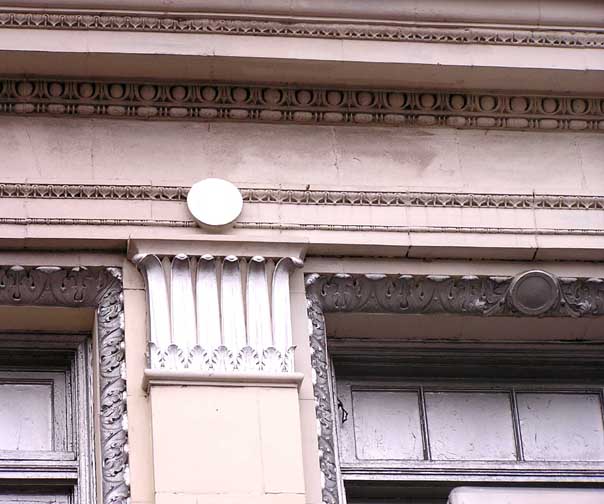
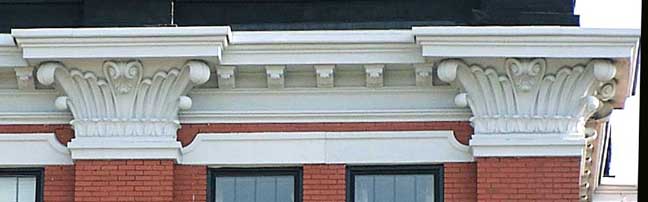
"With its single row
of acanthus leaves surrounding a single row of palm
leaves, the capital is a simplified version of the Greek Corinthian
order, and has become known commonly as the Tower of the Winds order." -
Calder
Loth, Classical Comments:
Tower of the Winds Order (Online Dec. 2012) |
The Corinthian column is almost always fluted... Even the flutes of a Corinthian column may be enriched. They may be filleted, with rods nestled within the hollow flutes, or stop-fluted, with the rods rising a third of the way, to where the entasis begins. The French like to call these chandelles [candles] and sometimes they end them literally with carved wisps of flame, or with bellflowers..
Alternately, beading or chains of husks may take the place of the fillets in the fluting, for Corinthian is the most playful and flexible of the orders. Its atmosphere is rich and festive, with more opportunities for variation than the other orders.
|
Greek Corinthian Order:
The Greek Corinthian order is composed of the following:
Corinthian entablature: Three major parts include cornice, frieze, and architrave.
Corinthian column: The slenderest and most ornate of the three classical Greek columns, including tallest base of the three classical Greek orders
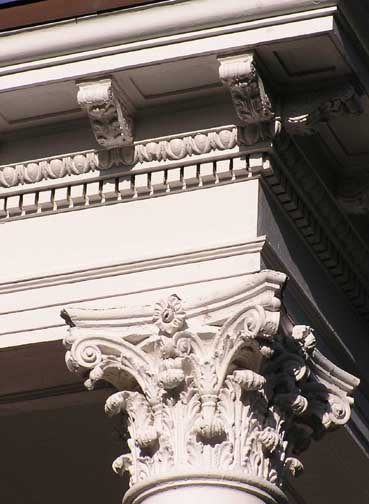
Corinthian capital: Ornate capital decorated with two rows of acanthus leaves, volutes, and a fleuron in the middle of the abacus atop the capital. An early Corinthian capital has only one row of acanthus leaves with an upper row of palm leaves (see illustration below).
Corinthian shaft: Slender fluted shaft (24 flutes)
Engaged column: also employed Orders
Corinthian pilasters: also employed Orders
Roman Corinthian Order: The main difference is that Romans used smooth - as opposed to fluted - shafts. The Romans used the Corinthian order much more than did the Greeks.
In GeneralThe Orders of classical architecture were formalized by the Greeks and applied to the design and proportion of buildings used the post-and-lintel, or column and entablature construction
The Corinthian is commonly regarded as the most elegant of the three orders. The shaft is the most slender of the Greek orders.
The Corinthian order's name is derived from the Greek city of Corinth. However, it is generally thought to have been more developed in Athens.
Vitruvius wrote that the Corinthian order had been invented by Callimachus, an architect and sculptor who was inspired by the sight of a votive basket that had been left on the grave of a young girl. An acanthus plant had grown through the woven basket, mixing its spiny, deeply cut leaves with the weave of the basket. See a fuller account.
Although of Greek origin, the Corinthian order was seldom used in Greek architecture. The other two orders were the Doric and the Ionic (which also features volutes, although proportionately larger).
The Composite Order is similar to the Corinthian, one main difference being the egg-and-dart molding used on the Composite, but absent on the Corinthian.
From the sixteenth century onwards, theorists recognized five orders, including the three Greek order plus the Roman Tuscan and Composite orders.
See also: Vitruvius Pollio on Doric, Ionic and Corinthian Orders (The Greeks were first to declare that architecture was based on the proportions and form of the human body.)
Examples from Buffalo:
- Right illustration above: Buffalo Savings Bank, M&T Branc
- Williams-Butler House
- Photo: 140 Chapin Pkwy (entablature)
- Photo: 144 Windsor Ave. (entablature)
- Buffalo Savings Bank / Goldome / M& T Bank Branch (columns, capital)
- Campanile Apartments (entablature)
- James McNulty Monument (entablature and capital)
- Delaware Court Building (entablature; early form of capital: row of water leaves (type of lotus leaf) above a row of acanthus leaves)
- Silverthorne House (interior entablature)
- General Electric Building / Iskalo Building (interior capitals)
- Williams-Butler House (interior capitals)
- Edward H. Butler Mausoleum (capitals and pilasters)
- 1141 Delaware Avenue (variation)
- 41 Chapin Pkwy (variation; Roman)
- Charles F. Sternberg House / The Mansion on Delaware Avenue (columns)
- Hamlin House
- Market Arcade (capital)
- Buffalo Museum of Science (Tower of the Winds order)
- Delaware Court Building (Tower of the Winds order)
- Grover Cleveland H. S. (Tower of the Winds order)
- Wilcox House (interior)
- Niagara Share Building (interior pilaster)
- St. Anthony's RC Church (pilasters)
Other examples:
- Left illustration above: Temple E, Corinth, Greece
- Temple of the Winds style - Corinth, Greece 4 examples
- St. Stephen Walbrook
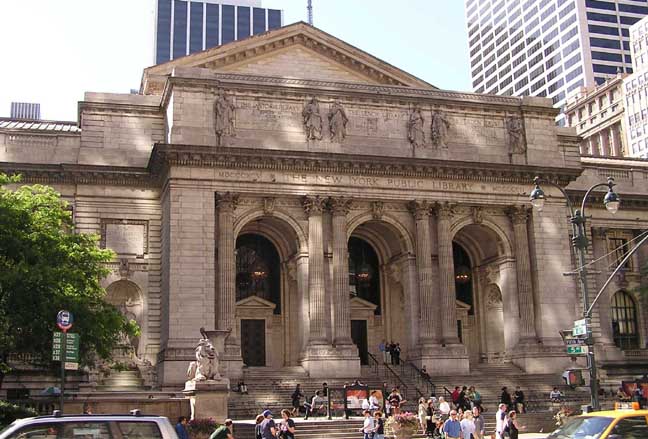
- The New York Public Library, New York City
- University of Virginia, Charlottesville, Virginia (Roman version: not fluted)
- Supreme Court Building, Washington, DC
- 2 Drawings from Andrea Palladio's The Four Books of Architecture (entablature)
- Pantheon, Rome, Italy
- Galleria Vittorio Emanuele II, Milan, Italy
- St. Paul's Cathedral, London, England
- Coliseum, Rome, Italy (engaged column)
- Arch of Constantine, Rome, Italy (entablature)
- Museum, Olympia, Greece (capital)
- Pompeii, Italy (capital)
- Sforza Castle, Milan, Italy (3 capitals)