FURNITURE: Colonnade ................................. Illustrated Architecture Dictionary
Colonnade(d)
col un AID
A series of columns in a straight line carrying an entablature
In Classical architecture, a long sequence of columns joined by their entablature, often freestanding
A row of columns, either surrounding a temple or standing as an independent architectural element
A series of columns placed at regular intervals.
A row of evenly spaced columns, usually supporting a roof or a set of arches.
Peristyle: A colonnade surrounding either the exterior of a building or an open space, e.g., a courtyard.
|
Row of columns generally supporting an entablature, used either as an independent feature (e.g., a covered walkway) or as part of a building (e.g., a portico). The earliest colonnades appear in the temple architecture of ancient Greece. In a basilica [or church], colonnades are used to separate the side aisles from the central space.
|
| In
classical architecture, a colonnade denotes a long
sequence of columns
joined by their entablature, often free-standing, or
part of a building. When in front of a building, screening the door (Latin porta), it is called a portico, when enclosing an open court, a peristyle. A portico may be more than one rank of columns deep, as at the Pantheon in Rome... - Wikipedia
(1/2011)
|
Portico: Colonnade standing before a building, supporting a roof, and serving as a porch
Peristyle: Colonnade surrounding a building or garden.
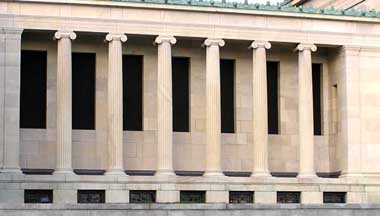
Tetrastyle: Four columns in a row
Hexastyle: Six columns in a row
Octastyle: Eight columns in a row
Decastyle: Ten columns in a rowLoggia: An arcaded or colonnaded porch or gallery attached to a larger structure
Found in classical Greek and Roman architecture and derivatives, including Beaux Arts Classicism, Federal, Georgian Revival, Greek Revival, Neoclassicism, Renaissance Revival, Second Empire
Examples from Buffalo architecture
- Illustration above - Hexastyle: Albright-Knox Art Gallery
- Albright-Knox Art Gallery - Interior Sculpture Court
- Albright-Knox Art Gallery
- Pan-American Exposition Colonnade
- Birge Memorial, Section 23, Forest Lawn Cemetery
- Central Park United Methodist Church
- Tetrastyle - University Presbyterian Church
Other examples: