Illustrated FURNITURE Glossary ............ Illustrated Architecture Dictionary
Windsor Chairs / Settees
Illustrations Beneath Text:
|
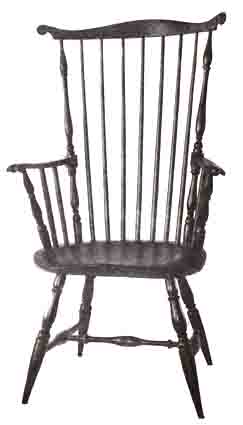
Windsor chairs A Windsor chair is a wood chair whose back and sides consist of multiple thin, turned spindles that are attached to a solid, sculpted seat; its straight legs splay outward and its back reclines slightly. It is not a "high style" piece of furniture, often made by country carpenters. Evidence of hand planing is normally found under the seat of chairs made by hand. Origins The Windsor originated in England early in the 18th century, and was first common around the town of Windsor. The withes and bowed shapes that formed the spindles and back wee turned and cut originally near Windsor, hence the name. They were painted green and used as garden chairs. "Windsor Chairs are believed to
have originated in 18th Century England during the reign of King George
III. Legend has it, the King discovered the chair while foxhunting. He
stumbled upon a cottage during a thunderstorm where he found a plain
chair, known as a "stick chair," that had spindles for its back and
legs. As the story goes, King George ordered his carpenters to
construct these "stick chairs" for Windsor Castle. They soon became
known as Windsor chairs." - Ashlan Chairs (May 2011) One reason for their sturdiness was that parts were made of green wood, which later shrank until the joints were tight. "English Windsor makers used only woods available to them: seats usually were made of elm, turned parts were made of beech, and bent arms were made of ash and yew." - Gummel Chair Works (May 2011) It's certain that the Pilgrims brought Windsor chairs to New England in 1620. In North America, the Windsor chair
form was first used in Philadelphia where the chair became hugely
popular around the time of the Revolution. If the Windsor chair developed in England, its form was perfected in America. The main design difference between the English and American versions is the use of a splat (that middle piece in the back of the chair) in British chairs. Chippendale introduced a pierced splat between the rods of the back. Hepplewhite added a wheel-like feature in the center splat. Colonial craftsmen eliminated the central splat featured in the original chair's back. They also slenderized the splats and legs, and developed, for some models, the 'continuous arm' - that is, the chair arms and back rim are made of a single, bent piece of wood. These alterations simultaneously strengthened the chair while giving it a light, airy appearance. Windsors come in a variety of styles, including armchairs, side chairs, rockers, and writing chairs.
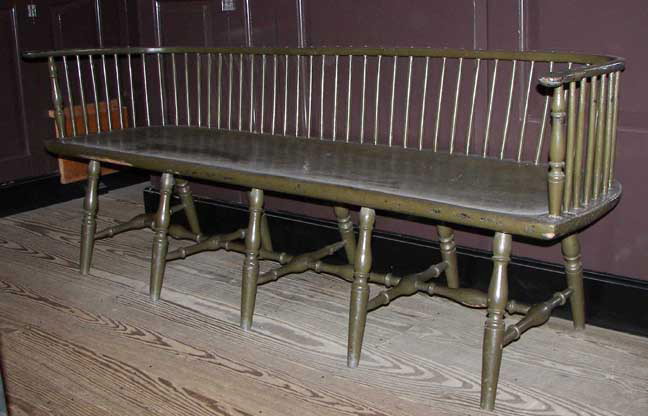
There are even Windsor settees. The spindled backs come in several
heights and shapes too, and Windsors are usually identified by that
feature: "low back," "comb back," and "bow back." "Comb-back chairs were made mostly in Philadelphia; continuous-arm chairs were a New York innovation. Rhode Island Windsors had a short taper at the end of the leg. Connecticut chairs had no “rain gutter”,
the carved decorative groove that follows the back rim of the seat.
Sometimes the use of a particular wood identified the chair with an
area. For example, you could fairly safely bet that any Windsor with a poplar seat came from Pennsylvania." - Gummel Chair Works (May 2011)
Construction Windsors are all-wood chairs with interlocking parts that were delicately turned
or simply cut. Fresh-cut oak, chestnut and hickory, which were flexible and could be turned or steam bent while still green, were used for spindles and bent parts. Legs were turned, set at an angle, and reinforced by turned stretchers. Birch and maple were used for legs. Legs were originally cabriole in shape; later they were made of turnings. Ring-and-vase turnings were typical until about 1800. The larger the turnings, the better the quality. Birch and maple were commonly used for the arm posts. The chair’s handholds often were carved into decorative knuckles. Early chairs made in America usually have stretchers
connecting the front and back legs and a cross stretcher connecting the
two side stretchers, creating what is known as an "H" stretcher
assembly. Birch and maple were commonly used for undercarriage
turnings, including stretchers . Braced backs are
desirable (and more expensive). Bamboo turnings were typical from about 1790-1850. Ears were sometimes scrolled. Since different woods had contrasting colors and grains, the chairs
were usually painted solid green, red, black, yellow, or white; such paint also protected
the wood. After painting, varnish was often applied. Sometimes varnish was mixed
with the paint before application. Chairs with original paint are much more highly
prized (and more expensive). "Most chairs made up to and around 1780 were originally painted green. During the fourth quarter of the eighteenth century to mid nineteenth century chairmakers began to branch out into new colors. During this time period it was the trend to paint them red. During the latter part of the nineteenth century the chairs were commonly painted black. Later, American chairmakers began to paint their chairs in brighter colors—black, red, straw, mustard and gold leaf—and decorated them with pinstripes, pastoral scenes, cornucopia and imitation rosewood grain. Many of these motifs were stenciled onto the chair and embellished with bronze powders, bright hand-painted accents and gilt decoration." - Gummel Chair Works (May 2011) "Patina," an important feature, is basically accumulated dirt. See also: Walter A. Dyer, Early American Craftsmen Digitized 1915 book. Many illustrations. Terminology sometimes quite different. |
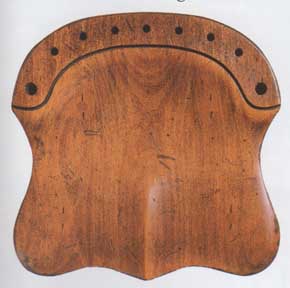
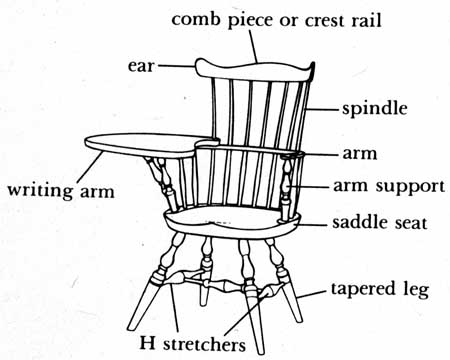 Crest rail ...... Rail ..... Ear ..... Saddle seat ..... Arms ..... Tapered leg ..... H stretcher |
|
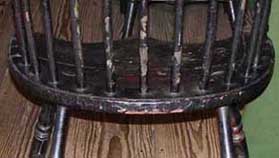 Shield seat 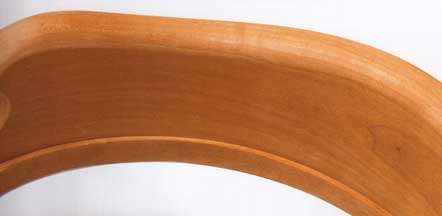 Applied arm on top rail of low-back Windsor. |
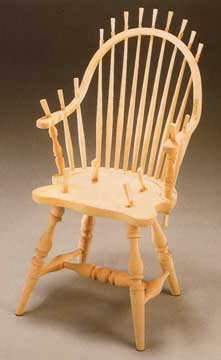 Traditional construction technique "All
legs, arm post, and spindle holes are drilled completely through the
seat and arms. Glue is placed in the hole. The legs, posts and spindles
are then secured in the holes.
"These parts are then split with a chisel and a wooden wedge with glue is driven down into the split to widen the parts in their holes creating a super tight fit. [The excess portion of the wedge is then cut flush with the surface.] "This 18th century assembly method prevents the chair from becoming loose over years of use." - Illustration and text courtesy of Frederick Duckloe & Bros., Inc., Portland, Pa.
|
Low-Back / Captain's chair 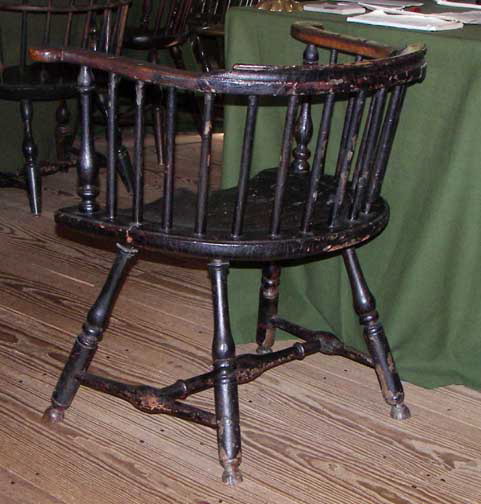 Low-Back / Captain's chair 1750-1800 Basically Pennsylvania or Rhode Island types. ... A flat semicircular top rail set on short spindles and doubling as an armrest. ... A back formed by flattened arms that curve outward at the ends, an applied arm at the rear, and short spindles of the same length. ... Spindles are not ornamentally turned in this example. ... Note applied arm on the top rail. |
|
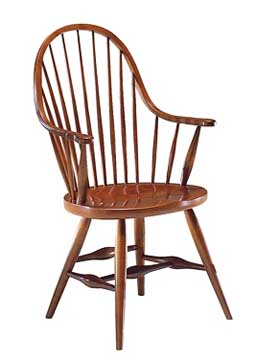
Bow-Back / Loop-Back 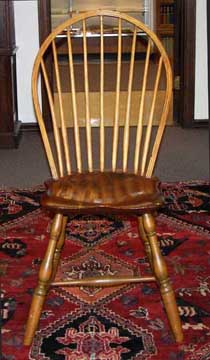 ... ... Bow-back / Loop-Back 1760-1840 Has a back formed by a continuous steam-bent bow that is wedged into the seat. ... On armchairs, the arms are usually mortised through the bow. ... Mortise: A hole or recess cut into a part, designed to receive a corresponding projection (a tenon) on another part so as to join or lock the parts together. ... The greater the bow, the better the quality. ... Saddleback seat "Based on an oriental design, the
bow-back was first made in England and then, in the 1780s, in
Philadelphia. It was an immediate success and quickly became the
Philadelphia chairmaker's most popular product, both locally and for
export. In fact, it was the most numerous of 18th century Windsors,
especially the side-chair, the arm-chair being much less common ...
Bow-backs from Philadelphia characteristically were made with
bamboo-turned legs and stretchers. " - Bob Dillon Windsor Chairs (May 2011).
Loop-Back illustration: Old Editions Book
Shop and Café
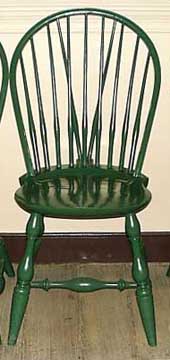 Braced-Back Loop-Back Loop is mortised into the seat; hoop is mortised into arm. ... Mortise: A hole or recess cut into a part, designed to receive a corresponding projection (a tenon) on another part so as to join or lock the parts together. ... Saddleback seat Braced-Back Loop-Back illustration: George Wythe House, Williamsburg, Va. |
|
Sack-Back / Hoop-back Armchair 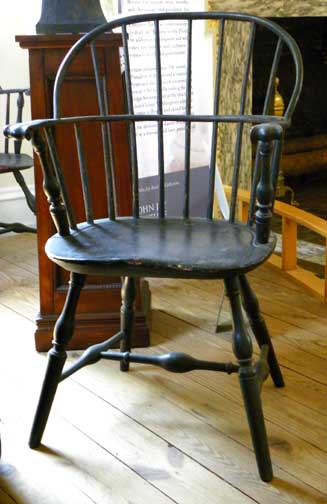 Sack-Back / Hoop-back Armchair 1765-1840 Back divided horizontally into two sections by center rail that also forms arms. ... 7 central spindles mortised into top rail and divided by center rail. ... Mortise: A hole or recess cut into a part, designed to receive a corresponding projection (a tenon) on another part so as to join or lock the parts together. ... The arms are almost always a single piece of steam-bent wood. ... Sack-back Windsors invariably have oval seats. ... Speculation on the name "sack-back": a sack could be tied to the back of the chair to protect the sitter from drafts. ... Variation: Some chairs also have a short comblike extension in the back of three to seven of the central spindles which end in a comb piece.
|
|
|
|
Fan-Back 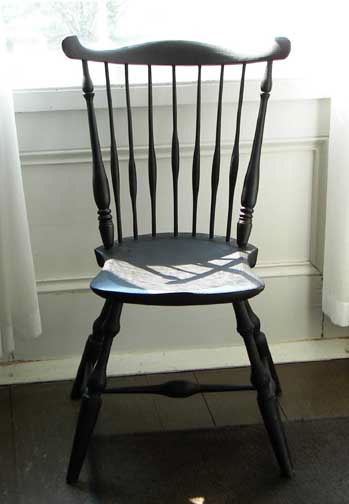 Fan-Back Has a back formed by spindles that fan outward up to a crest rail, or comb piece. ... A side chair with a serpentine top rail like the comb-back, but no dividing arm rail, so that the back consists of long spindles flanked on each side by a heavier turned stile ... Fan-backs are very much like comb-backs, except that comb-backs are in 2 distinct sections. ... Saddleback seat Examples:
|
|
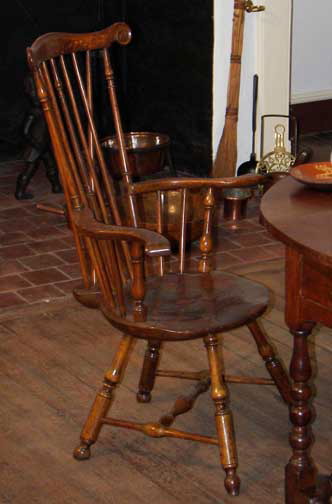
Comb-Back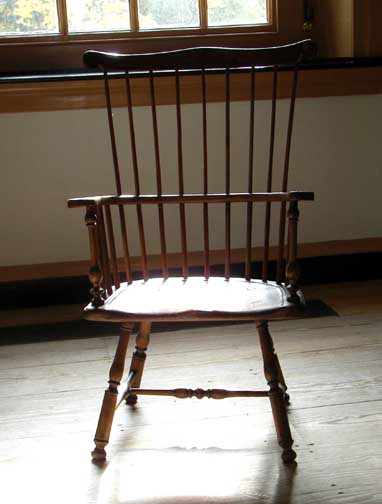 Comb-Back Has a back resembling a comb, which is formed by a continuation of the spindles through the arms, ending in a comb piece. ... The arms may be a single steam-bent piece of wood or they may break in the rear and have an applied arm on top (See the applied back on the low-back chair above. Examples:
|
|
Writing-Arm 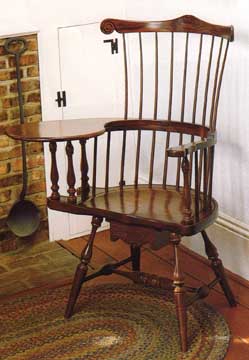 "Chairmakers
created the writing-arm Windsor in about 1770. Chairmakers
started with oversized chairs, and then added a large paddle-shaped
writing surface on the right side. They attached the paddle in one of
three ways: with the writing surface substituted for the regular arm;
with the paddle attached over the original arm; or with the chair and
arm designed and constructed as a writing-arm chair from inception.
They also frequently added small drawers beneath the paddle and the
seat." - Gummel ChairWorks (May 2011)
Illustration: Courtesy of Frederick Duckloe & Bros., Inc., Portland, Pa. |
|
"Birdcage" 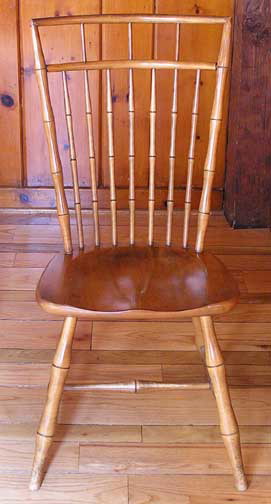 Birdcage "The birdcage side chair developed from the traditional bow-back style
Windsor to included a square back design that incorporated Asian
influenced bamboo style turnings. These popular and comfortable chairs
featured a New York style shield seat, as opposed to the Philadelphia’s
oval seat. The top corners are hand carved just like their 19th century
counterparts to resemble a mitered or 'duckbill' bamboo joint." - Etsy (May 2011)
Examples: |
|
Painted with decorated top rail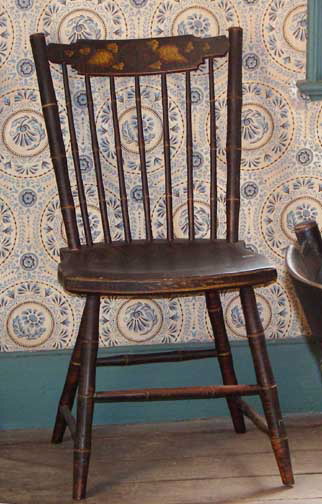 Examples:
|
|
Settee
Examples:
|
Photos and their arrangement © 2005 Chuck LaChiusa