Illustrated Architecture Dictionary
Illustrated Architecture Dictionary
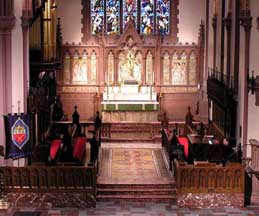
Chancel
CHAN sul
The space around the principal altar of a church for the clergy and choir, often separated by a screen or railing from the body of the churchThe area in a church which traditionally contains the altar.
Etymology: from Latin: "cancellus" = a screen
The words chancel and sanctuary are often synonyms. Protestant churches tend to use "chancel," whereas Catholic churches tend to use "sanctuary."
Chancel aisle - The side aisle of a chancel in a large church; it usually passes around the apse, forming a deambulatory
Chancel arch - An arch which, in many churches, marks the separation of the chancel or sanctuary from the nave or body of the church
Chancel rail - The railing or barrier in place of a chancel screen by which the chancel is separated from the nave.
Chancel screen - Screen dividing the chancel from the naveIconostasis - A screen in Byzantine churches separating the sanctuary from the nave and pierced by three doors, originally a lattice of columns joined by a decorated parapet and coping. Since the 14th-15th c. it has become a wooden or stone wall covered with icons, hence the name.
See also: Church Vocabulary
In churches with a historic floor plan, the chancel is the front part of the church from which the service is conducted, as distinct from the nave, where the congregation sits.
The chancel is usually an elevated platform, usually three steps up from the nave.
In churches with a lecture-hall floor plan, the term sanctuary is often used to mean both chancel and nave because the two are not architecturally distinct.
In the historic floor plan, the words chancel and sanctuary are often synonyms.
- Rev. Ken Collins' Website (online May 2020)
Examples from Buffalo architecture
- Illustration above: St. Paul's Episcopal Cathedral
- St. John's Grace Episcopal Church
- Central Presbyterian Church
- St. Andrew's Episcopal Church
- Parkside Lutheran Church
- Calvary Episcopal Church, WILLIAMSVILLE, NY
Other examples:
- Trinity Church in New York City