Illustrated FURNITURE Glossary... ............. .Modern Style Architecture
Furniture - Modern
Style / International / Mid-Century Modern
| "Modern" vs. "Contemporay" “Modern” refers to a design movement that was popular in the United States from around 1925 to 1975, whereas “Contemporary” is an ever-evolving style that refers to what is popular at the present time. "Although
used interchangeably by many, modern
furniture and contemporary furniture are not the same. While they may
have a lot of similarities in terms of the clean lines and minimalistic
look, they bear striking differences as well.
"Modern-style furniture focuses on simplicity and function. The colors tend to lean on the neutral shade and the materials are often natural like leather, wood, and polished metal. One typical living room furniture set in modern style will be a white leather couch, with an emphasis on lines and geometric shapes. It is clean and clutter-free, streamlined and unadorned. "The contemporary furniture adds more zest and character. Along with leather, metal and wood, glass and stone are now part of the materials commonly used. Pops of color are usually seen on this design style. If modern style loves lines, contemporary styles still uses lines but also loves curves. To give a clearer picture, contemporary living room furniture set can be a more rounded neutral-colored couch with an accent chair in a different color." - LADF (online Feb. 2017) |
| International
Style The modern movement in furniture design began in the late 19th century with the emergence of the Arts and Crafts movement in England and Art Nouveau in France. During the 1920s, two important decorative styles evolved, Bauhaus and Art Deco, which reflect, in part, radical innovations in painting and sculpture. Bauhaus / International Style Bauhaus style derived from the Bauhaus, a school of art and design founded in Germany in 1919. More innovative than Art Deco, Bauhaus design, also known as the International style, focused on new industrial materials, machine production, and severely functional forms totally unrelated to those of the past. The designers were motivated by a desire to create furnishings that were functional and made of materials used in modern architecture and that could be mass-produced while remaining attractive and comfortable. The movement was concerned not only with design but also with materials. It recognized that mass production was most suited to industrial products such as chrome, steel, plastic, and glass. Slim lines, a bold streamlined look, and a highly functional character typify modern furniture. America Many of the Bauhaus's finest designers, including Marcel Breuer and Ludwig Mies van der Rohe, emigrated to America when the rise of Hitler closed the Bauhaus, and after 1940 the U. S. became the center for this movement. Because the innovations of Bauhaus design have become virtually synonymous with modern design, furniture in this style is commonly called"modern." The tubular-steel chair with cantilevered seat became a symbol of the modern age, and was much imitated by American manufacturers. The modern style remains the dominant theme in interior design even today, although the movement has undergone various modifications over the years. Wood, largely repudiated in the 1930s, is once more popular, spurred on by new designs and the sophisticated use of lamination. The introduction after World War II of new plastics and molding techniques has resulted in a generation of molded plastic furnishings. Epitomizing this approach were Charles Eames's revolutionary plywood or plastic chairs, molded to the shape of the human body. Finally, while the earliest designers in the modern vein were concerned with mass-produced works, craftsmen after World War II have turned again to handmade, highly individualistic pieces. Produced in small quantities, these are already attracting collectors' attention. |
|
Mid-century Modern describes an era of style and design that began roughly in the mid-1940s and continued into the mid-1960s. It is an organic offshoot of Modern design that’s often associated with the casual furnishings and carefree look of Eichler tract homes in suburban California during the 1950s. In addition, the Mid-century Modern era is noted for the mass-production of household objects, from furniture to clocks to lamps to radios, because many of its chief designers (Charles and Ray Eames foremost among them) made it a requirement that their work be affordable to the average homeowner rather than the wealthy elite. The United States, Britain, Japan, and Scandinavia were centers for the Mid Century Modern aesthetic. In the U.S., Herman Miller produced plywood, fiberglass, and wire-mesh chairs for Charles and Ray Eames (the metal chairs with covers designed by Alexander Girard are highly collectible), as well as the famous Marshmallow sofas for George Nelson. Knoll made insect-like wire chairs for Harry Bertoia and cool, white-and-red fiberglass-and-aluminum Tulip chairs for Eero Saarinen. In England, Ernest Race produced handsome sideboards and economical folding deck chairs in the Mid-century Modern style. Fellow Brit Robin Day Japanese designer and sculptor Isamu Noguchi, a giant of Mid-century Modern, designed for both Knoll and Herman Miller. His three-piece wood and glass table from 1948 has been a mainstay of the Miller catalog for more than half a century, while the bases on his tables for Knoll used metal rods in a way that was very similar to some of the Eames’s chairs. Japanese-American George Nakashima, who was interred during World War II, designed for Knoll but also brought a woodworker’s sensibility to his furniture, often using the natural and even deformed shapes of his raw materials to lead him. And then there were the Scandinavians. Børge Mogensen designed chairs of elegant simplicity that harmonized form with functionality, while his Sleigh Chair was as whimsical as its name suggests. Arne Jacobsen’s Swan chair held its users in a palm-like embrace. Finn Juhl took a more sculptural approach for his wood-frame seats — even a Juhl coffee table looks like a work of art. As for Hans Wegner, he made a chair that was so highly regarded it was used by Nixon and Kennedy in a 1960 presidential debate and has since become known simply as The Chair. Furniture was not the only product of note to come out of the Mid-century Modern movement. For some reason, clocks, especially wall clocks, became a design force to be reckoned with. When George Nelson wasn’t designing furniture for Herman Miller, he was working with the Howard Miller Clock Co. on a series of marvelous modern wall clocks. He made clocks whose hands pointed to colored balls on the ends of slender shafts; clocks that resembled sunbursts, sunflowers, and asterisks; and even a clock that suggested a human eye. Nelson and Miller were also responsible for the Bubble Lamps, which were made of steel and translucent plastic and were designed to hang from the ceilings of Mid-century Modern homes, either as individual globes, ellipses, and cylinders or in clusters. Other lamps popular during this period, and produced by a wide range of designers and manufacturers, were the pole-tension lamps that lit up corners of livings rooms and the "atomic" boomerang lamp shades designed for table lamps. Nothing escaped Mid-century Modern, from transistor radios to lava lamps, which had yet to be associated with the psychedelic 1960s still a few years a way. It was perhaps the last time that design drove the look and feel of popular culture. Soon, the roles would be irrevocably reversed. worked with Hille Ltd. to create everything from convertible beds to tables and chairs. He is also credited with designing the first polypropylene stacking chair. |
| Excerpt The Abrams Guide to Period Styles for Interiors: Midcentury Modern By Judith Gurp Harry N. Abrams, Inc., 2005, p. 314  |
| Art Deco vs. Mid-Century
Modern Art Deco
In architecture and interiors, Art Deco emphasizes ornamentation for the sake of ornamentation and repetition within the designs. Typical details include repeating geometric shapes, symmetry, block-like structures juxtaposed with rounded corners, parquet floors, zig-zags, and emphasis on entrances. Both the Chrysler building and Empire State building are iconic symbols of the design style. Mid-Century Modern Mid-Century Modern design departs from the excess ornamentation of Art Deco with a movement towards clean lines, simple designs, and a lack of details resulting from the idea that function should dictate form. Design icons such as Frank Lloyd Wright, Charles and Ray Eames, Herman Miller were pioneers of the movement. Mid-Century Modern interiors tend to be open concept. Every design element has a purpose. Designers often use neutral colors, a mix of man-made materials such as plastic or metal and natural, organic materials such as teak and walnut woods. Split-level homes, large floor to ceiling windows, and integrating design with nature and natural surroundings are all elements of Mid-Century Modern design too. - RiverbendHome (online Feb. 2017) |
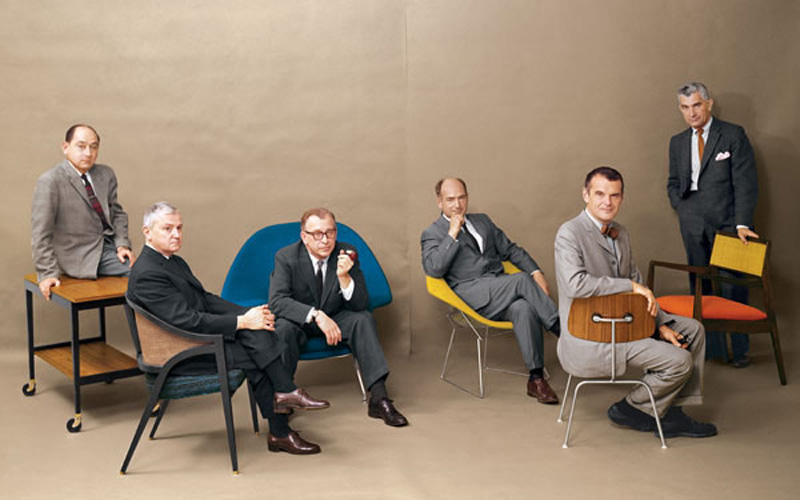
L to R George Nelson, Edward Wormley, Eero Saarinen, Harry Bertoia, Charles Eames, Jens Risom - Playboy 1961
Source: Edward Wormley (online Feb. 2017)
Examples :
Alvar Aalto
Armchair
Montreal Museum of Fine Arts 1932
Milo Baughman
Dining table
Two armchairs
CooCooU27
CooCooU27
1970s
Luigi Blau
Chair Hofmobiliendepot Imperial Furniture Collection, Vienna, Austria 1980 Marcel Breuer
Cesca armchair
Wassily Chair
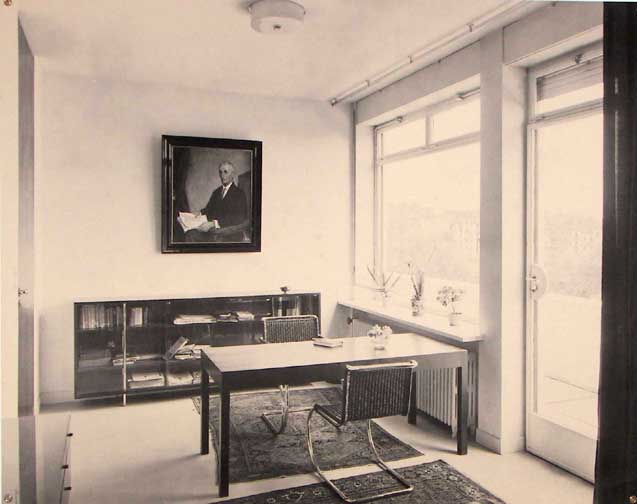
Tubular Steel desk
Montreal Museum of Fine Arts
Private collection
CooCooU27
1928
1927
1930s
Charles and Ray Eames
Lounge chair
Private collection 1956
Arne Jacobsen
Egg armchair
Egg armchair
Montreal Museum of Fine Arts
HWI
1958
1958
Florence Knoll
Credenza
Table
CooCooU27
CooCooU27
1950
Finn Juhl Love seat
CooCooU27 1932
Charles Rennie Mackintosh
Armchair
Montreal Museum of Fine Arts 1899
George Nelson Assoc.
Marshmallow Sofa Montreal Museum of Fine Arts 1955 Marcel Parizeau
Dressing table and chair
Montreal Museum of Fine Arts 1937
Walter Pichler
Galaxy Hofmobiliendepot Imperial Furniture Collection, Vienna, Austria 1966 Warren Platner
Coffee table
Private collection 1966
Harvey Probber
Executive Desk CooCooU27 1950s
Roland Rainier
Stackable chair
Hofmobiliendepot Imperial Furniture Collection, Vienna, Austria 1953
Gerrit Thomas Rietveld
Red-Blue Armchair
Montreal Museum of Fine Arts 1918
Gilbert Rohde
Burl wood credenza CooCooU27 1940s
Jens Risom
Desk
CooCooU27
Johannes Spalt Armchair Hofmobiliendepot Imperial Furniture Collection, Vienna, Austria 1963
Mies van der Rohe
Barcelona benches, chairs
Barcelona chairs
Tugendhat Brno chair
Barcleona Pavilion, Barcelona, Spain
M&T Bank
IBM Building, Seattle
Photo: Hofmobiliendepot Imperial Furniture Collection, Vienna, Austria1929
1929
1930
Kem Weber
Lounge Chair
Montreal Museum of Fine Arts
1934
Edward Wormley
Button-Tufted "Party Sofa"
"Sheaf of Wheat" Side Table
CooCooU27
CooCooU27
1956
c.1960
Frank Lloyd Wright
Misc.
Misc.
Misc.
Misc.
Misc.
Misc.
Darwin D. Martin House
Darwin D. Martin House
Darwin D. Martin House
Darwin D. Martin House
Musée d'Orsay, Paris, France
Unity Temple, Chicago, IL
.
.
.
.
.
Frank Lloyd Wright Oak Park Spindle Box chair
Oak Park Spindle Love Seat
Dana Thomas Occasional chairs
Boynton Compound Curve Side Chair
Boynton Hall Table
Dana-Thomas Plant Stand
Dana-Thomas dining room furniture
Dana-Thomas dining room oak buffet
Misc. Japanese school furniture
Barton House
Barton House
Barton House
Barton House
Barton House
Barton House
Barton House
Barton House
Jiyugakuen Myonichikan School, Tokyo, Japan
.
.
1902
1908
1908
1902
1902
1902
1921
Eliel Saarinen, Eero Saarinen, Charles Eames
Kleinhans Music Hall upholstered hall chair
Kleinhans Music Hall vanity chair
Kleinhans Music Hall vanity bench
Kleinhans Music Hall upholstered armchair
Kleinhans Music Hall upholstered lounge bench
Kleinhans Music Hall Mary Seaton Room armchair
Kleinhans Music Hall
Kleinhans Music Hall
Kleinhans Music Hall
Kleinhans Music Hall
Kleinhans Music Hall
CooCooU27
1940
1940
1940
1940
1940
1940
See also:
- 21st Century style - Paul Volther, Corona Chair - Albright -Knox Art Gallery
- 21st Century style - Verner Panton, Peacock Chair - Albright -Knox Art Gallery
- Contemporary style - Franz West, Chair for documenta X - Hofmobiliendepot Imperial Furniture Collection, Vienna, Austria
- Contemporary style - Frank Gehry, High Sticking Chair - Montreal Museum of Fine Arts
- Six chairs - Maiman House
Photos and their arrangement © 2005 Chuck LaChiusa
| ...Home Page ...| ..Buffalo Architecture Index...| ..Buffalo History Index... .|....E-Mail ...| ..