City Hall - Table of Contents
East and west friezes
- City Hall
Buffalo, NY
|
Built: |
1929-1931 |
|
Frieze designer: |
John Wade |
|
Sculptor: |
Albert T. Stewart |
|
Chief Stonecutter: |
Joseph Graf |
|
Building material: |
Ohio sandstone |
|
Style: |
Art Deco bas-relief |
Frieze: 1. The middle section of the Classic entablature, located above the architrave and below the cornice; a panel below the upper molding or cornice of a wall; 2. Any sculptured or richly ornamented band in a building
|
Excerpt
By John H. Conlin The central figure is an adaptation of a Sibyl of Michelangelo's Sistine Chapel ceiling. The ancient Sibyls were recorders and foreseerers of events. [Sculptor Albert T.] Stewart collaborated with Architect Wade to insure "that the rhythms and composition of the panel would harmonize precisely with the rhythms and composition of the massive architecture of the building itself." Wade had designed a complete frieze with Native Americans on the left and settlers on the right of a sibyl He discarded it because it did not fit the proportions of the building. Here placed the generic subjects with ordinary people of the city, "something of Buffalo." It was hoped that the use of sculpture in conjunction with this building would influence the use of sculpture in other buildings. Stewart was the sculptor of the rear frieze and of four large figures in the center of the main lobby. His work may also be found on buildings at Amherst and Williams Colleges, and at the Metropolitan Museum of Art and the American Museum of Natural History in New York City. |
East:
Front frieze on Niagara Square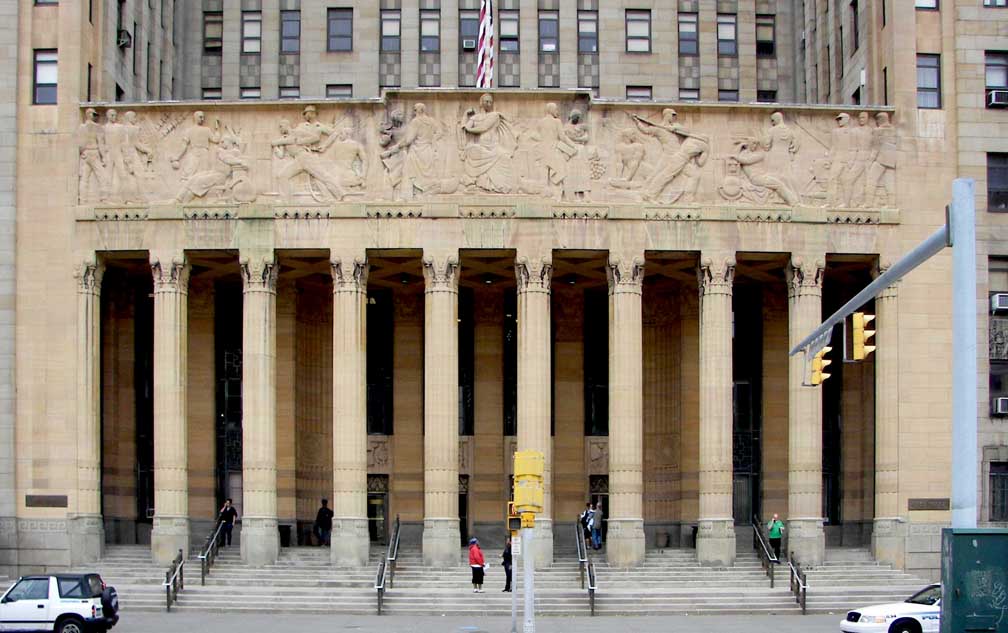 East frieze on Niagara Square ... Colonnade ... Details, from left to right: 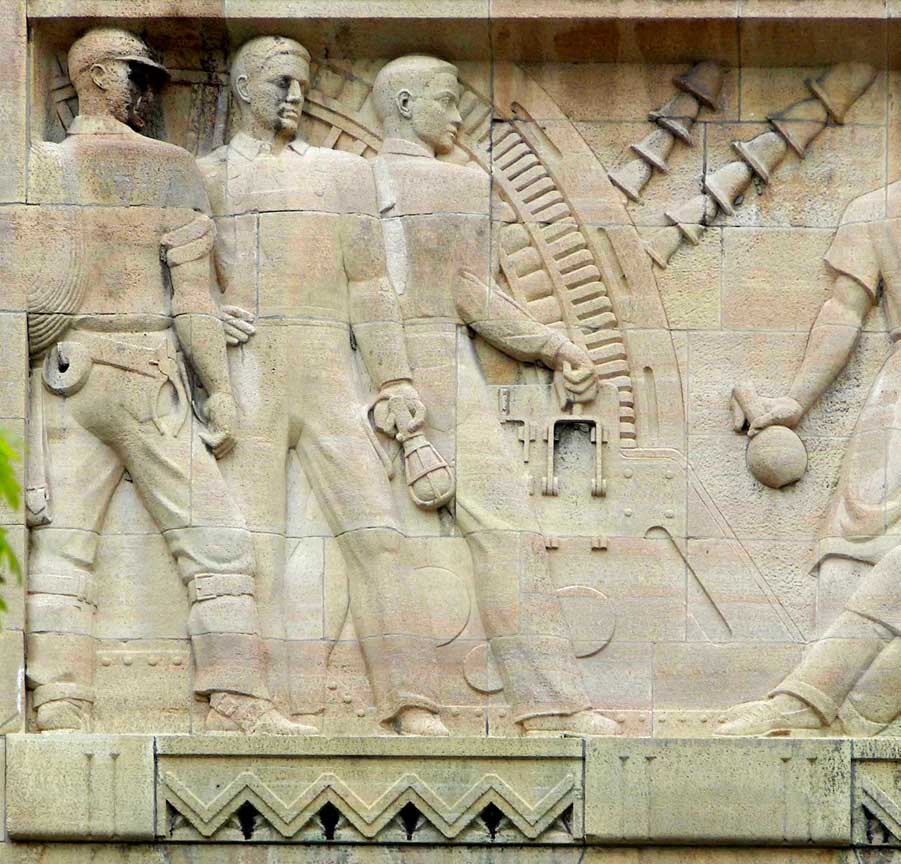 Placed about a dynamo are three figures suggesting Electricity and its subsidiaries ... Chevrons 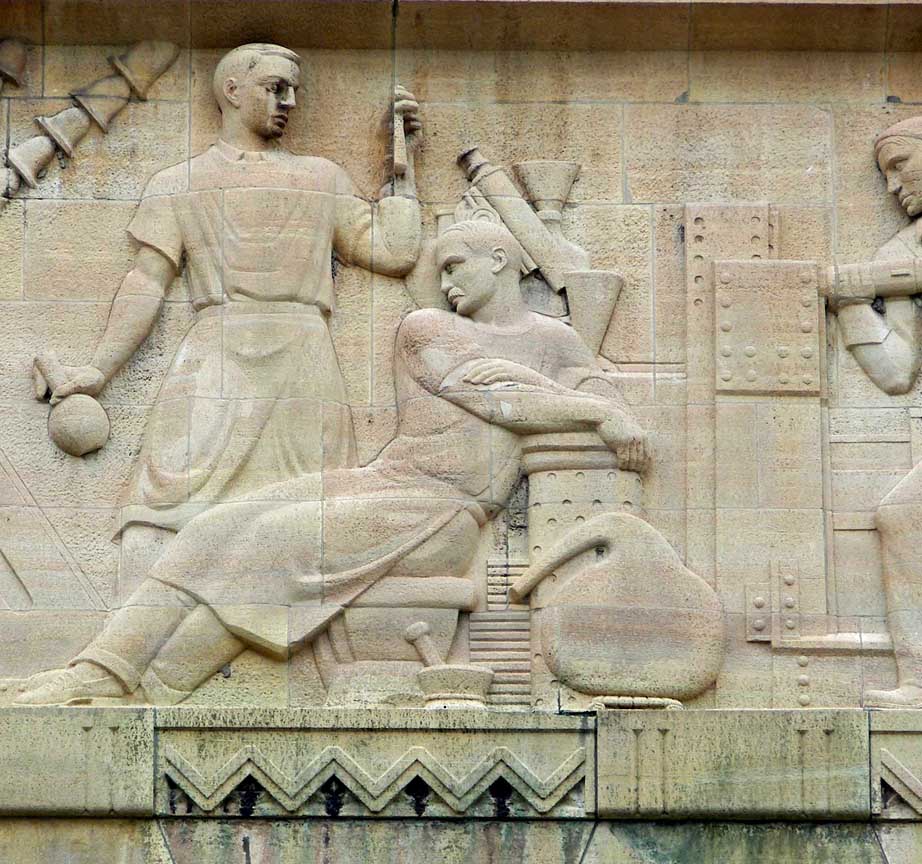 Chemistry and Healing 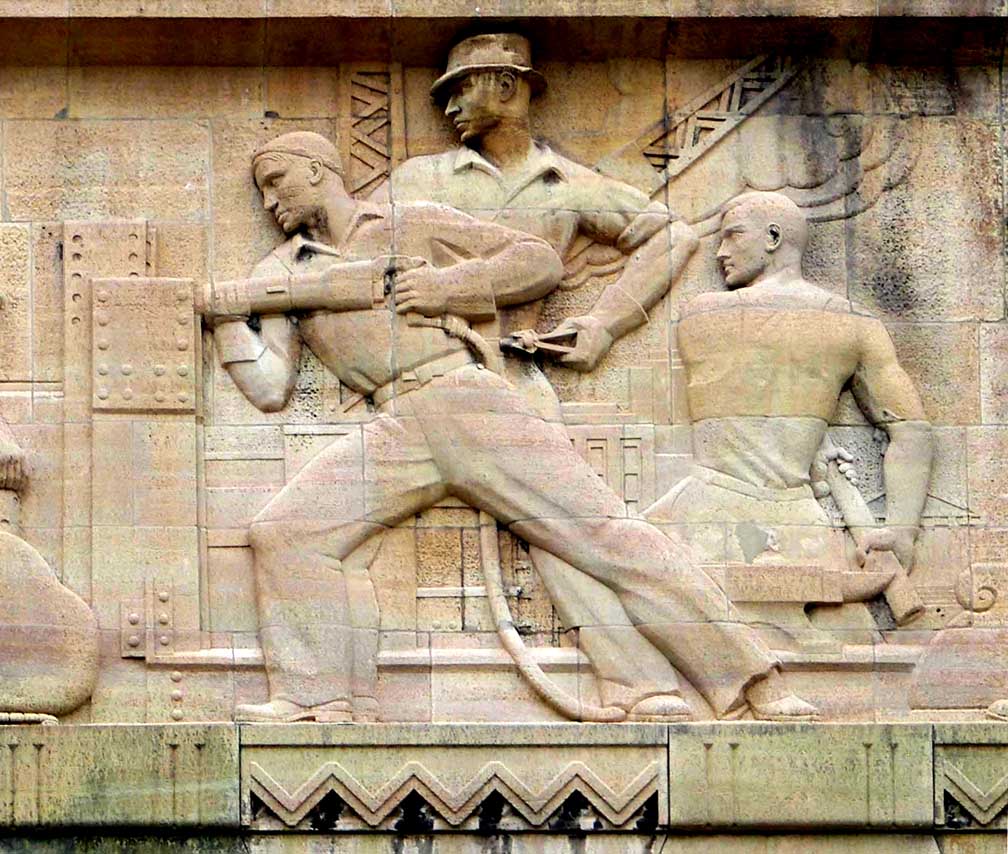 Building and Growth of the City: men riveting bolts into steel beams 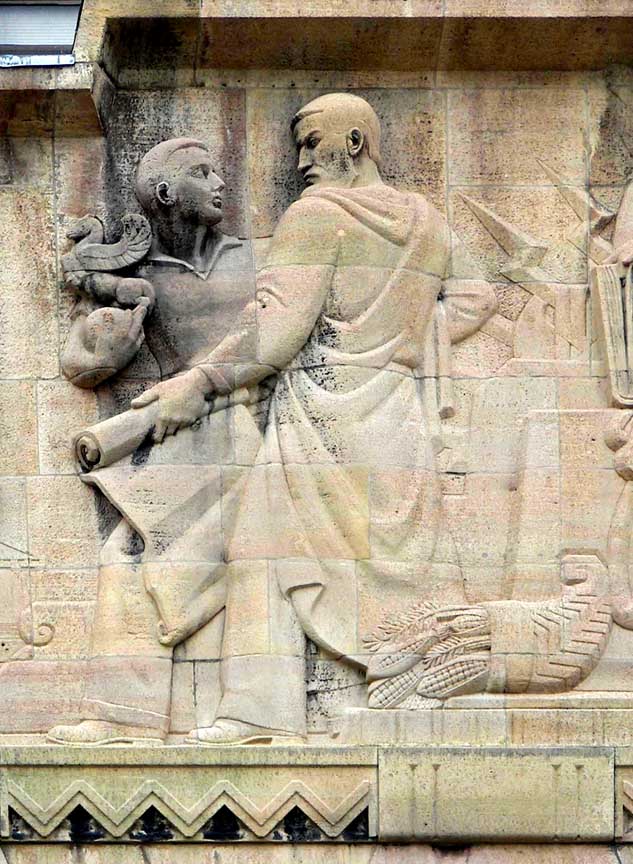 Sculptor Albert T. Stewart: "Architecture and Poetry, with Age giving counsel to Youth." 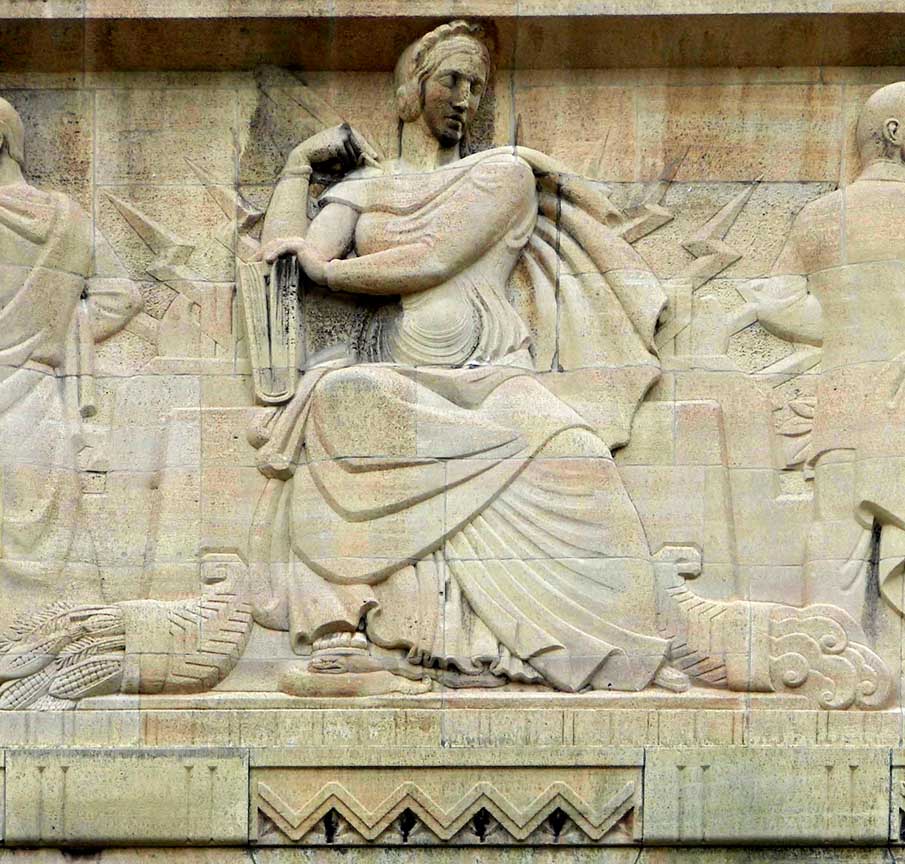 "The central figure is an adaptation of a Sibyl of Michelangelo's Sistine Chapel ceiling. The ancient Sibyls were recorders and foreseerers of events." - John Conlin ... Book represents Bufalo centennial history 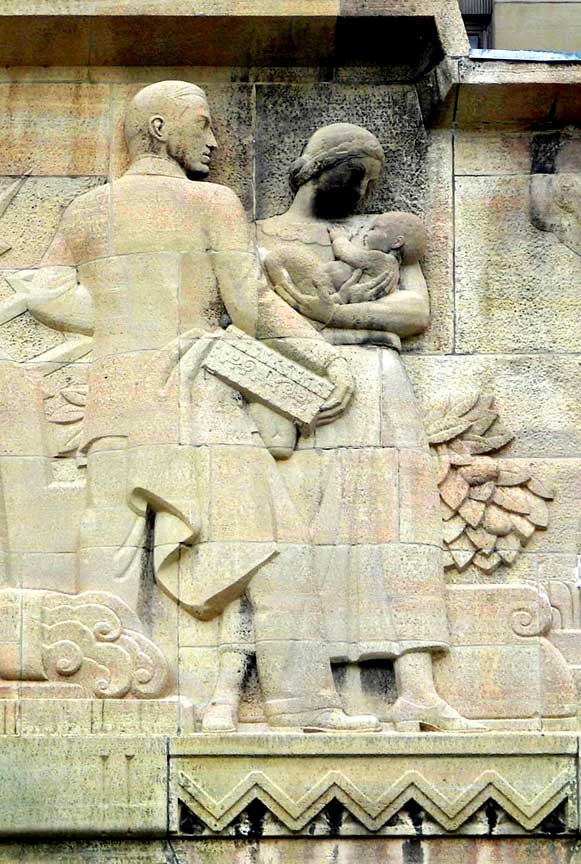 Sculptor Albert T. Stewart: "The family as a social unit, the man carrying the strongbox representing Thrift, the woman and child depicting Motherhood." 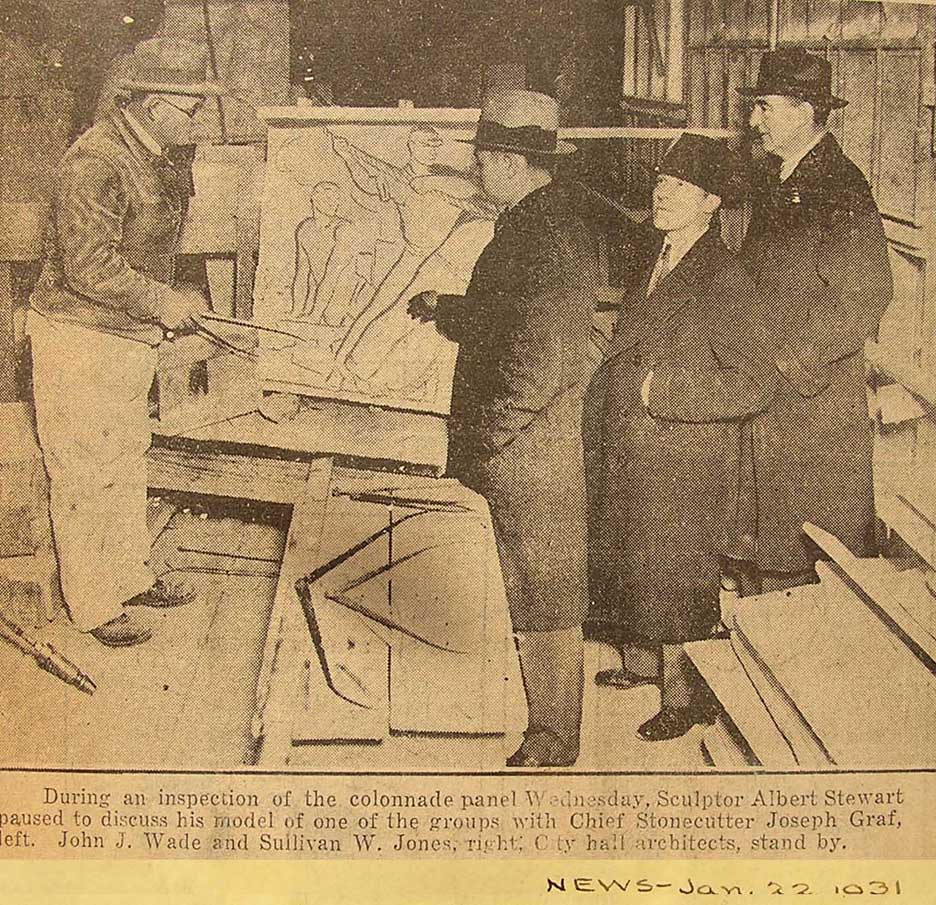 Chief Stonecutter Joseph Graf, Sculptor Albert Stewart and Architects John J. Wade and Sullivan W. Jones 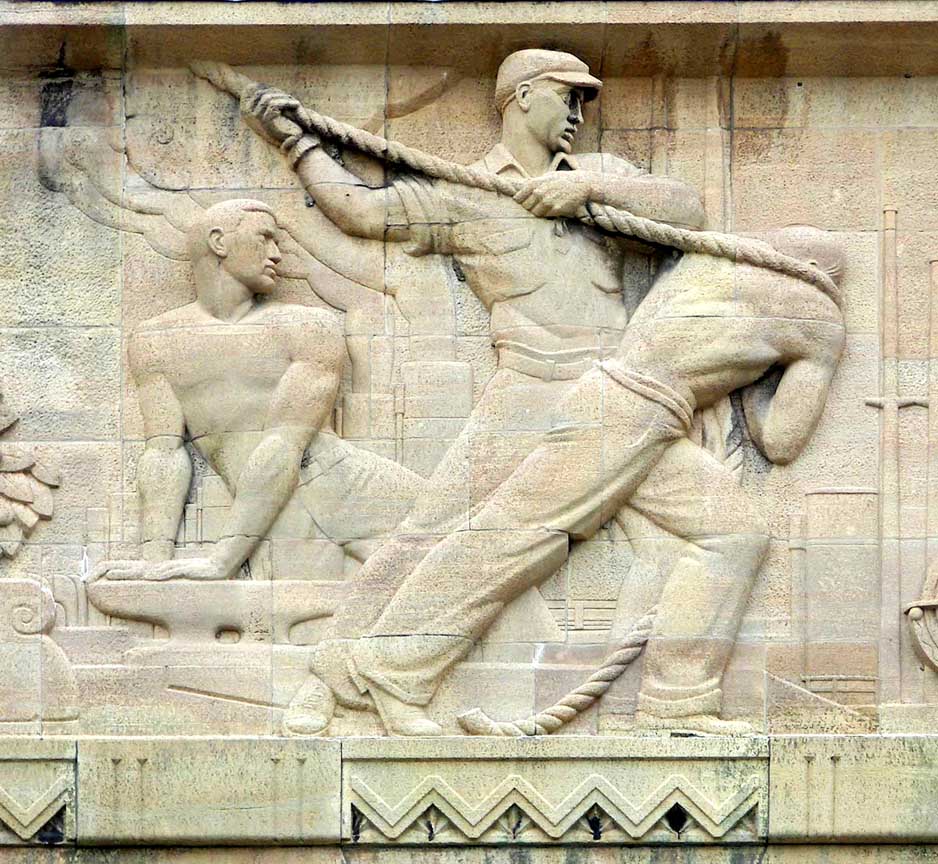 Water commerce 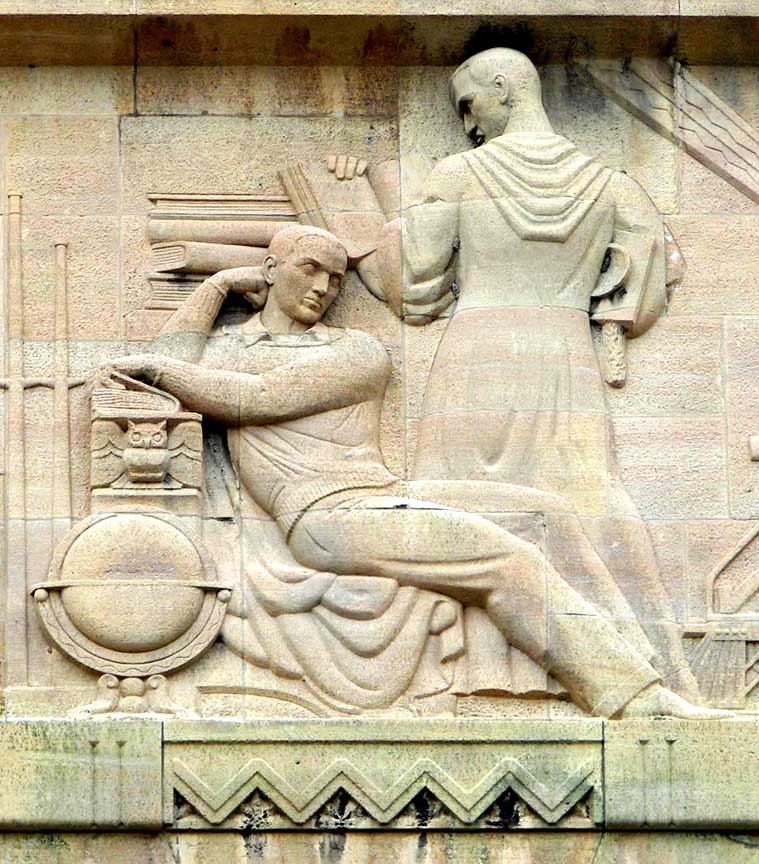 Education and Culture ... Owl 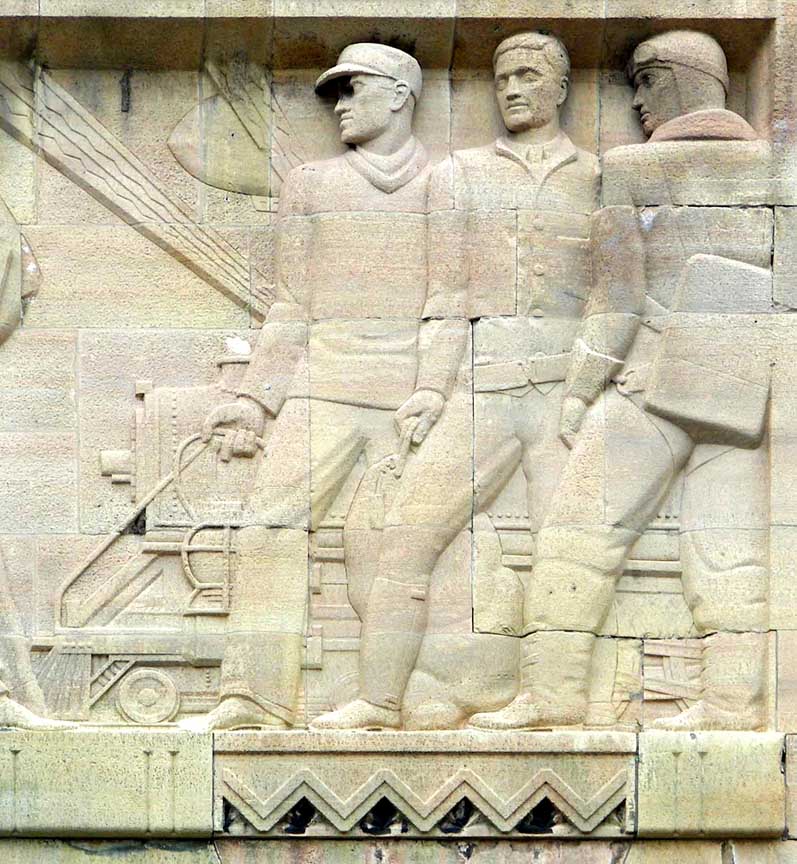 Modern transportation by rail, by water, and by air ... Note plane at top, train ... train engineer, ship crewman, pilot |
West:
Back frieze on
Elmwood Avenue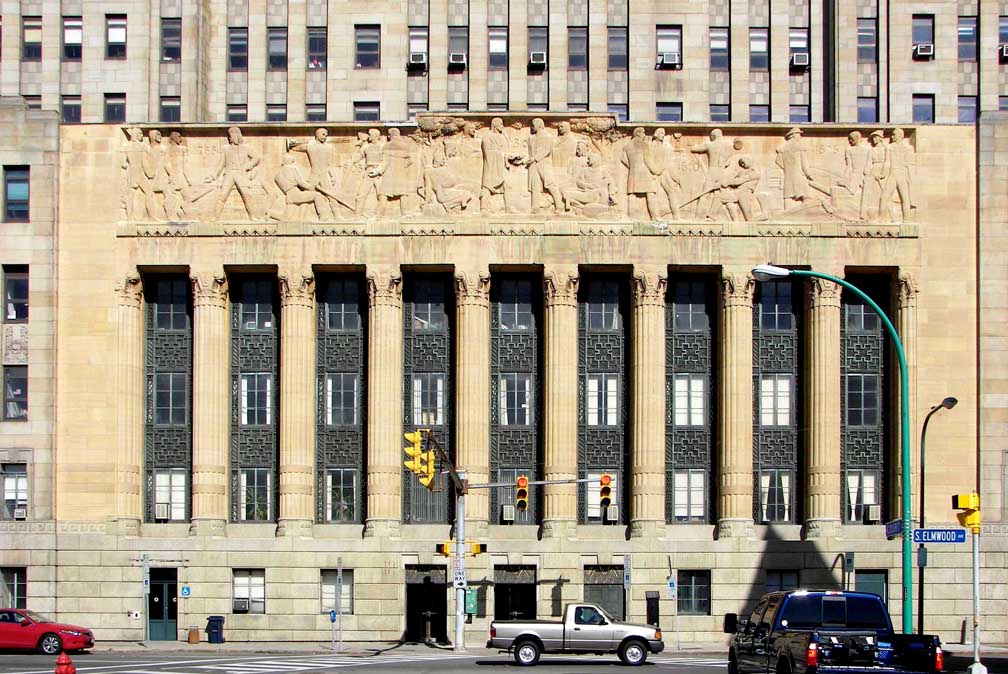 "The sculpted stone frieze at the rear of the building is of the same colossal dimensions as the one over the front portico. Similar columns support the frieze, and also serve as window divisions. Albert Stewart's frieze portrays five scenes from the early history of Buffalo in a chronological sequence, from left to right."- Buffalo City Hall: American Masterpiece, by John H. Conlin,1993 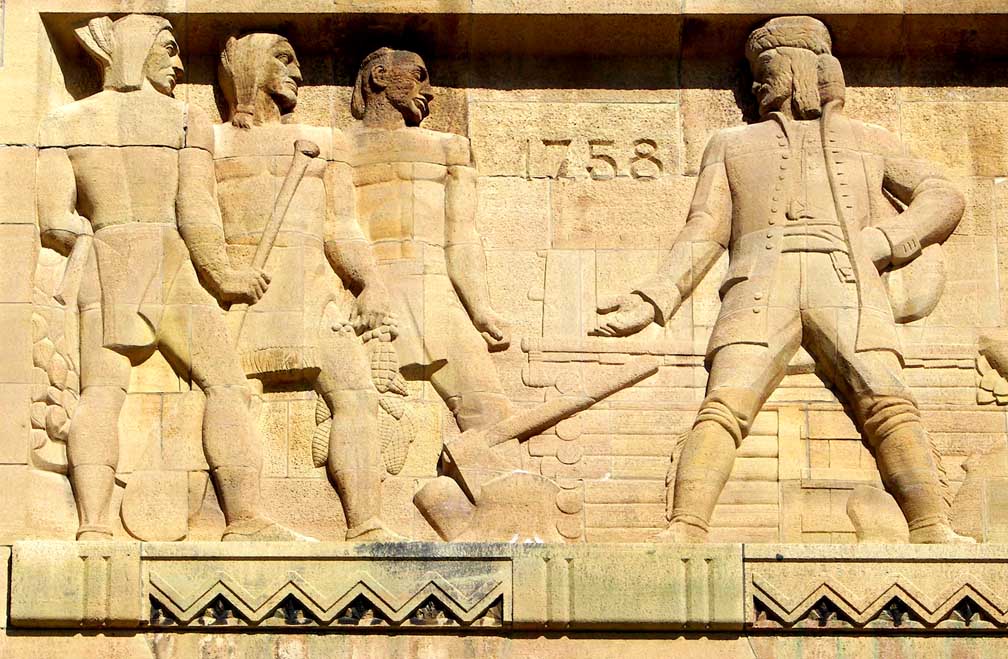 "At the left, a man in the garb of a French Canadian trader has left an axe in the stump of a tree while he addresses three Native Americans. Behind him is a partially completed building. The date, 1758, represents the first non-Native American construction on the site of Buffalo. Daniel Chabert Joncaire in that year built a house, barn, stable, and blacksmith shop near the mouth of the Buffalo River, Rivier des Boeufs." - Buffalo City Hall: American Masterpiece, by John H. Conlin, 1993. 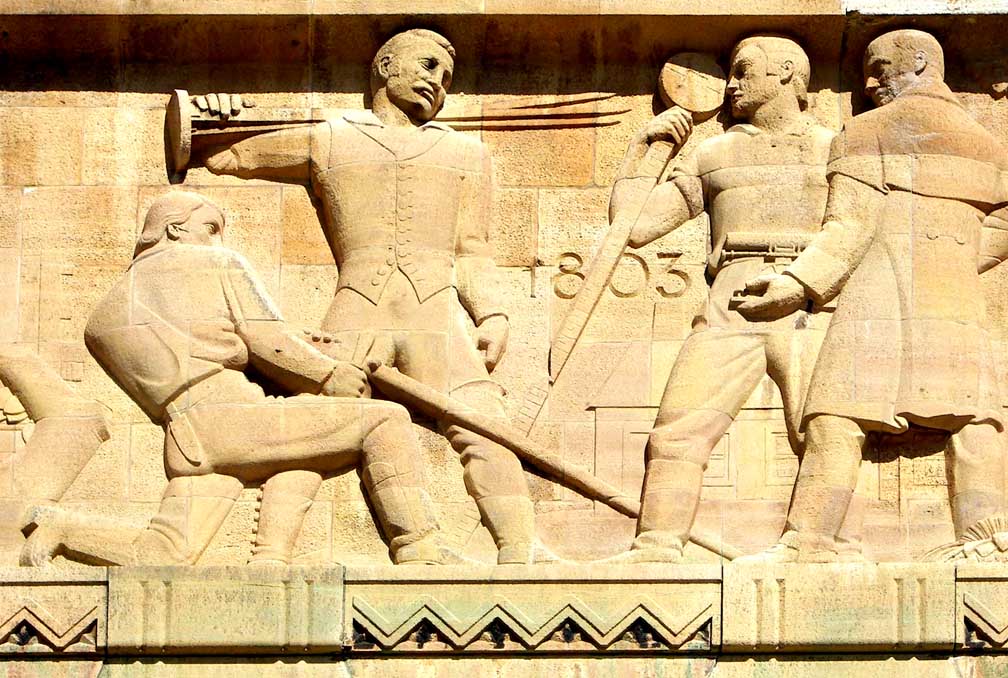 The next group, dated 1803, represents Joseph Ellicott giving instructions to the Holland Land Company surveying team. They are about to lay out the Ellicott plan for the village of New Amsterdam, as Buffalo was then named by Ellicott. - Buffalo City Hall: American Masterpiece, by John H. Conlin, 1993. 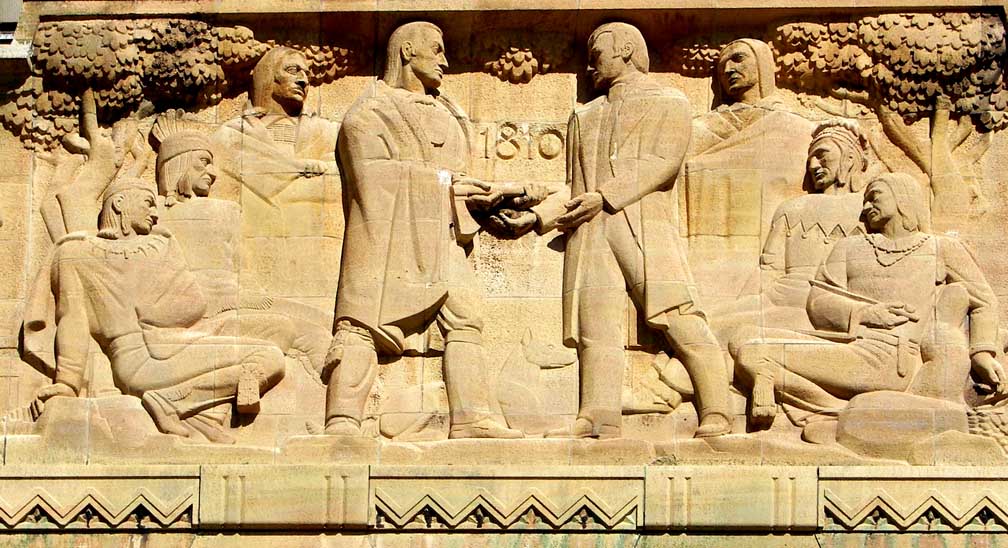 "The central group depicts a scene which took place in an oak grove on Scajaquada Creek, now within Forest Lawn Cemetery, when representatives of the Iroquois people met in council. The Seneca orator, Red Jacket, is presenting a ceremonial tomahawk to NativeAmerican Agent Erastus Granger. The actual tomahawk presented in 1810 is in the collection of the Buffalo and Erie County Historical Society. The scene represents the peaceful relationship betweenBuffalo and the Senecas." - Buffalo City Hall: American Masterpiece, by John H. Conlin, 1993. 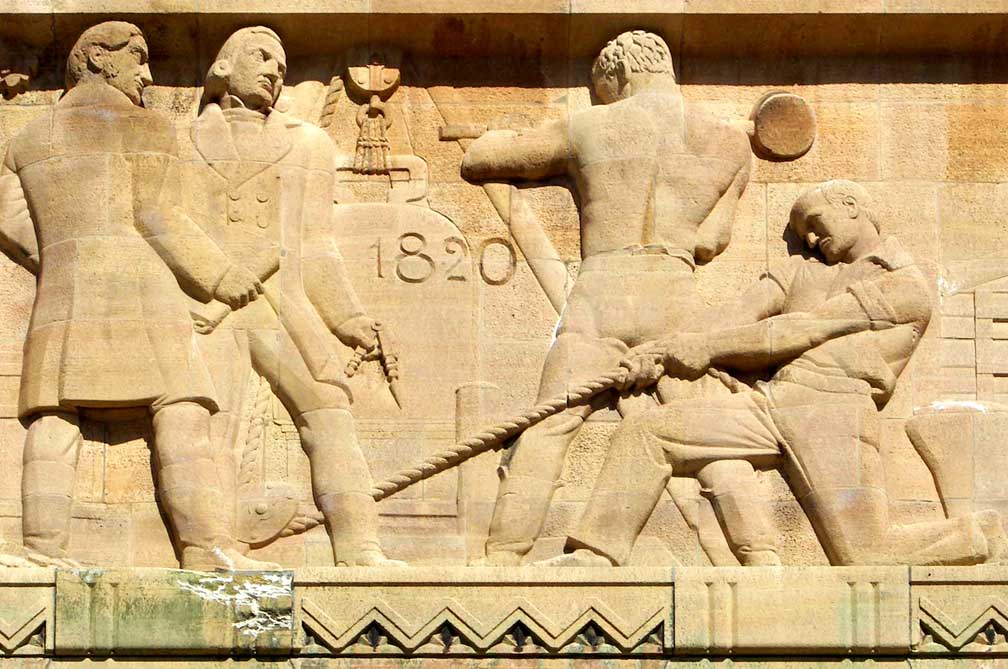 "To the right, dated 1820, a group of figures represents the efforts to build the first Buffalo Harbor. Samuel Wilkeson, who later became mayor of the city, was the driving force behind the project. The completion of the harbor on schedule enabled Buffalo to be chosen as the terminus of the Erie Canal." - Buffalo City Hall: American Masterpiece, by John H. Conlin, 1993. 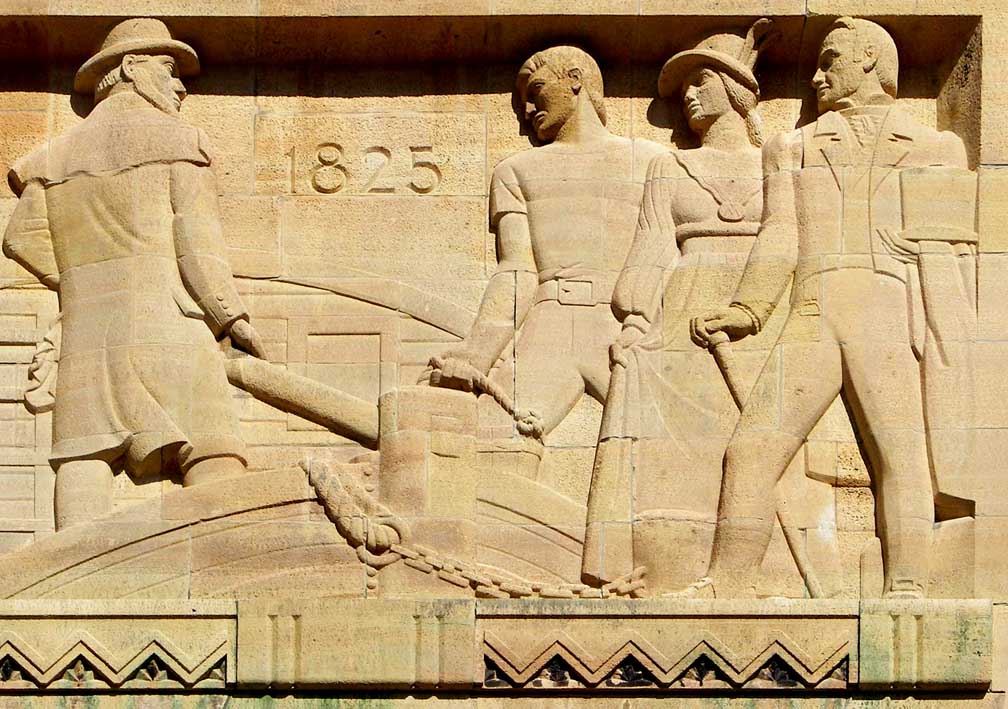 "The group on the far right represents the opening of the Erie Canal in 1825. It was the key event beginning Buffalo's steady growth in population and prosperity, which was continuing as City Hall was being built." - Buffalo City Hall: American Masterpiece, by John H. Conlin, 1993. |