St. Ann's RC Church - Table of Contents
History - St. Ann's Roman Catholic
Church
Broadway at Emslie Street, Buffalo, NY
1878
ON THIS PAGE:
- Germania, by James Napora
- The Founding of St. Ann's
- Steeples / Tower Clock / Tower Bells /Organ / Altar & Pulpit, by David Snyder
Germania
by James NaporaAn excerpt from
"Houses of Worship: A Guide to the Religious Architecture of Buffalo, New York," by James Napora. Master of Architecture Thesis. 1995. Found at Buffalo Central LibraryThroughout the 1850s, the city's German population began to push further east towards the area of Jefferson Avenue. At that time, virtually all the land in that area remained forested, with streams and ponds located amongst the thick growth of trees and brush. Batavia Road (Broadway) cut a wide swath through the area, but as the conditions did not warrant it, very few people elected to live so far out in the city.
With the heavy influx of immigrants to the city in the 1850s, many of the established houses of worship there were becoming increasingly crowded. In the Fall of 1857, Steven Van Rensselaer Watson, owner of a large portion of the land east of Jefferson escorted Bishop Timon of the Catholic Diocese out to this countryside. The Bishop was very interested in establishing a parish to ease crowding in Saint Mary's church downtown. He also desired to organize a college in conjunction with the church.
Realizing the importance of the house of worship as a social outlet for the Germans of the city, Watson offered a sizable parcel of land to the diocese for the establishment of one. As people were more likely to settle as a group in an area where a house of worship is located, he felt that the success of his ambitions to develop the area as a residential district were:closely tied to the Bishop's decision. In a prime example of the house of worship influencing the desires of a group of people and their desires to reside somewhere, the establishment of Saint Anne's parish in 1858 served as the catalyst for the growth of the neighborhood. With the initial house of worship complete, Germans soon began building homes on the newly planned streets surrounding the building.As more and more people settled in the area, the population quickly spread to the north and to the east. To the north, Michael Fox a local contractor, worked to fill the ditches and gullies in the area, preparing for the settlement of the neighborhoods now located there. In the 1880s and 1890s he was instrumental in developing the neighborhood along Broadway where Fox Street is now located. The small cottages he built originally were sold to working class immigrants arriving in the city at that time.
The Founding of St. Ann'sThe Jesuits came to buffalo in 1848. They founded St. Michael's Church in 1851.
Bishop Timon asked the Jesuits to start a new parish far out on Batavia Street (now Broadway), then a rural and sparsely settled area. St. Ann's was called the "wood choppers' parish" because this area was woodlands, filled especially with hickory and butternut trees. It was an "all German" parish with German or Alsatian priests.
In the early 1870's the small brick Romanesque church was too small, and the parish decided to build a new, larger church.
The New York City architect was Francis Himpler, German-born and educated at the Royal Academy in Berlin. When it was announced that the cost of construction would be $100,000 or more, the parishioners decided to build it themselves.
It took eight years to build the present church, 1870-78. Construction progressed slowly because work and material were paid for as the building advanced. The building was completed in 1886 at a cost of $120,000. When Bishop Ryan consecrated the building on May 16, 1886, the entire building had already been paid for except for furniture and furnishings.
As the city grew, so did this parish and by the late 1800's, St. Ann's was among the largest Catholic parishes in the U.S. Six other east side parishes were eventually carved out of St. Ann's original boundaries
The sisters of St. Francis of Stella Niagara have served this parish since 1874.Supervising Architect: Brother Halfmann, a member of the Jesuit order.
Style: Gothic Revival
Building material: Limestone. A quarry in Lockport was rented for two years to provide the stone.
Steeples / Tower Clock / Tower Bells /Organ / Altar & Pulpit
David Snyder
Steeples
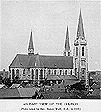
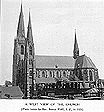
Three churches had damage done to their towers on March 6, 1964. The cause was a severe windstorm. They were St. Peter and Paul, Williamsville, St. Mary Magdalene at Fillmore & Urban Sts. (this church is now Antioch Baptist) and St. Ann's.St. Peter and Paul's was repaired, St. Mary Magdalene removed its original Moorish style towers and had them replaced with different style cupolas and St. Ann's became as it is today.
According to the late Father Gilbert Schmidt, no serious damage had been done to St. Ann's. The winds had pulled the cross on the high tower loose from its inside mount and it was tilted way over. Fr. Schmidt said that the old caretaker of the church was out of town. Had he been around, he'd have climbed the tower the next morning, fastened it back in place, and nothing would have been said.
As it happened, someone at Schlager Funeral home, which was across the street, saw it, called up and raised hell about the cross (and steeple) failing down, which led to engineers being called in, structural studies, etc. It was decided to take both spires down.
No sooner were they removed and replaced with the present flat roofs than one of the roofs blew off, and water damage started. It turned out that the perpendicular form of the pointed spires had promoted water drainage and the tie rods and other framework inside of them had helped keep both towers stable. The East spire was 70 feet long, the West one was 45 feet. According to a parish history, when the towers had their spires, the height of the East tower was 225 feet and the West tower 180 feet. I don't know what they measure today.
I took [Architecture Historian] John Conlin to see this church years ago and he pointed out all the vertical fissures in the tower pilasters and other parts of the church. The West and South sides of the church are especially exposed to severe weather. He told me that the fissures are due to neglected pointing and there's no way to treat it. As you can see in the photos, the pilasters on the East tower are braced with what looks like stainless steel plating that has been bolted on. I am told that the West tower is in critical shape at this time.
Tower Clock
The tower clock is a 3 train striker built by the E. Howard Company of Boston. Installed in 1895, it is still driven by weights and pendulum. The original hand winding mechanism was replaced by Howard in 1938 with a motorized rewinding system. In the 1980s, repairs were made by Marvin F. Deboy of Derby, NY (he grew up in this parish). Parts were cleaned and new pallets were made for the escapement. I assisted him and have been maintaining it, voluntarily (on and off), since that time. Currently, it is running and striking every quarter hour. Also, I was the person who painted the dials and hands in 1985.
Tower Bell
The six bells in the East Tower were cast by the Stuckstede foundry of St. Louis, Missouri (it's no longer in existence). Their names, weights, year and musical notes follow:
- 7800 lbs, 1889, A
- 3850 lbs, 1889, C
- 2275 lbs, 1912, D# (replaces an earlier bell which probably cracked)
- 1500 lbs, 1895, F
- 1100 lbs, 1891, G
- 500 lbs, 1889, C.
The Organ
Since it appears in a photo, it may interest you to know that the organ was built by Johnson & Son of Westfield, Massachusetts. Johnson was an important American builder of the 19th Century. This instrument was their op. 679 of 1887. The pipes (except for the ones on the case) were sold in 1966 to a local firm. So, although the case and front pipes are still in the church, its pipe organ no longer exists. If it did, it would be an art treasure equal to the stained glass windows.
Altar and Pulpit
To the best of my knowledge, both the main altar and the pulpit were from a firm named Halstreick of Rochester, New York. I have been told that the main altar has no screws in it; everything is doweled.