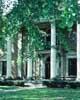
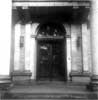
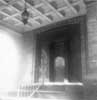
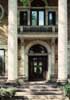
Interior photos of 824 Delaware

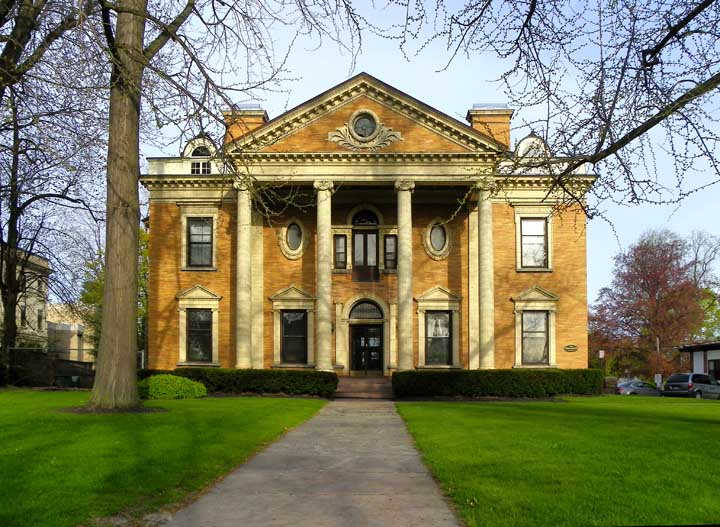
The Forman-Cabana House / Conners Children's Center
824 Delaware Avenue Buffalo, N.Y.
(in Delaware Preservation District)


May 2011
Click on illustration for larger size

TEXT Beneath Illustrations


Click on photos for larger size -- and additional information

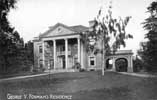
1903? photo.
Note balconette and
porte-cochere (later removed)

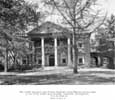
1931 photo.

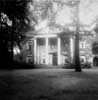
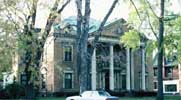
Aug. 1954 Early morning view of east facade of house while it was still ivy-covered

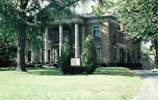
Oct. 1985 View of the east facade.

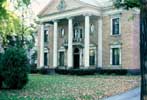
Oct. 1986 View of east facade and south side with bay window

Oct. 1986 View of the east facade

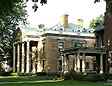
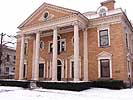
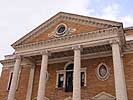
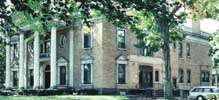
2003 photo. Two and a half story Greek Revival Style house.

2003 photo. East elevation

Oct. 1985 A closer view of the portico

Aug.1954
Early morning view of the east entrance, showing intricate wrought iron grill-
work. Note the well-proportioned lighting fixtures flanking the entrance

Aug.1954
North entrance, porte cochere with coffered ceiling.

Oct. 1985
Sunlit view of the main entrance, showing balconet.

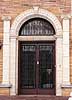
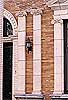
2003 photo. Round arched front entrance has flanking paired fluted Ionic pilasters

2003 photo. Front center two-story portico

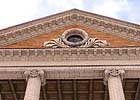
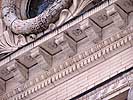
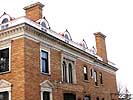
2003 photo. Entablature: raking cornice decorated with dentils and modillions

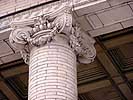
2003 photo. Tall circular columns are constructed of light-colored curvilinear brick

2003 photo. Bay leaf garland around window ... Rosettes and modillions support cornice

2003 photo. Fluted Ionic pilasters

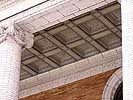
2003 photo. Coffered ceiling

Aug. 1954
Early morning sunlit view of east facade showing porte cochere.

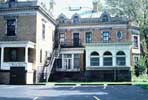
Oct.1985 View of the east facade and north-. election, w/o porte cochere.

2003 photo. Carriage entrance on right side (north) of house

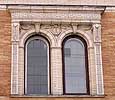
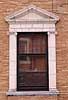
2003 photo. Entablature window heads

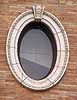
2003 photo. Oxeye window to the left of the carriage entrance

2003 photo. Pediment (triangle) with raking cornice has dentil course

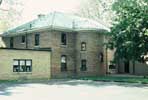
Oct.1985 View of the east half of the carriage house.

Oct.1985 View of the west side of the house, showing the alcove of the dining
room and the solarium with its arched window treatment

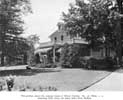
1931 photo of Cabana summer home


Georgia M. G. Forman House, 77 Oakland Place. Built in 1928 (Her husband, George, died in 1922)


FIRST OWNER

George V. Forman, an early oil magnate He was born near Milford, NJ in 1841. After graduating from Princeton in 1861 he practiced law in Trenton, NJ. Later he moved to Oil City, PA, where with Capt. J. J. Vandergrift, he established the Oil City Trust Co. Forman was president for a time.

While a resident of Olean and a member of the Exchange National Bank of Olean, Forman organized the Eastern Oil Co. incorporated in West Virginia. He then came to Buffalo to be president of the company.

Forman, a very punctual man, according to Anson Goodyear, "every morning left his house at a certain hour and met George Williams at his house just above North Street, to walk to the Fidelity Building together. Mr. Forman boasted a very prominent corporation and leaned backward to achieve his balance. Mr. Williams was emaciated and bent forward to achieve his. It was a procession on which people checked their watches."

George Forman, by 1895 living at #824 had four children. His oldest son, Howard Arter Forman, born in 1870, came to Buffalo where in 1892 he married Georgia Green of Lockport. Georgia had been born in 1871. She was brought to Buffalo by her parents in the 1880's and was educated at St. Margaret's, a former private school on North St. and also graduated from Miss Masters School at Dobbs Ferry. She married Howard A. Forman in 1892. For more than a decade she served on the Board of Managers of Children's Hospital. Georgia Forman was a contributor to the Room of Contemporary Art at the Albright Art Gallery, presenting it in 1940 with a Sixth Dynasty Limestone Buddhist statue of a winged lion (Chimera). Georgia Forman died at age 85 on 6/24/1955. She is buried in Forest lawn Cemetery in Section H, lot 126.

Howard, vice-president of Eastern Petroleum of which his father was president, and Georgia lived for some years on North Street. During the World War I he was Federal Fuel Administrator for Buffalo. After the war he and Georgia separated and by the early 1920s he had moved to Lexington, Kentucky, where he died in 1931. He left his wife well situated since in 1928 she moved into an exquisite modern mansion at #77 Oakland Place behind her ex-father-in-law, George Forman. She traveled widely through Europe and the Orient, amassing a fine collection of Japanese and Chinese objets d'art. Two years before her death in 1955 she moved after twenty-five years on Oakland into The Campanile. Number#77 Oakland was sold to the Catholic diocese of Buffalo in 1955 for an episcopal residence.

A third Forman mansion in Buffalo was that of George Forman's second son, George Alfred, at #1260 Delaware where his widow was residing in the early 1930s.

George Forman's daughter Mary married Conger Goodyear of the #888 Delaware Goodyears.

SECOND OWNER

George V. Forman died in 1922 . He was succeeded at #824 by Oliver F Cabana, who was born of French-Canadian ancestry in Island Point,Vermont, in 1865, one of ten children of Oliver Cabana, the village blacksmith, and his wife Edmire De Rainville.

At fourteen he came to live with relatives in Buffalo where, after studying bookkeeping at Bryant & Stratton, he went to work for a tanning and belt manufacturing firm. Six years later he sank his savings of $480 in a belt fastener and mender invented by his half-brother. He then bought out the brother's interest and formed the Buffalo Specialty Company. Cabana prospered and established two factories in Buffalo, also in Canada, England and Germany. Sales went into the millions and the name was changed to the Liquid Veneer Company.

In 1886 he married Isabelle Josephine Pilliard of Buffalo in the French Church at Clinton and Washington.

He then got into old mining, hospitals, oil producing, cattle raising, and banking, and was director of thirty-five companies and a member of numerous societies and clubs. Cabana became the official head of all the industries with which he was connected. He developed the Wright-Hargreaves Gold Mine in Kirkland Lake, Ontario. He was chairman of Liberty Bank of Buffalo, and was responsible for its building. He developed the Sun Diet Health Foundation in East Aurora, and wrote books on Central Park Hospital. He assisted in the development of Canisius College.

Democratic Party: Cabana used his wealth to become a power in the Democratic Party. He managed the campaign for Gov. Alfred E. Smith in Buffalo and Erie County in 1928. He bankrolled banquets for visiting sachems and during the Smith-Hoover presidential election wrote Al a check for $25,000, besides spending locally $26,000 ($888,930 in 1997 dollars.)

During the 1930s he gave more than $100,000 to Democratic causes besides making good on $27,000 worth of notes signed by party leaders. Cabana was an original Roosevelt-for-president man. For his second inaugural as governor in January 1931, Roosevelt summoned him to Albany and deputized him to clean house in Erie County. This made William H. Fitzpatrick, off-and-on County Democratic boss for thirty years, unhappy, but Cabana put down a Fitzpatrick revolt in the primaries. In the general election Democrats not only won the city clerk's office and captured the common council but for the first time in memory gained a one-man majority on the Board of Supervisors. It was a Democratic year anyway, but Cabana claimed credit for the win. This was the zenith of his political career.

Shortly before the election he resigned the chairmanship and appointed George Zimmerman in his stead. Cabana expected to remain the power behind the throne, but Zimmerman was his own man, and Cabana was out.

Cabana bred, developed and drove race horses in Elma and bred Holstein cattle.

He died in 1938. His friend, Archbishop Thomas J. Walsh of Newark, formerly of Buffalo, came back to celebrate the funeral Mass. The widow, Isabella, stayed at #824 until her death at ninety-two in 1953.

A daughter, Miss Isabelle Cabana, lived there until 1961 when the house was vacant for two years until it became a child care center

2003 OWNER

Child and Family Services: Conners Children's Center, Stanley G. Falk School in carriage house

COMPLETED

1893

ARCHITECTS

Green & Wicks. E. B. Green, principal designer

STYLE

Beaux Art Classical

BUILDING MATERIALS

Yellow Roman brick, stone

STRUCTURAL SYSTEM

Masonry load bearing walls

DEMOLITION ATTEMPT

In the 1970's, IBM attempted to demolish this building and its neighbors at #830 and #844


Text sources:


See also:


Special thanks to Gabriel E. Duffee, OSB, for proffering his photographs

2003 photos and their arrangement © 2003 Chuck LaChiusa
| ...Home Page ...| ..Buffalo Architecture Index...| ..Buffalo History Index... .|....E-Mail ...| ..

web site consulting by ingenious, inc.