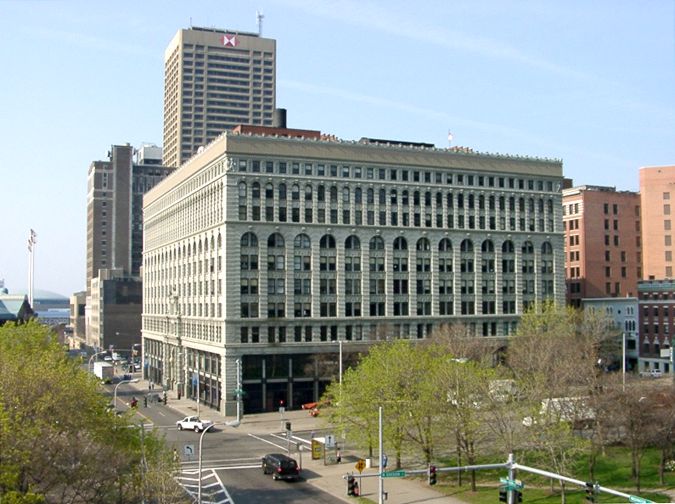
Dana Brooks, Daniel H. Burnham, Joseph Ellicott, and The Ellicott Square Building
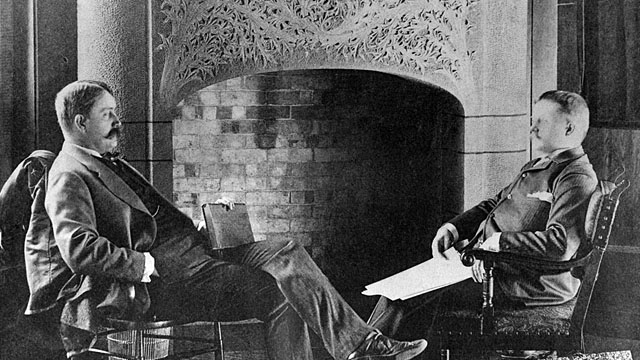
D. H. Burnham in Buffalo, NY
TEXT Beneath Illustrations
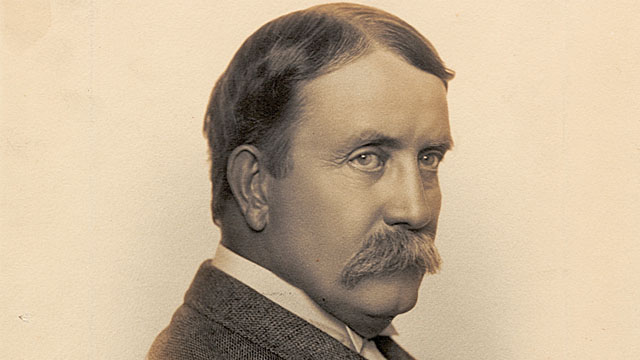
Daniel Hudson Burnham, 1846-1912
Photo source: Chicago History Museum
Burnham and John Welborn Root (1850-1891
In 1873 Burnham and Root became partners in their own practice which lasted until the death of Root in 1891.
Photo source: Chicago History Museum
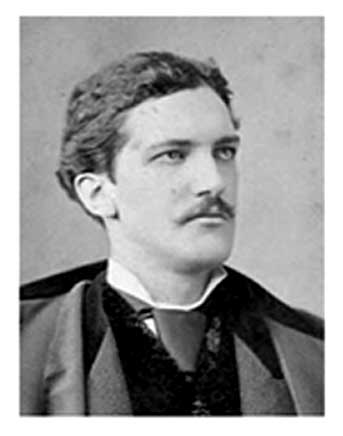
Charles B. Atwood (1849–1895)
Charles B. Atwood was an architect who designed several buildings and a large number of secondary structures for the 1893 World's Columbian Exposition in Chicago. Atwood also designed several other buildings in Chicago, as a member of Daniel Burnham's staff. These include the Reliance Building, and the Marshall Field and Company Building. He was the principal dsigner of the Ellicott Square Building in Buffalo.
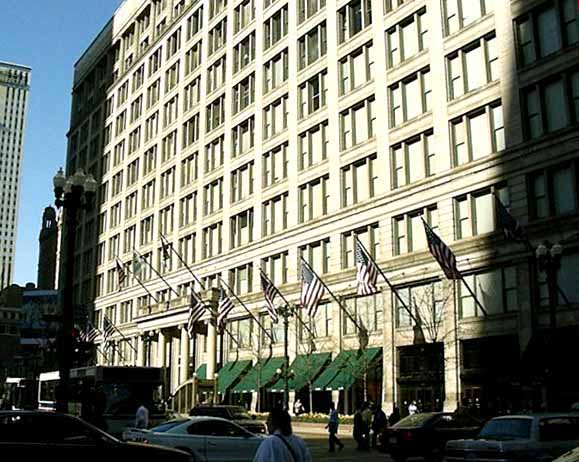
Marshall Field and Company Store, Chicago
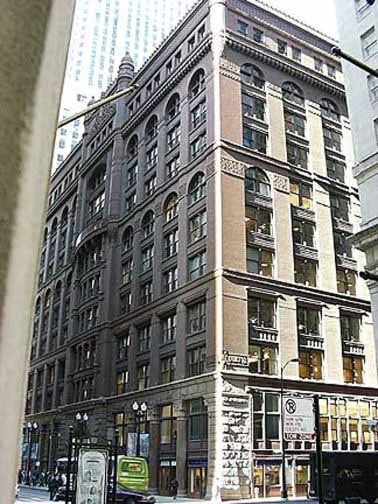
The Rookery, Chicago
Ellicott Square Bldg., Buffalo
Raised and educated in Chicago, Daniel Hudson Burnham gained his early architectural experience with William Le Baron Jenney, the so-called "father of the skyscraper." In 1873, Burnham formed a partnership with John Wellborn Root (1850-1891). Three of their Chicago buildings were designated landmarks in 1962: The Rookery (1886) and the Reliance Building (1890), both using skeleton frame construction, and the Monadnock Building (1891), the last and tallest (16-story) American Masonry skyscraper.
Burnham's forte was organization and administration. He was the businessman of the firm, of which Root was the designer.When Burnham became chief of construction for the World's Columbian Exposition (Chicago, 1893), Root was appointed chief consulting architect. When Root died in 1891, that position also went to Burnham, who selected as principal architects firms from the eastern United States working in academic eclecticism -- the antithesis of the New Chicago school of commercial architecture. The "White City" that resulted, with its boulevards, gardens, and buildings with classical facades, influenced planning in the United States.The Beaux Arts style was popularized during the 1893 Columbian Exposition in Chicago in 1893. One outgrowth of the Expo was the reform movement advocated by Daniel Burnham: the City Beautiful Movement.
Following Root's death in 1891, the firm became known as D.H. Burnham and Co. Its design output continued to be prodigious, including department stores (Marshall Field's) and office buildings (Ellicott Square Building, Buffalo)
Importance
Burnham was an American architect and city planner whose plan for Chicago anticipated by 30 years the need for planning and development on a metropolitan area basis. He served as president of the American Institute of Architects in 1894 and was asked to prepare plans for several cities, including Cleveland, San Francisco, and Baltimore. In 1905, on the request of the U.S. government, he drew up plans for cities in the Philippines, including Manila.
His Plan for Chicago (1907-09), prepared with Edward H. Bennett, and popularly referred to as the Burnham Plan, is a classic example of American city planning. Farsighted in many ways, it provided for a ring of forest preserves in outlying areas and along the city's lakefront to ensure a future green belt against an anticipated population explosion. The Burnham Plan was used for many years as the basis for city planning in Chicago.
Burnham is buried in Graceland Cemetery, Chicago.
Sources:
- Thomas S. Hines, "Burnham of Chicago, Architect and Planner," 1974
- Chicago Landmarks (2002)
Daniel Hudson Burnham, renowned city planner and architect, was born in Henderson, New York, in 1846. At age eight his family moved to Chicago where he was educated in the city schools; he completed his later studies under a private tutor in Bridgewater, Massachusetts. Burnham returned to Chicago in 1868 and was employed successively by William LeBaron Jenney, John van Osdel, and Gustave Laudreau.
In 1872 Burnham worked as a draftsman in the office of Carter, Drake & Wight, where he became acquainted with John Wellborn Root. In 1873 Burnham and Root became partners in their own practice which lasted until the death of Root in 1891. The responsibilities to complete the plans for and organization of the World's Columbian Exposition in Chicago then rested solely on Burnham. After Root's death Burnham headed his own practice (1891-1894) and then D.H. Burnham and Company (1894-1912).
Building upon his experience with the vast scale of planning for the World's Columbian Exposition, Burnham developed an international reputation as one of the early planners in the City Beautiful aesthetic. In 1901 Burnham was appointed Chairman of the Senate Park Commission (Washington, D.C.) and subsequently served as Chairman of the Commission of Fine Arts. Burnham is closely identified with plans for Cleveland, San Francisco, and Manila and Baguio, The Philippines. His magnum opus, the Plan of Chicago, was authored in partnership with Edward Bennett and published in 1909.
After Burnham's death in 1912, his partner Ernest R. Graham and the two Burnham sons, Daniel H. Burnham, Jr. and Hubert Burnham, continued the practice as Graham, Burnham and Company until 1917; it then reformed as Graham, Anderson, Probst and White. In addition to this professional legacy, Burnham's bequest of $50,000 to the Art Institute resulted in the establishment of the Burnham Library of Architecture.
- Art Institute of Chicago (July 2012)
Color photos and their arrangement © 2002 Chuck LaChiusa
..| ...Home Page ...| ..Buffalo Architecture Index...| ..Buffalo History Index...| .. E-Mail ...| ..
web site consulting by ingenious, inc.