Illustrated Architecture Dictionary
American
staircases
Also called
stairway
A flight or series of flights of steps and a supporting structure connecting separate levels
See also: newel ... stair-ends ...balustrade ... baluster ... turned
Flying staircase: Staircase without visible means of support.
On this page below:
Colonial (Pre-Revolutionary War)
Federal (1790-1830)
Greek Revival (1820-1860)
Mid-Century (1850-1870)
Victorian (1870-1910)
Colonial Revival (1880 to Present)
Arts & Crafts Inspired (1900-1940)
Beaux Arts Classicism (1890-1920)
Art Deco (1925-1940)
|
Colonial
(Pre-Revolutionary
War)
|
|
Federal
(1790-1830)
|
|
Greek
Revival
(1820-1860)
|
|
Mid-Century
(1850-1870)
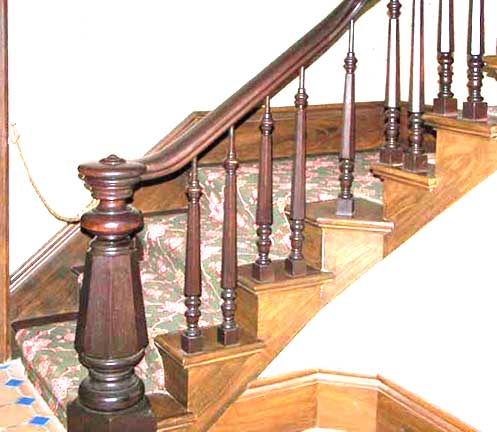
Along with porch parts, decorative staircase parts were among the many millwork items mass-produced and sold by catalog by the 1850s. The first wave of mass-produced catalog millwork was made possible not only by advances in machine woodwork production and printing but also railroad shipping. Until the mid-century central stair halls were typical. This changed with the freedom in planning introduced with the Gothic and Italianate Revivals. Stairs were located asymmetrically near the front door and usually near the principal parlor. Gothic and Italianate stairs tend to be a single flight from floor to floor. Newels: ranged from plain, turned posts to large square boxes built up from hardwoods. Turned octagonal common. Balusters: Often smaller versions of newels. Sometimes embellished with carvings or simply turned. Railings: Molded, often of black walnut. Designed to mate with newel tops if turned. Text primary source: Brent Hull, Stair Millwork by the Book (Old House Journal)
|
|
Victorian
(1870-1910)
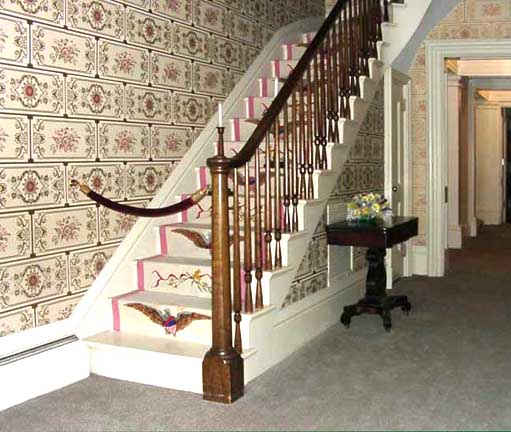
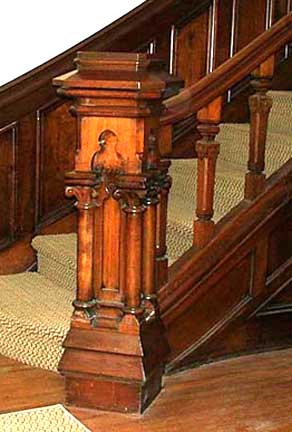
Increasingly sophisticated power woodworking machinery made possible more elaborate carving and turnings, it also made them less expensive and more widely available. Like mantels, Victorian staircases became a place to show off manufacturing ability and money. With the adoption of combination living spaces and stair halls late in the period, stairs became the focus of further experiments, and more elaborate series of flights and landings were contrived. Windows; Often the principal landing between the entrance floor and the floor above featured a stained-glass window. The richest windows were pictorial, while the more modest ones were geometric. Stair halls were regularly lit by skylights, either with plain glazing or stair glass, sometimes with elaborate designs. Coverings:Carpet was the preferred stair covering, but floor cloths and matting were also used. Brass was a popular material for the stair rods, but iron and even, occasionally, silver are also found. Newels: Victorian staircases start proudly with an elaborate newel, which is invariably highly detailed. Covered with embellishments- sometimes from a mixed bag of stylistic idioms - the most ornate examples are wonderfully rich with worked turnings and chamfers or applied carvings and rosettes. Newels with deeply turned balls or beaded decoration may show a geometrical influence associated with Eastlake furniture styling. Somtimes gas, and later electric, newel lamps were instlled atop the post. In simpler dwellings the newel could be the most elaborate piece of woodwork in the house. Balusters:
Victorian baluster
designs span a wide range of turnings, square and tapered
supports, and combinations of both. Sometimes the balustrade
is not composed of true balusters but is instead an
assemblage of horizontal and vertical members that forms a
decorative grille. Text primary source: Brent Hull, Stair Millwork by the Book (Old House Journal)
|
|
Colonial
Revival (1880 to Present)
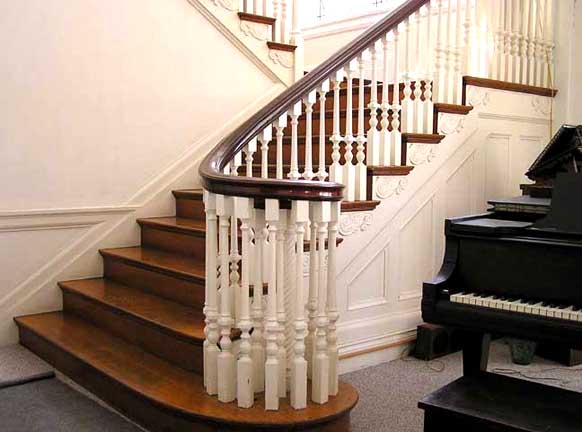
Newels: Compared to Victorian staircases, Colonial Revival newels are relatively simple, often resembling a large baluster. Square newels were also widely sold, especially during the 19th and early 20th century, but here the Colonial influence is readily identified by Georgian / Adam ornaments, such as urn-like turnings on the tops or carved swags and cameos applied to the sides. Often painted white. Balusters: Colonial-influenced balusters are typically turned on a lathe and very thin. (Remember, turning was a favorite woodworking technique for furniture makers of the 18th century.) They use classical shapes for the patterns, and on very high-style homes, there may be more than one style of baluster in a balustrade. By the 1890s, mass production made possible a fashion for the complex turnings of twisted balusters that appeared in many architect-designed houses. Open-string stairs, where the balustrade could be featured to best advantage, often varied baluster patterns and spacing. Often painted
white. Text primary source: Brent Hull, Stair Millwork by the Book (Old House Journal)
|
|
Arts
& Crafts Inspired (1900-1940)
Unlike the heyday
of the Victorian era in
the 1890s, when embellished wood decorated almost every
surface of a house, by the turn of the 20th century the Arts
&
Crafts movement was introducing new design ideas and
alternate materials, such as tile, metal, and exposed brick
on fireplaces. Innovative staircases in landmark Arts &
Crafts buildings like Red House (designed for William
Morris by his friend Phillip Webb) and the Gamble
House (designed by the brothers Greene) left their
mark on stair millwork for decades to come. Balusters:
Balusters are square-edged and unadorned. Sometimes you see
tapered sides, cutouts, or fretwork in wide,flat balusters.
Treads might be dominated by a single board baluster as wide
as 7", or pairs that alternate between 4"-wide boards and
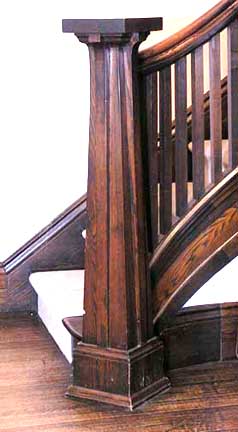
narrow 7/8"-square sticks. Text primary source: Brent Hull, Stair Millwork by the Book (Old House Journal)
|
|
Beaux Arts Classicism (1890-1920) Beaux Arts Classicism
|
|
Art
Deco
(1925-1940)
|
See also: French Renaissance horseshoe staircase - Fontainebleau Palace, France